Easy
Red Honey Gourami (Trichogaster chuna)
22–28°C · pH 6–7.5 · 40L
£8.99

Photo coming soon
The size, price and care details on this page are for this listing.
Wild-type Honey Gourami, Trichogaster chuna, for a mature, planted and gently filtered freshwater aquarium. One unsexed fish is supplied per quantity in the selected approximate size; wild-caught provenance is not guaranteed.
Trichogaster chuna
Confirm your email, then we’ll send an availability message for this exact item if it returns within 180 days.
This request is only for this product—no newsletter or other promotions. A mail-provider retry may very rarely duplicate the same availability message. Unconfirmed addresses are removed after 48 hours. See our privacy policy.
Wild-type Honey Gourami, Trichogaster chuna, for a mature, planted and gently filtered freshwater aquarium. One unsexed fish is supplied per quantity in the selected approximate size; wild-caught provenance is not guaranteed.
Start with a mature, filtered aquarium at least 60 cm long. Published size records disagree, and broad group guidance is not Honey-Gourami-specific, so verify Trichogaster chuna, the seller's adult-size advice and any claimed sexes before choosing one fish or a group.
Maintain these water conditions for optimal health and vibrant colors
The Honey Gourami (Trichogaster chuna) is a small, gentle labyrinth fish for a calm, well-planted freshwater aquarium. This listing is for the supplier-described wild-type form: a natural-looking trade form rather than the bright yellow or red domestic colour varieties sometimes sold under similar names. It is an appealing centrepiece for aquarists who enjoy subtle colour, deliberate movement and close observation of fish behaviour.
Quantity one buys one unsexed fish in the size selected above. This is not a pair, male-and-female set, trio or six-fish pack. The word “wild” in the supplier name does not prove that the current stock was collected from the wild, and no collection locality or lineage certificate is supplied. Choose the available size from the live variant selector; availability and the current price are shown beside each option.
| Care point | Practical starting guidance | Why it matters |
|---|---|---|
| Accepted name | Trichogaster chuna | Older labels include Colisa chuna and Colisa sota |
| Temperament | Peaceful but often shy; breeding males can defend a surface area | Calm companions and visual barriers reduce pressure |
| Aquarium footprint | At least 60 cm long for one fish; increase space for a group or community | Horizontal area, surface access and separate retreats matter more than a tall narrow volume |
| Temperature | 22-28°C; keep the chosen value stable | FishBase reports this species range; stability is more useful than chasing a daily “perfect” number |
| pH | 6.0-8.0 | Match the fish gradually to stable, suitable water |
| Hardness | About 5-19 dGH | A broad published range does not make rapid chemistry changes safe |
| Water quality | 0 ammonia, 0 nitrite; keep nitrate controlled with testing and partial water changes | Labyrinth breathing does not protect a fish from dissolved waste |
| Flow | Gentle, with calm areas near floating plants | Strong current can keep a shy fish hidden and disrupt bubble-nest behaviour |
| Diet | Small quality flakes or micro-granules plus varied frozen or live invertebrate foods | The mouth is small and variety supports condition without overfeeding |
| Care level | Moderate beginner choice in a mature, thoughtfully stocked aquarium | The fish is not difficult, but it is a poor match for a new, unstable or boisterous tank |
These figures are planning ranges, not targets to move the aquarium through. Test the water you actually have, compare it with the conditions in the established display, and make any necessary adjustment gradually. A mature tank with stable chemistry is safer than an aquarium repeatedly altered to reach an exact midpoint.
The current accepted scientific name is Trichogaster chuna (Hamilton, 1822), in the gourami family Osphronemidae. The species has moved through several combinations in scientific and aquarium literature. Colisa chuna, Colisa sota and Trichopodus chuna may therefore appear in older books, supplier lists and searches. Eschmeyer’s Catalog of Fishes treats sota and chuna as the same species and lists Trichogaster chuna as the valid current name.
“Wild-type” describes the natural-style form rather than a selectively intensified yellow, gold, orange or red aquarium strain. It should not be read as a chain-of-custody statement. The supplier calls this line “wild”, but the listing does not include evidence that an individual was wild caught, the place where it was collected, a generation number or a locality certificate. Customers who require documented wild provenance should not infer it from the trade name.
The distinction is especially important because true wild specimens are described as relatively uncommon in the UK hobby. Farmed or trade-raised fish can still show the understated female stripe, honey-yellow male colour and seasonal display associated with the species, but colour is influenced by sex, age, social context, lighting, diet, health and settling time.
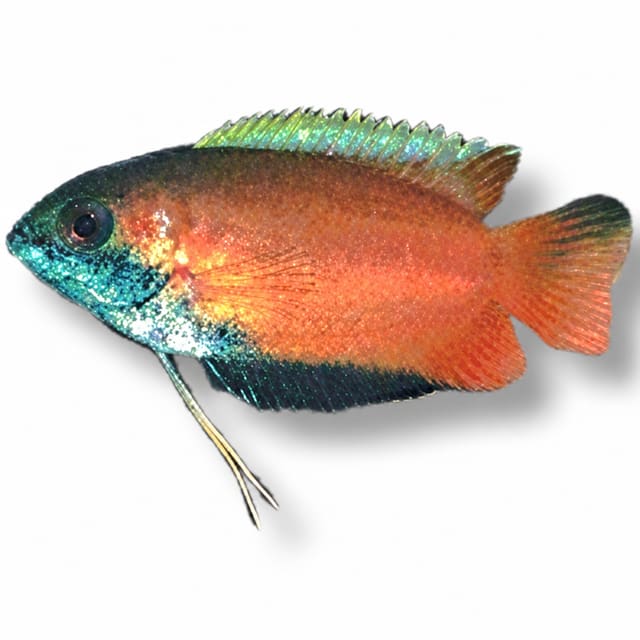
A Honey Gourami is not simply a small Dwarf Gourami. Trichogaster chuna and Trichogaster lalius are separate species with different adult appearance and social expression. Some orange-red fish sold as “red honey gourami” may instead be domestic forms of the Thick-lipped Gourami, Trichogaster labiosa. Buy by a defensible scientific identity and compare body shape and markings rather than relying on a colour adjective alone.
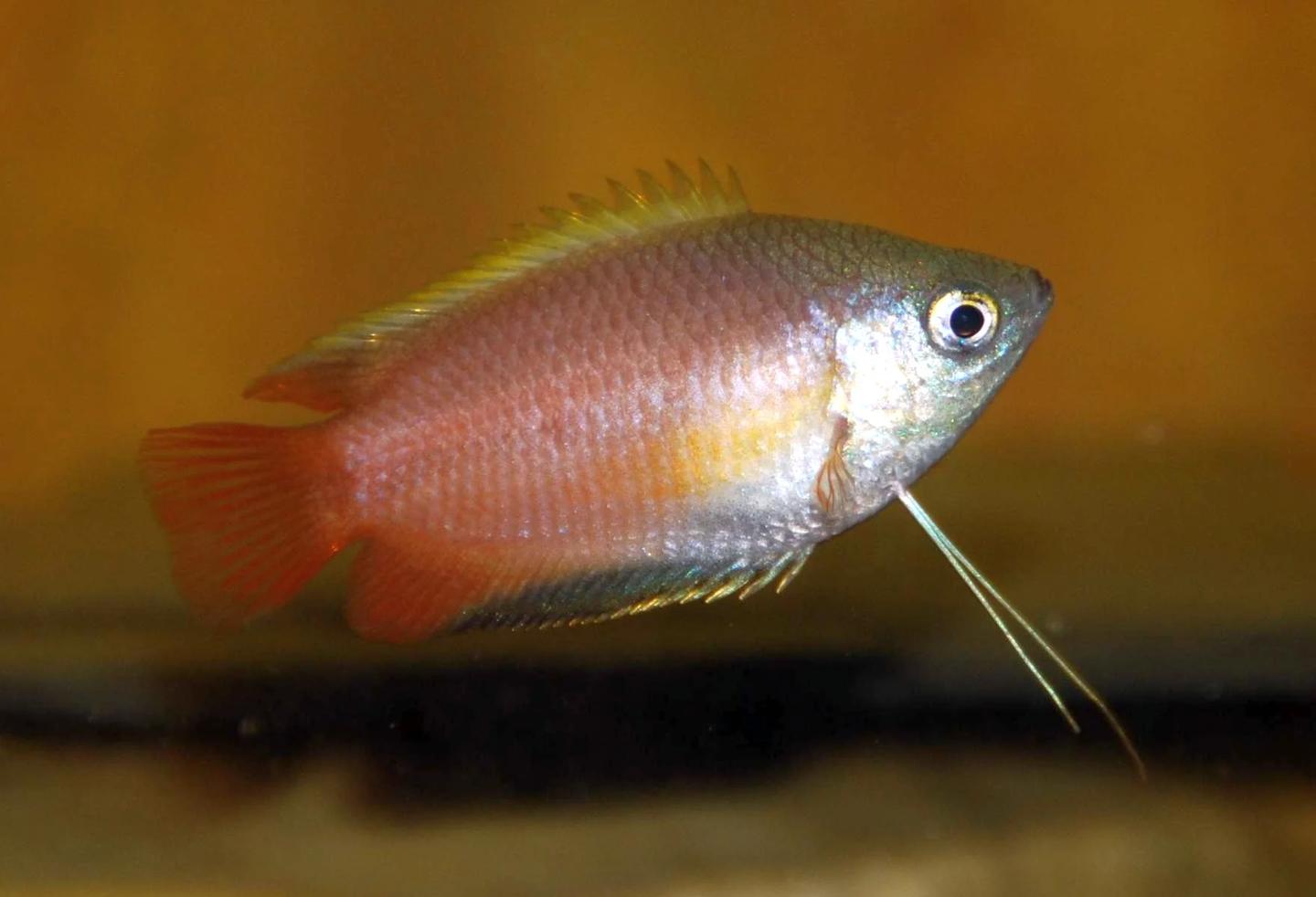
The typical aquarium Honey Gourami is compact and laterally compressed, with a relatively small mouth, long dorsal and anal fins and the thread-like pelvic feelers shared by many gouramis. Those tactile fins are used while investigating plants, decor and other fish. Wild-type females are usually muted beige to yellow-brown and may show a dark horizontal stripe. Mature males can become richer honey-yellow, with a dark throat and underside when displaying or breeding; a yellow edge to the dorsal fin is also reported.
Young fish, stressed arrivals and non-displaying males may look much plainer than a settled breeding male. A pale fish is not automatically female, and a colourful juvenile is not a reliable sex guarantee. Body fullness, fin shape, colour pattern and behaviour become more informative together as the fish matures, but shop-size stock can remain difficult to sex confidently.
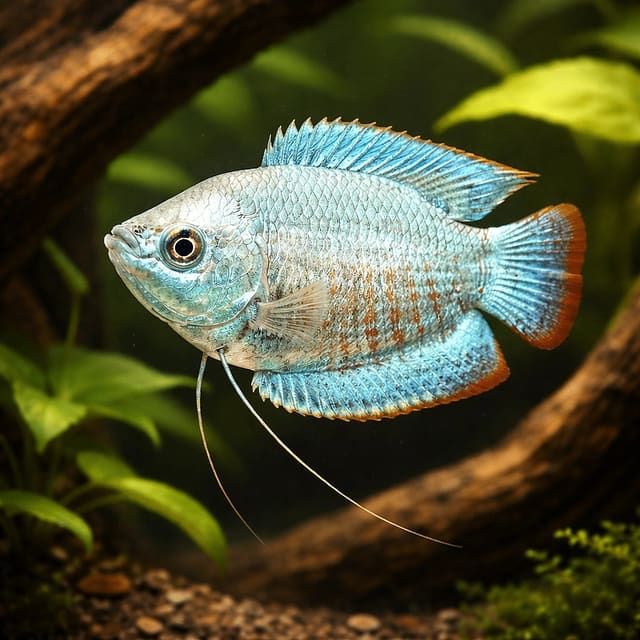
The existing gallery asset is a representative aquarium illustration, not a photograph of the exact animal that will be dispatched. Its strong turquoise pattern and deep body must not be used to identify sex, guarantee wild-type colour or judge the size option. The fish you receive can differ in hue, markings, proportions and display intensity. The protected image remains in the gallery for continuity, but the written identity and live variant selector are the reliable purchase references.
Most UK aquarium guidance describes Honey Gouramis at roughly 5 cm, and this is the useful expectation for the compact fish commonly seen in the trade. FishBase now also records a much larger published maximum of 13.7 cm total length. Those two figures should not be collapsed into a false certainty: one reflects the familiar aquarium profile, while the other is a scientific maximum record rather than a promise that a shop fish will reach that length.
Plan around adult welfare and usable space, not the smallest advertised number. A 60 cm aquarium gives a sensible starting footprint for one fish, surface cover and companions selected with care. More floor and surface area is needed when keeping several gouramis, when adding a mid-water shoal or when the layout does not provide clear retreats.
Trichogaster chuna is a South Asian freshwater species. Current catalogue records include India, Nepal and Bangladesh, while FishBase describes vegetated pools, ditches, flooded fields, ponds, beels, rivers and lakes. These are not all identical environments, but the shared aquarium lesson is useful: Honey Gouramis are associated with plant-rich margins and comparatively quiet water rather than an exposed high-flow channel.
The species is a facultative air breather. Its labyrinth organ allows it to take atmospheric oxygen at the surface, an adaptation that helps in warm, slow or seasonally oxygen-poor water. This ability is fascinating, but it does not replace filtration, cycling or water changes. A gourami can gulp air and still be harmed by ammonia, nitrite, high organic load or a sudden shift in temperature.
In the aquarium, provide an unobstructed route to the surface, warm air above the water and calm zones among floating leaves. Keep a lid or close-fitting cover, both to reduce escape risk and to maintain a more stable layer of air over the water. Leave enough open surface for breathing; do not allow floating plants to form a sealed mat.
For one Honey Gourami, begin with an established aquarium at least 60 cm long and around 30 cm front to back. A common 60 × 30 cm footprint is more useful than an equally sized tall, narrow tank because it provides a broader surface, a longer feeding route and room to place separate planted shelters. FishBase also lists 60 cm as the minimum aquarium length.
A minimum is not a complete stocking plan. Filtration capacity, mature plant mass, the number and adult size of other fish, surface competition and the amount of unobstructed swimming space all affect the answer. A larger aquarium gives more stable water, makes territorial encounters easier to avoid and allows the aquascape to contain both shaded retreats and open feeding areas.
Yes, one can be kept as the single gourami in a peaceful community. A solitary fish may be less socially demonstrative than several compatible conspecifics, but this can be the clearest option when sex is unknown or the aquarium cannot support multiple surface territories. Provide dense cover and calm companions so the fish is not exposed or intimidated.
They can be kept with their own species in a sufficiently large, heavily furnished aquarium, but buying two unsexed fish does not create a guaranteed pair. Two males may display or contest space, and a male can repeatedly pursue a female in breeding condition. Where several are planned, add extra room, floating cover and broken sight lines, and be prepared to separate an individual if pressure becomes persistent.
Advice to keep one male with two females assumes the fish have been sexed accurately and the aquarium can support them; neither assumption is part of this sale. Do not order a numerical “trio” and treat the social outcome as automatic. Observe the actual fish and adjust the plan around behaviour.
A useful species range is 22-28°C, pH 6.0-8.0 and about 5-19 dGH. UK trade guidance for gouramis is similarly broad. Captive-raised fish may settle in a range of water types, but sudden change remains stressful. Ask whether the planned community shares the same temperature and chemistry before purchase, and use a reliable thermometer and liquid or well-maintained digital tests.
Do not add this fish to an uncycled aquarium. Ammonia and nitrite should both read zero before livestock is introduced. Nitrate should be kept controlled rather than allowed to climb between occasional large clean-outs. OATA advises that nitrate should not exceed 20 mg/l above the level in the source tap water; measure the tap and aquarium separately so the result has context.
During the first weeks after adding livestock, test more often than usual. Feed sparingly, check that the filter remains running and look for a change in breathing, posture or appetite. In a stable established tank, a regular partial water-change routine, substrate cleaning where debris collects and careful filter maintenance are more dependable than reactive full clean-outs.
Use dechlorinated replacement water close to the aquarium’s temperature. Avoid changing pH or hardness abruptly with unmeasured additives. Rinse biological filter media in removed aquarium water when necessary rather than sterilising it under chlorinated tap water, and never replace all mature media at once unless a product-specific safety issue requires it.
There is no universal percentage that suits every aquarium. Stocking, feeding, source-water nitrate and plant growth change the workload. A weekly partial change is a practical baseline; test results and debris accumulation should decide whether your system needs more frequent maintenance.
Choose a filter that provides dependable biological filtration without turning the upper tank into a fast stream. A sponge filter, air-driven system, baffled internal filter or spray bar can all work when sized and maintained correctly. Position the outlet so part of the surface moves for gas exchange while plants or hardscape create quieter pockets.
Very strong flow can make a Honey Gourami spend most of its time behind the filter or decor, and it can disperse a male’s bubble nest. Completely stagnant water is not the answer: low circulation can allow waste and surface film to collect. The goal is gentle circulation with choice.
A labyrinth fish regularly visiting the surface is normal. Repeated urgent gasping by several fish, clamped posture or a sudden change from normal behaviour is not something to dismiss as “just labyrinth breathing”. Test ammonia, nitrite, temperature and oxygenation immediately and check that the filter has not stopped.
Honey Gouramis tend to show more natural behaviour in a well-furnished aquarium. Use tall stem plants, broad leaves, roots or wood to break up the view from one end of the tank to the other. Floating plants diffuse light and give the fish sheltered surface routes, but thin them regularly so feeding and breathing areas remain open.
Dark substrate and a background can make a shy fish feel less exposed, although substrate colour is a design choice rather than a biological requirement. Smooth sand or fine gravel is suitable. Avoid sharp decor around the long pelvic feelers and make sure stacked wood or stone cannot shift.
Bright planted-tank lighting can be used if the layout includes shade. A bare aquarium under intense light often keeps a new Honey Gourami close to a corner, whereas plant cover lets it choose when to move into the open. Set the photoperiod for healthy plant growth and algae control rather than leaving the light on late to force longer viewing.
Clean aquarium-safe leaves, wood and tannin-producing botanicals can suit a natural-style display, but they are optional. Botanicals change appearance and may influence water chemistry depending on the source water. Add them gradually, monitor pH and remove anything that develops an unsafe odour or heavy decay. Do not use garden material that may carry pesticides or road pollution.
Offer a varied omnivorous diet in pieces small enough for the fish’s mouth. A quality fine flake, micro-granule or small soft pellet can provide the staple. Rotate in frozen or live daphnia, cyclops, brine shrimp and suitable mosquito larvae to encourage natural picking and improve dietary variety.
Feed where the fish can reach food without competing with a fast surface feeder. A newly introduced Honey Gourami may wait under plants until bolder fish have eaten. Spreading a tiny portion across two calm areas can help, but the long-term solution is compatible stocking, not continually adding extra food.
| Food type | How to use it | Watch for |
|---|---|---|
| Fine flake or micro-granule | Small daily staple portions | Choose pieces the fish can swallow without repeated spitting |
| Frozen daphnia, cyclops or brine shrimp | Rotate through the week for variety | Thaw a small amount and avoid adding packing liquid unnecessarily |
| Live foods from a trusted source | Useful enrichment and conditioning food | Uncontrolled pond collections can introduce parasites or contaminants |
| Plant-based ingredients | Part of a balanced prepared food | This fish is an omnivore, not an algae-control tool |
For most established adult fish, one or two very small feeds a day is more appropriate than one large portion. The food should be consumed promptly and the abdomen should not remain distended. Juveniles may benefit from smaller, more frequent feeding when the filter and maintenance schedule can support it.
Remove persistent uneaten food. Overfeeding raises organic waste, encourages surface film and can damage water quality long before the fish appears obviously ill. Honey Gouramis are not dependable algae eaters or snail control, and they should not be bought as a cleaning fish.
A settled Honey Gourami usually moves deliberately through the upper and middle water, pauses under leaves and explores with its pelvic feelers. It may learn the feeding routine and become more visible over time. New fish can remain hidden for several days, especially in a bright tank or beside active tank mates.
The species is widely described as peaceful, but “peaceful” does not mean behaviour-free. Males can display, chase and defend the area around a bubble nest. Females need routes away from courtship, and two fish of either sex can have unequal confidence. Watch whether one animal is prevented from feeding or is held permanently in a corner.
Short displays without injury can be normal. Repeated biting, torn fins, weight loss, constant hiding or exclusion from food requires action. Add visual barriers only if the aquarium still has enough swimming room, and separate fish when layout changes do not resolve sustained pressure.
Choose small to medium peaceful fish that share the same water and do not dominate the surface. Calm rasboras, smaller peaceful tetras and suitable Corydoras can be considered in an aquarium large enough for every species’ social group. Research the exact species, adult size and temperature range; a family name alone is not a compatibility guarantee.
Avoid habitual fin nippers, large predatory fish, highly boisterous feeders and cichlids likely to control the same space. Bettas and other gouramis can react to similar body shapes or surface territories, so mixing labyrinth fish should not be the default recommendation. It may work in a spacious, structured tank under close observation, but separate species are often easier to manage.
| Potential companion | Assessment | Planning note |
|---|---|---|
| Calm rasboras or small peaceful tetras | Often suitable | Keep their proper social group and leave calm surface space |
| Small Corydoras | Often suitable | Choose a compatible temperature and provide the correct bottom area and group size |
| Otocinclus | Possible in a mature aquarium | They need established biofilm, their own food and a group; do not add them to a new tank |
| Another Honey Gourami | Conditional | More room, cover and behaviour monitoring are required; unsexed fish do not guarantee a pair |
| Dwarf or Three-Spot Gourami | Caution | Similar shape and surface use can produce territorial stress |
| Paradise Fish | Usually choose separately | A bolder, more territorial labyrinth fish can overwhelm a shy Honey Gourami |
| Fin-nipping barbs or aggressive cichlids | Avoid | Persistent activity, nipping and territorial pressure are poor matches |
Adult ornamental shrimp may coexist in a densely planted tank, but shrimplets and very small crustaceans can be eaten. This is normal opportunistic feeding, not proof that the fish is an effective shrimp-population controller. Most healthy adult aquarium snails are not a target, and Honey Gouramis should not be sold as a snail-eating solution.
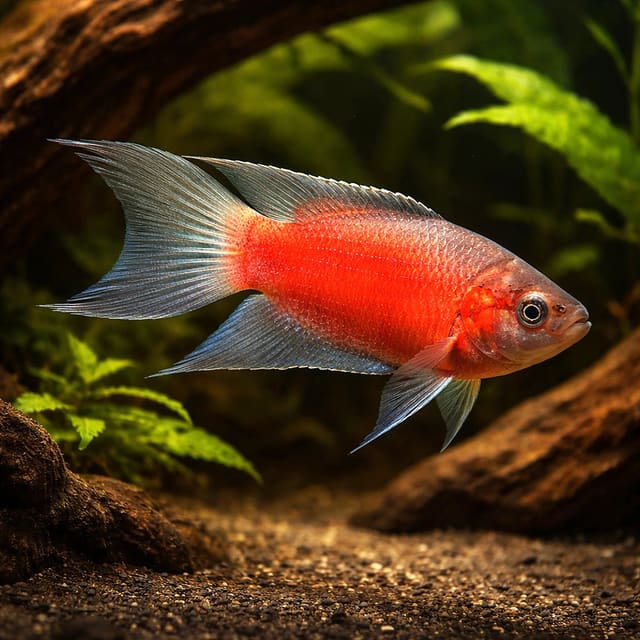
Browse the wider Labyrinth Fish collection to compare adult size and temperament. The Honey Dwarf Gourami Red is a brighter trade form that should not be assumed to have identical identity or colour. The Cobalt Dwarf Gourami is a separate, more intensely coloured species form. A Red Paradise Fish is typically a bolder choice, while the Cosby Three-Spot Gourami grows larger and needs a different stocking plan. These links are comparisons, not recommendations to mix them in one aquarium.
This product is sold unsexed. A size choice describes approximate body size, not sex. Mature wild-type males generally show stronger honey-yellow colour, a dark throat and underside in breeding condition and a yellow dorsal edge. Females are usually rounder, more muted and may retain a horizontal body stripe.
Those differences can be weak in juveniles or stressed fish. Transport, hierarchy and lighting can temporarily suppress colour. We therefore do not promise a male, female or compatible pair from an unsexed variant. If a breeding project depends on sex ratio, allow for maturation, extra housing and the possibility that a fish must be moved.
Honey Gouramis are bubble-nest spawners. A mature male may build a raft of bubbles beneath floating leaves, court a female and guard the eggs near the surface. FishBase records male nest guarding. Spawning behaviour can occur in a community aquarium, but raising fry successfully usually requires a controlled separate setup and a plan for the adults.
Use a mature, gently filtered aquarium with floating cover and a secure lid. A sponge filter is useful because it provides biological filtration without strong suction. Condition adults with varied small foods, maintain stable suitable water and give the female dense retreats. Do not force a reluctant or harassed fish to remain with a displaying male.
After spawning, the male may collect eggs and return them to the nest. Timing varies with temperature and conditions, so observe the nest rather than relying on a single fixed number of hours. Once fry are free swimming, they require microscopic first foods and later newly hatched brine shrimp or another appropriately small diet.
Fry are sensitive to poor water and abrupt changes. Keep the air above the water warm and humid while the labyrinth organ develops, avoid strong current and perform careful small maintenance. Breeding should only be attempted when there is space and a responsible plan for the young.
Choose a quarantine process that protects both the new fish and the established aquarium. A separate cycled, heated and covered tank allows you to confirm feeding, normal waste, breathing and behaviour before introducing the fish to a community. Shared nets and wet equipment can transfer pathogens, so disinfect or dedicate equipment appropriately.
A new Honey Gourami may be pale, cautious and unwilling to feed immediately after transport. Give it dim light, cover and quiet. Offer a tiny familiar food once it has had time to settle, and remove uneaten food. Improvement should be gradual: the fish should begin exploring, maintain balance and show a steadier feeding response.
Test water before reaching for medication. Poor water, temperature shock and aggression can produce symptoms that resemble disease. Do not combine treatments without checking active ingredients, oxygen demand and sensitivity of any shrimp or snails. When diagnosis is uncertain or the condition is severe, consult an aquatic vet or an experienced fish-health professional.
Prepare the aquarium before ordering: confirm that it is cycled, test the water, check the heater and filter, and plan a quarantine space. Read the current livestock delivery information for dispatch areas, timing and charges. Someone should be available to receive the box and follow the instructions promptly rather than leaving livestock exposed to outdoor temperatures.
On arrival, inspect the unopened bag as required by the Live Arrival Guarantee. If there is a problem, follow the current photo and contact-time requirements on that page before opening or disposing of packaging. The published guarantee terms control; this care guide does not replace them.
Dim the aquarium lights and compare bag temperature and source water with the prepared tank. Follow the enclosed/current acclimation instructions and avoid allowing shipping water to enter the display unnecessarily. Do not leave a sealed shipping bag floating for an extended period after opening: gas exchange can change the chemistry of transport water.
Release the fish gently, provide cover and keep the room quiet. Do not chase it for a photograph or add food immediately just to test it. Check breathing and balance, then offer a very small meal later when it has settled. Continue observing through the first days and test water if behaviour changes.
| Fish | Typical character | Key distinction |
|---|---|---|
| Wild-type Honey Gourami Trichogaster chuna |
Small, peaceful, often shy | Subtle natural-style colour; this listing is unsexed and not certified wild caught |
| Cobalt Dwarf Gourami Trichogaster lalius form |
More conspicuous display fish | Separate species and domestic colour form; do not use Honey Gourami care as a complete substitute |
| Three-Spot Gourami Trichopodus trichopterus |
Larger and more assertive | Needs more space and can place greater territorial pressure on companions |
| Paradise Fish Macropodus opercularis |
Bold and potentially territorial | Different temperature and community-planning considerations |
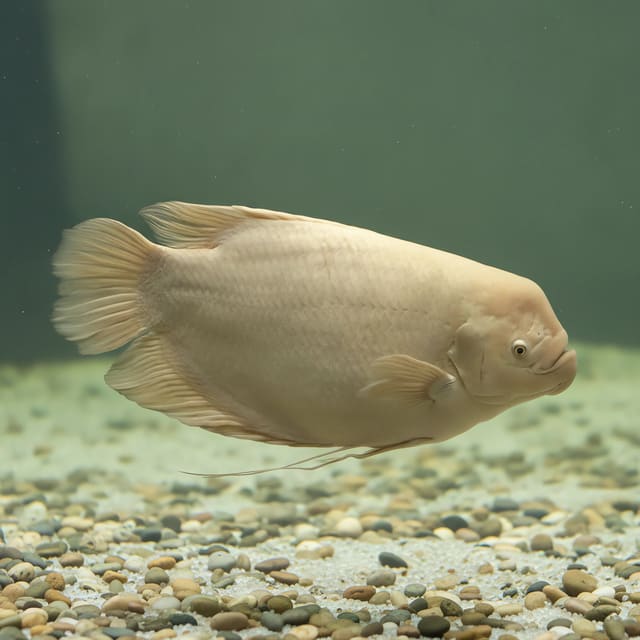
| Gold Giant Gourami Osphronemus goramy |
Very large long-term commitment | Not a small-community alternative; see the Gold Giant Gourami listing for its own requirements |
It is for one fish per quantity. Select the approximate size you want from the available variants. Ordering two means two unsexed fish, not a guaranteed breeding pair.
No. “Wild” comes from the trade name and is presented here as wild-type form context. The current record does not prove wild-caught origin, collection locality or lineage.
The fish is unsexed. Sex cannot be selected or guaranteed. Mature display colour can help with identification later, but juveniles and recently transported fish may not show clear differences.
The accepted current name is Trichogaster chuna. Colisa chuna and Colisa sota are historical names that remain common in books and trade lists.
No. Honey Gourami is Trichogaster chuna; Dwarf Gourami is Trichogaster lalius. They are related but separate species and should not be treated as interchangeable colour versions.
UK aquarium guidance commonly describes Honey Gouramis at around 5 cm. FishBase also lists a larger 13.7 cm published maximum record. Individual outcome varies, so provide adult-appropriate space rather than planning around the smallest figure.
Use an established aquarium at least 60 cm long as a sensible starting point for one fish. Increase the footprint and volume for a group, a community or a layout with limited usable swimming area.
FishBase reports 22-28°C. Choose a stable point that also suits the tank mates, avoid abrupt shifts and use a thermometer rather than relying only on the heater dial.
No. Surface air breathing does not remove ammonia, nitrite or organic waste. The aquarium still needs a mature biological filter, sensible feeding, testing and partial water changes.
They are generally peaceful and can be shy, but individuals differ. Breeding males may defend a nest area, and a fish can be stressed by a poorly matched companion or another gourami in too little space.
Potentially, in a larger planted aquarium with visual barriers and a separation plan. Because this stock is unsexed, a particular sex ratio or bonded pair cannot be ordered by quantity alone.
It may pick at tiny organisms, but it is not a dependable algae eater or snail-control fish. Feed a balanced small omnivore diet and address algae or snail causes directly.
Adult shrimp may coexist where there is dense cover, but shrimplets can be eaten. No community fish can be assumed completely safe with very small crustaceans.
Transport, bright light, an open layout and active companions can suppress colour and confidence. Provide shade and quiet, test the water and watch for gradual improvement. Persistent distress, damage or refusal to feed needs investigation.
No. It is a representative illustration retained from the existing gallery. It does not guarantee the exact colour, pattern, proportions, sex or individual dispatched.
The active sitewide welcome offer is 10% off an eligible first order with code WELCOME10. Enter it at checkout; current eligibility and checkout validation control the offer.
This guide separates supplier facts from general species guidance. Identity and synonym decisions use Eschmeyer’s Catalog of Fishes. Distribution, published water range, air breathing, habitat, aquarium length, reproduction and the larger maximum-size record use FishBase. UK welfare and water-quality guidance is cross-checked against the OATA gourami care sheet.
The warning that true wild fish are relatively uncommon and that planted shade suits the wild-type form is supported by Practical Fishkeeping. Sources describe a species; the Shopify selector and this page’s sale-unit statement describe what is sold here.
Last reviewed: 14 July 2026. Aquarium care evolves as records and welfare guidance improve. When a scientific maximum, trade expectation or supplier statement conflicts, this page states the uncertainty instead of turning one number into a guarantee.
No reviews for this item yet. Bought one? Honest reviews only, good or bad.
What customers say about ordering from us
I have a small group of long finned mountain minnows. So was delighted to be able to order ten of this variety to increase the genetics in my tank . The ones I recieved are healthy but it’s to early to give a verdict on wether they are of a long finned type since they are small currently.
Gordon Walker · 23 Sept 2026
100% success travel and "installation". Pleased with quality of purchase. The Siamese fighter a bit "shy" so have not yet seen him at his best yet but looking good. Happy customer. GG
George E Garratt · 21 Sept 2026
Reviews of our shop, collected by Judge.me, an independent third-party review collector. Newest first.