Tanganyika Pearl Killifish (Lamprichthys tanganicanus)
23–25°C · pH 8–8.5
From £19.77Some sizes on sale

Large South American annual killifish supplied at 4-6 cm. Best in a covered 60 L+ species setup around 20-23 C with live/frozen foods and peat or coco-coir spawning media.
Adult size is the maximum length this species reaches at full maturity (scientific sources). The livestock you receive will be younger and smaller. Product-photo provenance and any image-specific limitations are stated on the listing.
Megalebias wolterstorffi
Save when buying multiple fish. Each quantity is one fish; sex and pair formation are not guaranteed unless the selected variant explicitly states them.
Confirm your email, then we’ll send an availability message for this exact item if it returns within 180 days.
This request is only for this product—no newsletter or other promotions. A mail-provider retry may very rarely duplicate the same availability message. Unconfirmed addresses are removed after 48 hours. See our privacy policy.
Large South American annual killifish supplied at 4-6 cm. Best in a covered 60 L+ species setup around 20-23 C with live/frozen foods and peat or coco-coir spawning media.
Adult size is the maximum length this species reaches at full maturity (scientific sources). The livestock you receive will be younger and smaller. Product-photo provenance and any image-specific limitations are stated on the listing.
Maintain these water conditions for optimal health and vibrant colors
Wolterstorff's Pearl Killifish is a specialist South American annual killifish best presented under the current FishBase and Eschmeyer name Megalebias wolterstorffi. The supplier name Cynolebias wolterstorffi and the GBIF-backed Austrolebias wolterstorffi name still appear in aquarium searches and older references, so they are kept here as natural synonym context rather than pushed into every sentence.
This SKU is supplied at 4-6 cm. FishBase gives a maximum size of 10 cm total length, and specialist aquarium notes place the species among the larger annual killifish, so plan for a sturdy pearlfish rather than a tiny nano community fish. It can be calm when settled, but it is not a throw-in community species. The best result comes from a covered, quiet, species-led aquarium where temperature, food, cover and spawning substrate are managed deliberately.
Taxonomy is one of the reasons this listing needed a careful manual rewrite. FishBase currently displays the species as Megalebias wolterstorffi; Eschmeyer's Catalog of Fishes also gives current status as Megalebias wolterstorffi. GBIF places it under Austrolebias wolterstorffi and lists Cynolebias wolterstorffi and Megalebias wolterstorffi as synonym names. The product title uses Megalebias for the main identity, while the older supplier name is retained so keepers can still recognise the fish they ordered.
For provenance and care planning, treat this as a southern South American annual killifish with seasonal-pool needs, not as a generic hot-water community fish. FishBase gives the Laguna dos Patos basin, while Eschmeyer places the distribution in Rio Grande do Sul, Brazil and Uruguay. Killi.co.uk breeding records also refer to Uruguay, Brazil, Canal Andreoni and Porto Alegre strains. The care advice below follows that southern South American annual-fish context, with cooler stable water and substrate-spawning behaviour kept central.
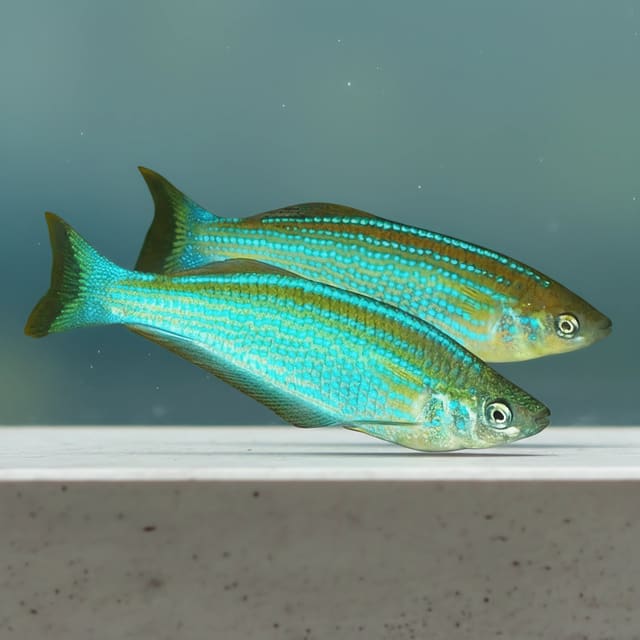
The original reference photo shows a compact, deep-bodied pearlfish with a pale blue-green lower body, dusky purple upper body, pale spotting and red-orange highlights on the pelvic and anal-fin area. The fins are broad and rounded, and the caudal fin carries the same spotted patterning as the body. It is a different visual impression from the slender top-dwelling killifish many customers imagine when they hear the word killifish.
Like many annual killifish, males usually carry the stronger pattern and body depth, while females are plainer and fuller. The colours show best under subdued light with a darker base, floating cover and clean water. A bare, bright, busy aquarium tends to flatten the fish's colour and makes it behave more defensively.
Megalebias wolterstorffi is associated with seasonal freshwater habitats in southern South America. Annual fish in these systems grow, feed and spawn while water is present, then the eggs survive a dry period in the substrate. That life history is central to the species. It explains why the fish needs rich food, calm conditions, a secure cover and a spawning medium rather than just generic community-fish care.
FishBase describes the species as freshwater, benthopelagic and non-migratory, with a subtropical 20-25 C range. It also notes bottom spawning and around three months of incubation. Those details matter in an aquarium: the fish is tied to the lower and middle levels, appreciates a soft spawning base, and should not be pushed into high-flow, hot-water community conditions.
Use a 60 litre or larger aquarium for a pair or carefully managed small group. Give the fish floor space, low cover and a secure lid. Killifish jump, and a larger annual species can still find small gaps. A sponge filter or very gentle filter outlet is better than strong flow. Floating plants, Java moss, leaf litter, fine sand and a removable peat-fibre or coco-coir spawning container all suit the species.
If you are keeping them mainly for display, keep the layout calm and uncluttered enough for easy feeding. If breeding is the aim, make the spawning container easy to remove and check. Specialist reports for this species mention peat or similar spawning substrate, neutral to soft-acid water, and successful breeding around 16-23 C. The practical message is simple: clean, stable, cooler water and managed substrate are more important than a decorative high-energy community aquascape.
A temperature study on Austrolebias wolterstorffi tested 16, 20, 24 and 28 C and found 28 C detrimental to growth. That supports the same practical care point as experienced killifish keepers give: do not keep this species as a hot tropical community fish. The cooler half of the FishBase range is the safer everyday target.
This is a carnivorous annual killifish. Use live and frozen foods as the foundation: daphnia, cyclops, baby brine shrimp, mosquito larvae, white worm, grindal worm, blackworm and chopped bloodworm are all suitable depending on the fish's size. Fine prepared carnivore foods may be sampled once the fish is settled, but they should not replace live and frozen foods for conditioning.
Feed small amounts once or twice daily and remove leftovers quickly. Rich food is useful, but stale food in a specialist tank quickly damages water quality. If this fish is kept with anything else, watch feeding closely; it should not have to compete with fast barbs, tetras or cichlids for every meal.
Wolterstorff's Pearl Killifish is best sold honestly as a species-first fish. It is not a predatory bully, but males can be assertive and pairs need cover. Specialist notes for Megalebias wolterstorffi are more cautious than the old generic community wording. A species aquarium gives the fish the best chance to feed calmly, show colour and breed.
If tank mates are used, choose only very calm fish with matching temperature and water needs, and accept that breeding control will be harder. Avoid large fish, fin nippers, fast competitive feeders, boisterous cichlids, hot hard-water community setups and ornamental shrimp you would be upset to lose. Snails are usually the safest companions.
This is a bottom-spawning annual killifish. Provide peat fibre, coco coir or a similar soft spawning medium. Breeders usually collect or remove the medium, keep it damp rather than submerged, and re-wet eggs after development. FishBase notes bottom spawning with about three months of incubation; killi.co.uk breeding reports for this species describe peat or similar media, neutral water, and egg storage around 20-23 C in one successful report.
Fry can grow quickly when fed well and kept clean, but that does not make the species beginner-proof. Plan the breeding setup before purchase if eggs are the goal. A display-only setup can still be rewarding, but annual killifish become much easier to understand when the aquarium is designed around their substrate-spawning life cycle.
Order this fish as a specialist livestock purchase, not as a casual add-on. We pack live fish for a UK live-animal courier service, with oxygenated bags, insulation and heat packs when conditions require them. The Tropical Fish Co Live Arrival Guarantee applies when the delivery rules are followed.
For best results, prepare the tank before dispatch day: covered lid, mature filter, stable water, small live or frozen foods ready, and a quiet first week after arrival. This species rewards that preparation with better colour, calmer feeding and more natural annual-killifish behaviour.
No reviews for this item yet. Bought one? Honest reviews only, good or bad.
What customers say about ordering from us
I have a small group of long finned mountain minnows. So was delighted to be able to order ten of this variety to increase the genetics in my tank . The ones I recieved are healthy but it’s to early to give a verdict on wether they are of a long finned type since they are small currently.
Gordon Walker · 23 Sept 2026
100% success travel and "installation". Pleased with quality of purchase. The Siamese fighter a bit "shy" so have not yet seen him at his best yet but looking good. Happy customer. GG
George E Garratt · 21 Sept 2026
Reviews of our shop, collected by Judge.me, an independent third-party review collector. Newest first.