Moderate
Firemouth Cichlid (Thorichthys meeki)
20–32°C · pH 6.5–8.5 · 108L
£5.39

Chameleon Cichlid (Australoheros facetus) is a territorial South American cichlid reaching about 18-20 cm. One unsexed fish is supplied per selected size.
Adult size is the maximum length this species reaches at full maturity (scientific sources). The livestock you receive will be younger and smaller — pick a size above for the actual shipping size. Product-photo provenance and any image-specific limitations are stated on the listing.
Australoheros facetus
Save when buying multiple fish. Each quantity is one fish; sex and pair formation are not guaranteed unless the selected variant explicitly states them.
Confirm your email, then we’ll send an availability message for this exact item if it returns within 180 days.
This request is only for this product—no newsletter or other promotions. A mail-provider retry may very rarely duplicate the same availability message. Unconfirmed addresses are removed after 48 hours. See our privacy policy.
Chameleon Cichlid (Australoheros facetus) is a territorial South American cichlid reaching about 18-20 cm. One unsexed fish is supplied per selected size.
Adult size is the maximum length this species reaches at full maturity (scientific sources). The livestock you receive will be younger and smaller — pick a size above for the actual shipping size. Product-photo provenance and any image-specific limitations are stated on the listing.

Cichlids are a family of roughly 1,800 accepted species, not one care type. Before buying, identify the exact species and source, then compare adult measurement, usable tank dimensions, social system, territory, tested water, diet and an exit plan. No family-wide minimum tank, water range or tank-mate list is safe.
Maintain these water conditions for optimal health and vibrant colors
Chameleon Cichlid (Australoheros facetus) is a substantial South American cichlid for aquarists prepared to manage territorial behaviour. Its colour and contrast can vary with age, condition, environment and breeding state, while dark vertical bars are characteristic of the species. Adults can reach about 18-20 cm, with larger specimens reported, so this is not a small community fish.
This listing is for one unsexed fish per selected quantity. Choose from the size options shown in the selector. A quantity of two means two individual fish; it does not guarantee a male and female, a compatible pair or a bonded pair. Sex is not guaranteed at any offered size.
Gulf's White Convict Fish is a trade label attached to this stock, and the historical scientific combination Cichlasoma facetum may still appear in older aquarium references. The accepted name is Australoheros facetus. It is not the pale or albino form of the Central American convict cichlid Amatitlania nigrofasciata that is often sold online as a "white convict".
| Accepted scientific name | Australoheros facetus (Jenyns, 1842) |
|---|---|
| Other names | Chameleon Cichlid; chanchito; formerly Cichlasoma facetum |
| Adult size | About 18-20 cm, with larger reports |
| Care level | Intermediate |
| Temperament | Territorial; aggression can increase sharply during breeding |
| Temperature | 18-25°C; aim for a stable 20-24°C in a managed aquarium |
| pH | 6.5-7.5 |
| Hardness | 5-12 dGH |
| Minimum aquarium | 300 litres and about 120 cm long for one adult or a compatible pair |
| Diet | Opportunistic omnivore; varied quality prepared, frozen and plant-based foods |
| Aquarium region | Mostly middle to lower levels, with access to the full aquarium |
| Sale unit | One unsexed fish per selected quantity |
The 300-litre and 120 cm recommendation is a conservative aquarium-planning guide based on adult size, territoriality and biparental breeding behaviour, not a universal published species threshold. A breeding pair or an unusually aggressive individual may need more space or separate accommodation. Use the tank-volume calculator to check the true working volume after substrate and decor.
Australoheros facetus is a valid species in the cichlid family. A 2022 morphology and genetic review places it in rivers along the Uruguayan coast and in the adjacent lower Parana and lower Uruguay region of Uruguay and Argentina. That modern revision separates many fish from the Laguna dos Patos and Lagoa Mirim systems of southern Brazil as Australoheros acaroides. Older references can therefore show a broader Brazilian range for A. facetus; this page follows the newer revision rather than repeating that older distribution unchanged.
The species occurs in freshwater, including small streams and vegetated still-water habitats. Its body is moderately deep and laterally compressed. Dark vertical bars are typical, but their strength and the ground colour can vary with age, condition, environment and reproductive state. The common name "Chameleon Cichlid" reflects this variable appearance; it does not mean that every fish will become white or display one fixed colour pattern.
The current identity and range follow the peer-reviewed 2022 Australoheros revision, the earlier genus review, FishBase and the Catalog of Fishes. These sources do not establish Gulf's White Convict Fish as a standard scientific or international common name, so it is retained here only as the stock's trade label.
Plan the aquarium around adult behaviour rather than the size of a juvenile at purchase. Provide a long footprint, strong biological filtration and consistent maintenance. Use sand or fine gravel with securely positioned rocks, wood and caves to form visual barriers. Leave open swimming room as well as sheltered areas. Territorial boundaries are easier to manage when one fish cannot see the entire tank from every position.
Plants can be included, but established cichlids may dig or rearrange the substrate. Choose robust plants, protect their roots and make sure all rockwork remains stable if the fish excavates beneath it. Keep water quality steady and avoid sudden changes. The species has broad physiological tolerance, but laboratory tolerance is not a target for everyday care. Do not assume that its cool-water tolerance makes an uncontrolled or seasonally cold UK aquarium suitable.
Use a reliable heater and thermometer where room conditions cannot hold a stable suitable range. Match planned aquarium conditions with the water-parameter tool, then change temperature or chemistry gradually. Stability, oxygenation and low waste are more useful than chasing an exact number within the recommended range.
This is a territorial cichlid, not a general peaceful-community recommendation. Individuals may defend caves, spawning sites and large sections of the aquarium. A pair guarding eggs or fry can become especially forceful. Keep a divider, spare aquarium or another safe separation plan available before attempting to form a pair.
| Potential choice | Planning guidance |
|---|---|
| Similarly sized robust cichlids | Possible only in a sufficiently large, structured aquarium with close observation and separation capacity |
| Large robust catfish | May be considered when water needs and adult size align, but no combination is guaranteed |
| Small or delicate fish | Avoid; they may be chased, injured or treated as prey |
| Slow or long-finned fish | Avoid because they may not escape territorial aggression |
| Breeding pair with other fish | High risk; a species-only aquarium or prompt separation may be necessary |
Introductions should be supervised and the aquarium should be checked for persistent chasing, blocked access to food, torn fins or a fish confined to one corner. Compatibility depends on the individual fish, aquarium layout and available space. The tank-mate tool can help organise a shortlist, but observed behaviour must decide whether a combination remains safe.
Wild Australoheros are opportunistic feeders associated with small fish and benthic invertebrates, supplemented by some vegetable material. In the aquarium, offer a varied diet based on a quality cichlid pellet or granule, supported by suitable frozen foods and a plant component. Examples can include frozen crustacean or insect-based foods, spirulina-based food and suitable vegetable matter.
Feed portions the fish can finish without leaving waste to decay. Adjust quantity and frequency to the fish's size, condition, water temperature and the energy density of the food. Variety is preferable to relying on one rich frozen or live food. Remove uneaten food and monitor body condition rather than feeding simply because the fish continues to beg.
Australoheros facetus is a biparental substrate spawner. A compatible pair selects and defends a site, and both parents guard the eggs and fry. This is interesting behaviour to observe, but it also creates the period of greatest compatibility risk. Do not purchase two unsexed fish on the assumption that they will form a pair.
If breeding occurs, minimise disturbance while maintaining water quality and watch the other fish closely. Be prepared to separate fish before injuries occur. Reliable published information does not support promising one exact clutch size, hatch time or breeding outcome for every aquarium, so this listing does not make those guarantees.
| Listed option | What the option means |
|---|---|
| 4-5 cm | One unsexed juvenile fish in the listed size band |
| 5-6 cm | One unsexed fish in the listed size band |
| 7-9 cm | One unsexed fish in the listed size band |
| XL | One unsexed larger fish; check current availability if an exact measurement is essential |
Fish are living animals and natural variation is expected. The selector controls the size band purchased; gallery scenes do not change the sale unit. Check the current delivery information before ordering. For an exact-stock or compatibility question, use the contact page before checkout.
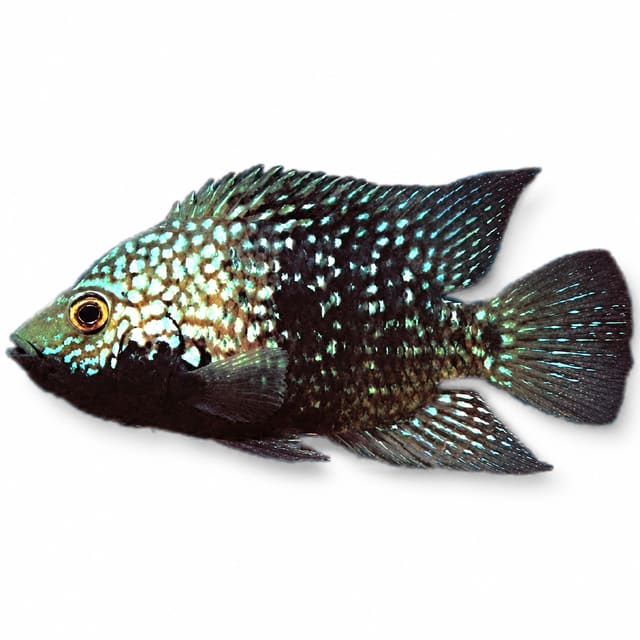
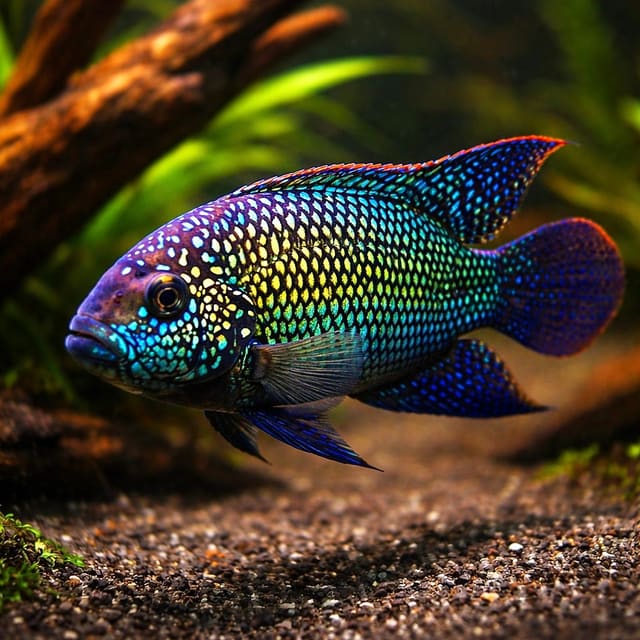
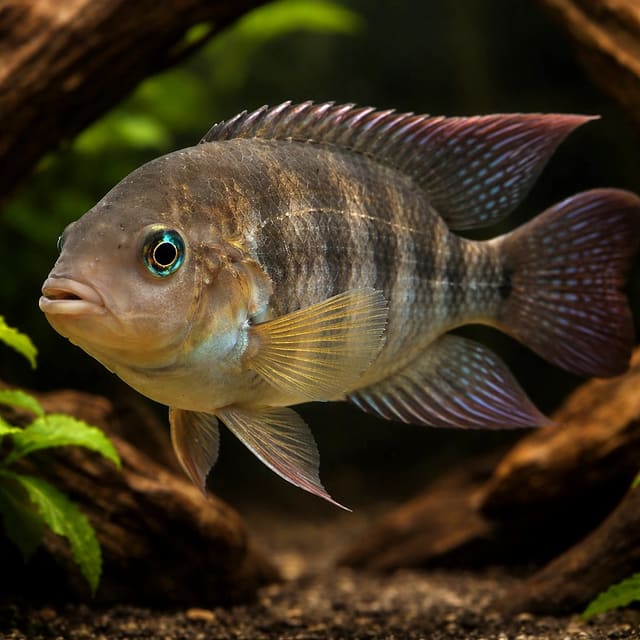
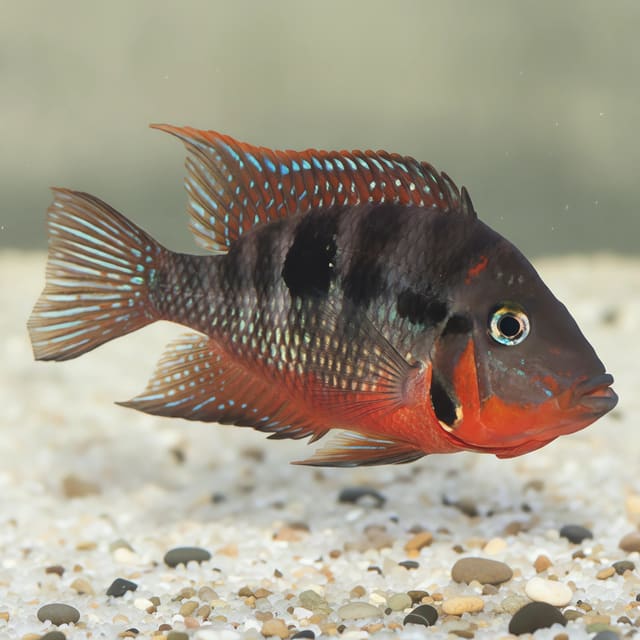
The four existing gallery pictures are representative illustrations. They show blue and gold cichlid-like fish in aquarium scenes, but they are not photographs of the exact fish dispatched and should not be used to verify the precise colour, bar pattern, sex or size of current stock. The image showing two fish does not mean that a pair is included. Each selected quantity remains one unsexed fish.
No reviews for this item yet. Bought one? Honest reviews only, good or bad.
What customers say about ordering from us
I have a small group of long finned mountain minnows. So was delighted to be able to order ten of this variety to increase the genetics in my tank . The ones I recieved are healthy but it’s to early to give a verdict on wether they are of a long finned type since they are small currently.
Gordon Walker · 23 Sept 2026
100% success travel and "installation". Pleased with quality of purchase. The Siamese fighter a bit "shy" so have not yet seen him at his best yet but looking good. Happy customer. GG
George E Garratt · 21 Sept 2026
Reviews of our shop, collected by Judge.me, an independent third-party review collector. Newest first.