−14%
Rosy Barb (Barbus Puntius conchonius)
16–24°C · pH 6–8 · 90L
£2.57£2.99

Peaceful, active Stoliczka's Barb with silver-green body, two dark flank marks and warm orange-green fins. Best kept as a lively shoal in a planted community aquarium.
Adult size is the maximum length this species reaches at full maturity (scientific sources). The livestock you receive will be younger and smaller — pick a size above for the actual shipping size. Product-photo provenance and any image-specific limitations are stated on the listing.
Pethia stoliczkana
Shoaling fish: kept in a group they feel safer, stay calmer and show their best colour.
Confirm your email, then we’ll send an availability message for this exact item if it returns within 180 days.
This request is only for this product—no newsletter or other promotions. A mail-provider retry may very rarely duplicate the same availability message. Unconfirmed addresses are removed after 48 hours. See our privacy policy.
Peaceful, active Stoliczka's Barb with silver-green body, two dark flank marks and warm orange-green fins. Best kept as a lively shoal in a planted community aquarium.
Adult size is the maximum length this species reaches at full maturity (scientific sources). The livestock you receive will be younger and smaller — pick a size above for the actual shipping size. Product-photo provenance and any image-specific limitations are stated on the listing.
Maintain these water conditions for optimal health and vibrant colors
Stoliczka's Barb (Pethia stoliczkana) is a lively, peaceful shoaling barb for planted community aquariums. It stays compact, moves confidently through the middle and upper levels, and brings a bright silver-green flash without needing specialist softwater care. This page covers the current Shopify size options, 3-4 cm and >4 cm, so the smaller and larger fish stay together under one accurate species page.
The accepted name used here is Pethia stoliczkana. Older names still seen in supplier lists and hobby searches include Puntius stoliczkanus, Barbus stoliczkanus, Puntius ticto stoliczkanus and the supplier-style wording Barbus/Puntius ticto stoliczkae. Those names are useful cross-references, but the accepted name, exact source photo and care notes here are the safest way to identify the fish.
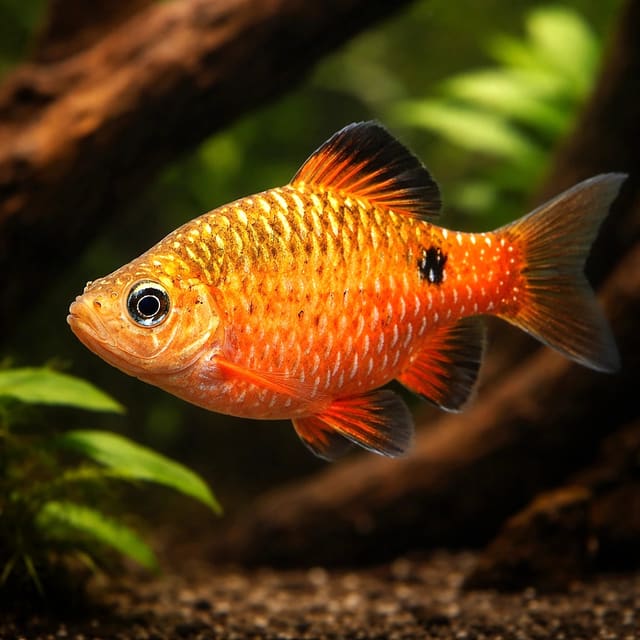
The original reference photo shows a small, alert barb with a silver-green body, a dark shoulder blotch behind the gill cover, a second dark mark near the tail, warm orange over the rear body and greenish translucent fins. That two-spot pattern is the main visual cue, and it is why this species can also be found under two-spot barb style descriptions.
Mature males can show stronger fin colour, including red or orange tones in the dorsal and tail, while females are usually fuller-bodied and less intense in colour. Juveniles can look paler after transport or before they settle. In a planted, shaded aquarium with a varied diet, the metallic body sheen and darker flank marks become much easier to appreciate.
Pethia stoliczkana is recorded from parts of South and Southeast Asia, including drainage systems such as the upper Mekong, Salween, Irrawaddy, Meklong and upper Chao Phraya. SeriouslyFish describes the fish from Manipur in north-eastern India through Myanmar and Thailand to western Laos, usually in shady flowing streams and tributaries with clear, oxygen-rich water.
That habitat tells us how to keep it well: not as a still-water ornament, and not as a single fish in a small tank. Think sand or fine gravel, smooth stones, roots, driftwood, leaf litter, planted edges and open lanes where the group can swim. The taxonomy has been confused with Pethia ticto and older Puntius or Barbus names, so this page keeps the older names as synonyms while using the accepted Pethia stoliczkana name throughout.
Stoliczka's Barb is easy to keep when the aquarium is built around a group. A 75 litre aquarium is the sensible starting point, especially for the 3-4 cm option, but a longer 90 litre or larger tank gives an 8-10 fish group more room to move naturally. Keep a secure lid, because active barbs can jump when startled.
A planted stream-style layout suits them beautifully. Use a fine gravel or sand base, add smooth rocks and wood, then leave clear swimming space through the centre. Java fern, Anubias, Vallisneria, Cryptocoryne and floating plants can all help create shade and cover without blocking every lane. Moderate filtration flow is useful, and visible surface movement helps keep oxygen high.
This species is an unfussy omnivore. In nature, small barbs graze and pick at algae, diatoms, detritus, tiny insects, worms, crustaceans and zooplankton. In the aquarium, use a quality fine flake or small community pellet as the staple, then rotate frozen or live foods such as daphnia, Artemia, mosquito larvae and bloodworm.
Vegetable and algae-based foods are useful too. Spirulina flake, vegetable granules or a tiny amount of blanched green food can round out the diet and support digestion. Feed small portions once or twice daily. They are quick at feeding time, so watch that quieter tank mates still get their share.
Stoliczka's Barb is peaceful, but it is also busy. Keep at least six, and aim for eight to ten or more when space allows. A proper shoal spreads out displaying, reduces stress and brings out the confident midwater movement that makes the species worth choosing. Lone fish or pairs can become nervous, washed out or nippy simply because the social structure is wrong.
Good tank mates include peaceful danios, rasboras, small to medium tetras, other gentle barbs, hillstream or river-style loaches and Corydoras kept in suitable conditions. Avoid large predators, aggressive cichlids, very slow long-finned fish, tiny fry-sized tank mates and dwarf shrimp. The best community is active but not aggressive, with fish that can enjoy the same clean, well-oxygenated water.
Like many small cyprinids, Pethia stoliczkana is an egg-scattering fish and does not guard its eggs. In a mature planted aquarium, occasional fry may appear if there is enough cover, but planned breeding is easier in a separate tank with fine-leaved plants, spawning mops or mesh that lets the eggs fall away from the adults.
Condition adults with varied frozen and live foods, move a healthy pair or small group to the breeding setup, then remove the adults after spawning. Eggs usually hatch quickly in warm, clean water, and the first foods for fry need to be very small before they can move onto baby brine shrimp.
Your Stoliczka's Barb order is packed for live-fish transport and sent by live-animal courier. This listing includes the original reference photo alongside the existing aquarium scene images, so you can compare the real supplier fish with planted display-style views. New customers can use WELCOME10 for a first-order discount, and eligible livestock orders are covered by the Tropical Fish Co Live Arrival Guarantee.
No reviews for this item yet. Bought one? Honest reviews only, good or bad.
What customers say about ordering from us
I have a small group of long finned mountain minnows. So was delighted to be able to order ten of this variety to increase the genetics in my tank . The ones I recieved are healthy but it’s to early to give a verdict on wether they are of a long finned type since they are small currently.
Gordon Walker · 23 Sept 2026
100% success travel and "installation". Pleased with quality of purchase. The Siamese fighter a bit "shy" so have not yet seen him at his best yet but looking good. Happy customer. GG
George E Garratt · 21 Sept 2026
Reviews of our shop, collected by Judge.me, an independent third-party review collector. Newest first.