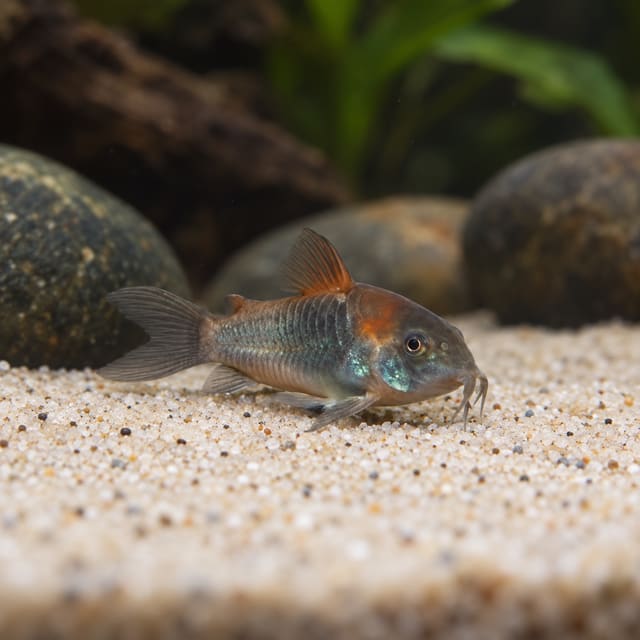
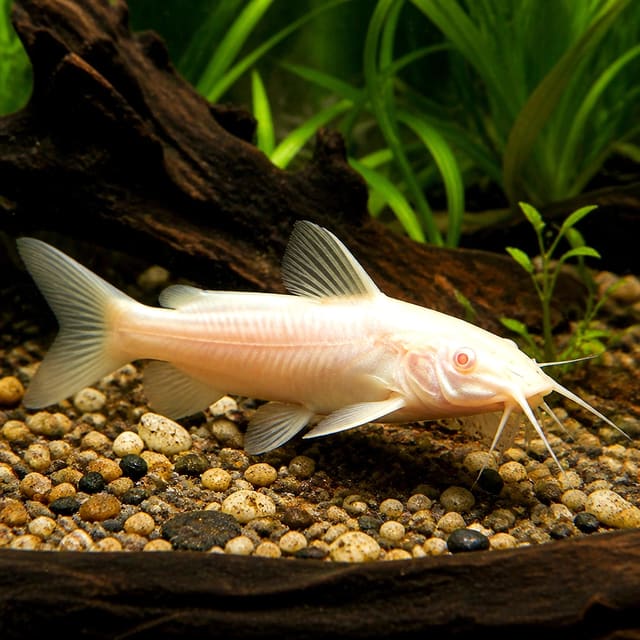
Albino Bronze Cory (Osteogaster aenea)
22–27°C · pH 6–8 · 72L
£2.99

Guitarrita (Bunocephalus coracoideus) is a peaceful, secretive Amazon-basin banjo catfish best suited to a mature aquarium with sand, dim cover and patient after-dark feeding. Sold as one fish in 3–4 cm, 5–7 cm or 7–10 cm dispatch sizes; plan for 15 cm standard length and at least 68 litres with an 80 cm aquarium length.
Adult size is the maximum length this species reaches at full maturity (scientific sources). The livestock you receive will be younger and smaller — pick a size above for the actual shipping size. Product-photo provenance and any image-specific limitations are stated on the listing.
Bunocephalus coracoideus
Guitarrita (Bunocephalus coracoideus) is a peaceful, secretive Amazon-basin banjo catfish best suited to a mature aquarium with sand, dim cover and patient after-dark feeding. Sold as one fish in 3–4 cm, 5–7 cm or 7–10 cm dispatch sizes; plan for 15 cm standard length and at least 68 litres with an 80 cm aquarium length.
Adult size is the maximum length this species reaches at full maturity (scientific sources). The livestock you receive will be younger and smaller — pick a size above for the actual shipping size. Product-photo provenance and any image-specific limitations are stated on the listing.
Maintain these water conditions for optimal health and vibrant colors
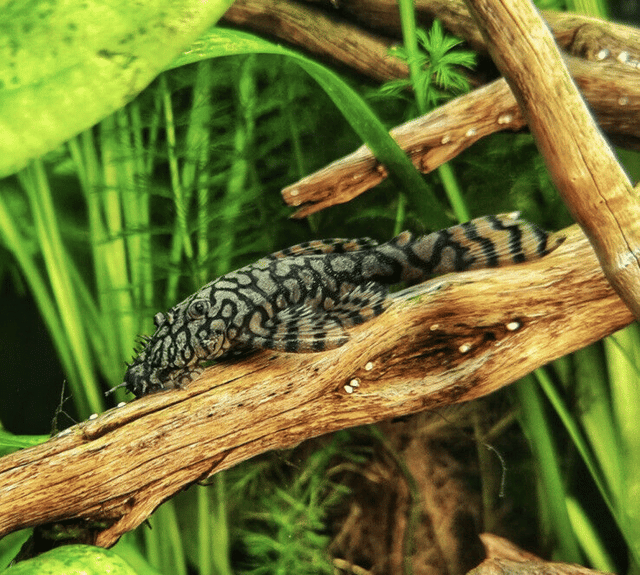
Guitarrita (Bunocephalus coracoideus) is a peaceful South American banjo catfish whose broad, flattened outline and leaf-like camouflage make it very different from a constantly cruising community fish. It is a patient, largely inactive bottom-dweller that normally spends the bright part of the day concealed among sand, wood, rock crevices or leaf cover, then becomes more active after dark. That quiet rhythm is part of its appeal, but it also means the keeper must deliberately check that food reaches it.
One purchase supplies one fish in the size selected. This listing offers 3–4 cm, 5–7 cm and 7–10 cm dispatch sizes. The size you select is the size supplied, not the adult size. FishBase records a maximum of 11 cm standard length, while the specialist aquarium profile gives 15 cm standard length. Plan around the larger 15 cm figure so the aquarium still works for a mature fish, and remember that a length measurement alone does not describe the floor area, cover or feeding access it needs.
| Suits | A patient keeper with a mature filtered aquarium who enjoys a secretive fish and can check feeding after lights out |
|---|---|
| Long-term space | At least 68 litres, with an aquarium length of at least 80 cm and useful floor area retained around cover |
| Social choice | Equally suitable singly or in a compatible group; one fish per purchase |
| Routine water | 20–27 °C, pH 5.8–7.8 and 2–20 dGH; aim towards the upper end of the temperature range |
| Feeding style | Sinking dried food plus live or frozen foods, offered after lights out and checked rather than assumed eaten |
We rate this species intermediate. Its peaceful temperament is straightforward, but its camouflage and sedentary feeding style make observation more important than with a conspicuous daytime fish. A suitable keeper will prepare several shaded retreats, preserve a soft floor, maintain stable water, and use a feeding routine that confirms the fish receives its share. If you want an animal that remains visible throughout the day, another catfish may be a better match; Guitarrita rewards quieter observation.
Browse the catfish and plecos collection only after comparing adult size, water, activity and feeding needs. Similar-looking bottom fish can use an aquarium in very different ways. Guitarrita should be chosen for its own subdued behaviour and habitat requirements, not as a general cleaner or a substitute for aquarium maintenance.
The scientific identity is Bunocephalus coracoideus, a member of the Aspredinidae family. FishBase places it in the Amazon River basin and records it from ponds and forest creeks rich in plant debris. Its trade name Guitarrita means “little guitar”, referring to the body shape seen from above. The fish’s mottled form is adapted to disappear against a debris-rich floor, so an animal that rests motionless under cover can be behaving normally.
Start with the mature plan rather than the dispatch measurement. The three listed sizes let you choose the size supplied, but they do not change the adult care requirement. A smaller fish needs appropriately sized food and protection from feeding competition; a larger one still needs the same stable water, shaded hiding structure and long-term space. Avoid reading the largest dispatch band as a final growth limit.
Sex is guaranteed only when the selected option explicitly states male or female. This Guitarrita listing has no sex-guaranteed option. The specialist profile says sexing is difficult and that adult females tend to be larger and rounder-bellied, but those tendencies are not a guarantee for an individual fish. Choose the animal for its species, size band and care fit rather than an assumed sex.
Gallery images have been digitally enhanced to improve image quality. Natural colour, pattern, size and maturity can vary between live animals.
Plan for a mature length of 15 cm standard length, using the larger of the two credible records. The specialist aquarium profile describes a 60 × 38 × 30 cm aquarium of about 68 litres as adequate for this largely inactive species, while FishBase states a minimum aquarium size of 80 cm. A conservative home plan therefore combines both: use at least 68 litres and an aquarium at least 80 cm long, then increase the footprint when other bottom fish, bulky décor or a group would reduce usable space.
Volume alone is not the whole decision. Guitarrita spends most of its time on or within the lower structure, so the usable floor must remain connected. A tall 68-litre aquarium with a narrow base is less helpful than a longer layout with room for several retreats and an open feeding patch. Measure the interior after wood, rockwork and equipment are positioned. For a group, provide more than one secure resting place and more floor area than the basic single-fish plan.
Use a couple of inches of aquarium sand, or provide smooth crevices among stable rocks and bogwood. Dried oak or beech leaves can create natural-looking cover and help the fish blend into its surroundings. Fine material also reflects the FishBase aquarium note calling for fine gravel or sand. Avoid sharp pieces, unstable piles and narrow traps that could catch a broad-bodied fish. Every heavy object should rest securely rather than balancing on loose substrate.
Lighting should be subdued enough for the fish to settle. Plant cover, floating shade or carefully positioned wood can break up bright light, but the surface must still exchange gas freely and the keeper must still be able to inspect the aquarium. A fish hidden by appropriate cover is not a reason to strip the tank bare; instead, design at least one shelter so its entrance and nearby feeding point can be observed without disturbance.
Prepare and mature the aquarium before livestock arrives. The first tropical tank guide covers filtration, cycling and staged stocking. Guitarrita should enter a system with established biological filtration, stable temperature and confirmed zero ammonia and nitrite, not a newly filled aquarium that is still developing its bacterial population.
For routine aquarium care, use the species profile’s 20–27 °C, pH 5.8–7.8 and 2–20 dGH. Aim towards the upper end of the temperature range, as the profile specifically advises. FishBase records the species in warmer wild conditions of 25–28 °C, pH 6.0–8.0 and 5–19 dH; the specialist profile supplies the practical aquarium range used here. Stable conditions within the aquarium range are more useful than repeatedly adjusting water to chase a particular decimal.
| Temperature | 20–27 °C; aim towards the upper end |
|---|---|
| pH | 5.8–7.8 |
| General hardness | 2–20 dGH |
| Ammonia | 0 mg/l |
| Nitrite | 0 mg/l |
| Filtration | Mature biological filtration with circulation through the lower level |
Test the water available at home before choosing livestock. The water chemistry guide explains pH, hardness and the nitrogen cycle, while the water matcher can help compare measured aquarium values with this species range. Make any sustainable changes before ordering, then keep the routine steady. Sudden swings can be more disruptive than a stable value near one suitable boundary.
A well set up and maintained filter is essential. The RSPCA aquarium guidance explains that fish release toxic ammonia, which beneficial bacteria convert to nitrite and then to the safer nitrate. Test rather than assuming the filter is coping, particularly after livestock is added, feeding changes or flow falls. Guitarrita’s willingness to remain still can make poor conditions less obvious than they would be in an active shoal.
The species profile gives an illustrative filter turnover of four to five times the volume each hour for its roughly 68-litre example, corresponding to about 270–340 litres per hour. Treat that as a starting point for the example aquarium, because actual delivery changes with media, pipework, head height and maintenance. The aim is clean, oxygenated water and movement across the bottom without exposing the fish to a harsh jet. Diffuse a strong outlet against glass or décor while keeping quiet areas connected to the general circulation.
The genus is recorded as facultatively air-breathing, so an occasional purposeful visit towards the surface is possible. That trait is not a substitute for filtration or oxygenation. A sudden change in breathing, repeated surface activity, unusual exposure, refusal of food or a marked change in posture should trigger immediate checks of temperature, ammonia, nitrite, flow and oxygenation.
Guitarrita accepts sinking dried foods and relishes live or frozen foods such as bloodworm and earthworm. The challenge is access rather than appetite: the specialist profile calls it unfussy but not easily fed because of its sedentary lifestyle. Add food after lights out so it can feed without faster daytime fish taking everything first. Its reputation as a bottom fish does not make aquarium waste a complete diet.
Start with a quality sinking dried food that reaches the chosen feeding patch. Add appropriately sized live or frozen items for variety. Match particle size to the fish supplied: a 3–4 cm fish needs smaller portions than a 7–10 cm fish, while both need food that sinks and remains accessible. Whole large earthworms may be unsuitable for a small dispatch-size fish, so select or portion foods sensibly.
In a community, divide food between locations when tetras, dwarf cichlids or other catfish intercept it. A feeding tube or careful placement can help the item reach the floor, but observation still matters. Do not simply increase the whole aquarium’s ration: that can raise waste without solving access for the hidden fish. The useful measure is whether this individual maintains condition and reliably joins the after-dark feed.
Check body condition from above and from the side when the fish is visible. The species’ broad outline and camouflage can make gradual weight loss easy to miss. A fish that repeatedly stays concealed through feeding, becomes thinner, breathes differently or changes its usual resting place needs prompt attention to water quality, competition and health. Because adult females may be rounder, body shape alone should not be used as a sex diagnosis or as proof of overfeeding.
OATA’s broader catfish guidance advises feeding appropriate sinking foods and limiting the amount to what fish consume within a few minutes, while recognising that feeding style varies widely among catfish. Apply that general waste-control principle alongside the species-specific after-dark advice. Remove excess rather than leaving it to break down between sand, leaves or wood.
Consistent maintenance supports a fish that may not advertise discomfort through constant movement. The OATA freshwater catfish care sheet strongly recommends a partial water change of 25% at least once every week and regular testing for ammonia and nitrite. Adjust additional maintenance to the aquarium’s stocking, feeding, nitrate pattern and visible waste rather than waiting for the water to look dirty.
Treat replacement tap water with a suitable conditioner and bring it close to the aquarium temperature before use. Siphon exposed waste from the feeding patch and accessible floor while preserving the stable hiding structure. Check filter intakes and outlets for blockages. When filter media needs cleaning, rinse it lightly in removed aquarium water; do not run it under the tap, because chlorine or chloramine may damage the bacterial population.
Normal concealment has context. A Guitarrita that uses familiar cover by day and feeds after dark can be behaving as expected. A sudden change from its own pattern is more informative: failure to feed, persistent unusual exposure, rapid breathing, new marks, weight loss or a different resting posture deserves immediate water tests and closer assessment. General internet treatment recipes are a poor substitute for identifying the cause; contact an experienced aquatic professional when signs persist.
Prepare for delivery before the courier arrives. Read the current delivery and Live Arrival Guarantee policy, have the aquarium ready, and ensure someone is at the address. Tropical Fish Co hand-bags the fish in oxygen, uses an insulated poly box and adds a heat pack when weather calls for it. The parcel travels with a licensed live-animal courier on the confirmed delivery date.
Keep the lights subdued after introduction and avoid repeatedly lifting shelters to force a view. Confirm the fish has settled by watching from a distance and checking the first after-dark feeding opportunity. Test water after the new biological load is added, especially in a smaller system, and maintain the aquarium’s established routine.
Guitarrita is peaceful and totally unaggressive towards its own kind. The species profile says it is equally happy kept singly or as part of a group, so there is no schooling minimum to manufacture. One fish can be a sound social choice; a group can also work when the aquarium provides additional floor area, multiple retreats and reliable feeding access for every individual. Each purchase supplies one fish, so calculate the intended number deliberately.
The profile says it will not predate smaller fish and can live in many community aquariums. It names tetras, dwarf cichlids, Corydoras and smaller loricariids as possible companions in a South American-style community. Those examples are starting categories rather than universal approvals. Check the adult size, water range, activity and temperament of the exact species being considered, and leave enough lower-level space after all residents and décor are counted.
| Often suitable when needs overlap | Peaceful tetras, peaceful dwarf cichlids, Corydoras and smaller loricariids |
|---|---|
| Use caution | Fast feeders, active bottom fish and multiple nocturnal residents competing for the same food or shelters |
| Avoid | Aggressive or persistently harassing fish, and combinations that prevent this quiet catfish from feeding or resting |
The main compatibility risk is easy to overlook because it may not look like a fight. A fast, confident community can consume every sinking item while the Guitarrita remains under cover. Two peaceful bottom species can also crowd the same shaded zone or repeatedly disturb one another at feeding time. Compatibility succeeds only when the quiet fish maintains body condition and can use a refuge without continual interruption.
Temperament labels alone are insufficient. A peaceful but highly active fish may still prevent feeding, while a territorial species may make a hidden conflict hard to see. Choose calm neighbours and keep the total stock modest enough for filtration and maintenance. If the Guitarrita stops feeding or changes its concealment pattern after a new fish arrives, reassess the arrangement promptly.
Very small fish are not automatically prey for this species, according to the profile, but their own welfare still needs a separate check. Likewise, shrimp and snails are not named as species-level companions in the supplied references, so do not infer that every invertebrate combination is suitable. Base each community decision on the exact animals involved.
This is an enthusiast’s fish because much of its behaviour is subtle. Its camouflage resembles a dead leaf, and the profile notes that it can remain exceptionally still. A calm aquarium should allow that natural concealment while giving the keeper reliable ways to check welfare. The solution is not to remove all cover; it is to make the chosen cover observable and the feeding routine repeatable.
A small low-output torch used briefly from outside the aquarium can help confirm an evening feed without turning the main lights back on. Keep the observation short and consistent. Frequent netting, lifting wood or stirring the resting area can make the fish less settled and makes its normal pattern harder to judge.
When keeping several Guitarrita, distribute retreats and feeding points. Their lack of aggression does not create more floor space or more food. Watch for one animal consistently reaching the feed while another remains hidden. A group is successful when all members maintain condition and can choose cover, not simply when no overt fighting is visible.
FishBase records 11 cm standard length, while the specialist aquarium profile gives 15 cm standard length. Use the larger 15 cm figure for conservative adult planning. The 3–4 cm, 5–7 cm and 7–10 cm measurements describe dispatch sizes, not adult limits.
Use at least 68 litres and an aquarium at least 80 cm long, combining the species profile’s adequate-volume example with FishBase’s minimum length. Retain useful floor area around sand, shaded retreats and a visible after-dark feeding patch, and provide more space for a group or a busy community.
The species is equally happy singly or in a group, so one fish is a valid choice. For several, increase floor area, provide multiple retreats and confirm that every fish feeds. One purchase supplies one fish.
We rate it intermediate. It is peaceful, but its secretive, sedentary behaviour requires patient observation, mature filtration and deliberate feeding after lights out. It best suits a keeper comfortable checking water and body condition even when the fish spends much of the day concealed.
Offer quality sinking dried foods plus suitable live or frozen foods such as bloodworm and earthworm. Add food after lights out, place it near the shelter and confirm the fish eats. Remove leftovers rather than relying on this bottom-dweller to live on waste.
Use 20–27 °C and pH 5.8–7.8, with hardness of 2–20 dGH. The species profile advises aiming towards the upper end of the temperature range. Keep readings stable and test the actual aquarium before ordering.
No aggressive or fin-nipping behaviour is indicated in the species profile. It is peaceful and totally unaggressive towards its own kind. The practical concern in a community is usually whether a shy fish can feed and rest without being crowded or harassed.
Peaceful tetras, dwarf cichlids, Corydoras and smaller loricariids are named examples when water, adult size and temperament overlap. Use caution with fast feeders and active bottom fish that compete for food or cover, and avoid aggressive or persistently harassing companions.
Tropical Fish Co hand-bags the fish in oxygen, uses an insulated box and sends it with a licensed live-animal courier. Record a continuous unboxing video from the sealed parcel through opening while the fish remains in the sealed bag; include it if you make a Live Arrival Guarantee claim. Inspect the fish and contact the shop the same day, then float the sealed bag for 20–30 minutes before release.
Species identity, family, Amazon-basin distribution, wild habitat, 11 cm standard-length record, aquarium-length note and environmental range come from FishBase. The Seriously Fish species profile supplies the 15 cm standard-length planning figure, aquarium dimensions and volume, routine water range, cover, diet, after-dark feeding, social behaviour and named community categories.
General UK catfish maintenance and feeding context comes from OATA’s freshwater catfish care sheet. RSPCA aquarium guidance supports the filtration and nitrogen-cycle explanation. Tropical Fish Co’s current delivery page supplies the packing, courier, unboxing-video, same-day contact and 20–30 minute floating steps.
No reviews for this item yet. Bought one? Honest reviews only, good or bad.
What customers say about ordering from us
I have a small group of long finned mountain minnows. So was delighted to be able to order ten of this variety to increase the genetics in my tank . The ones I recieved are healthy but it’s to early to give a verdict on wether they are of a long finned type since they are small currently.
Gordon Walker · 23 Sept 2026
100% success travel and "installation". Pleased with quality of purchase. The Siamese fighter a bit "shy" so have not yet seen him at his best yet but looking good. Happy customer. GG
George E Garratt · 21 Sept 2026
Reviews of our shop, collected by Judge.me, an independent third-party review collector. Newest first.