Advanced
Tropheus moorii — Caramba
23–27°C · pH 8–9.5
£51.99
Lake Tanganyika featherfin sold individually and unsexed. Needs a mature 300 L+ hard-water aquarium and careful social planning.
Adult size is the maximum length this species reaches at full maturity (scientific sources). The livestock you receive will be younger and smaller — pick a size above for the actual shipping size. Product-photo provenance and any image-specific limitations are stated on the listing.
Ophthalmotilapia boops
Save when buying multiple fish. Each quantity is one fish; sex and pair formation are not guaranteed unless the selected variant explicitly states them.
Confirm your email, then we’ll send an availability message for this exact item if it returns within 180 days.
This request is only for this product—no newsletter or other promotions. A mail-provider retry may very rarely duplicate the same availability message. Unconfirmed addresses are removed after 48 hours. See our privacy policy.
Lake Tanganyika featherfin sold individually and unsexed. Needs a mature 300 L+ hard-water aquarium and careful social planning.
Adult size is the maximum length this species reaches at full maturity (scientific sources). The livestock you receive will be younger and smaller — pick a size above for the actual shipping size. Product-photo provenance and any image-specific limitations are stated on the listing.

Cichlids are a family of roughly 1,800 accepted species, not one care type. Before buying, identify the exact species and source, then compare adult measurement, usable tank dimensions, social system, territory, tested water, diet and an exit plan. No family-wide minimum tank, water range or tank-mate list is safe.
Maintain these water conditions for optimal health and vibrant colors
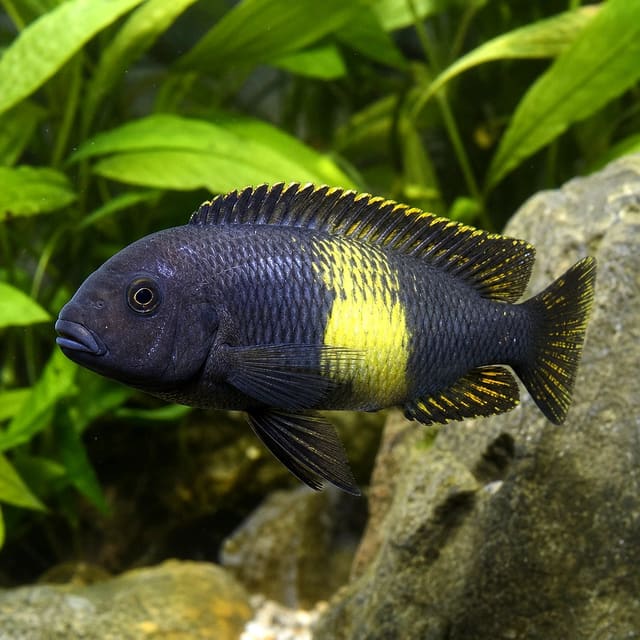
Ophthalmotilapia boops 'Neon Stripe' Nkondwe is a Lake Tanganyika featherfin cichlid sold under the Nkondwe 'Neon Stripe' trade name, known in mature males for a dark body, a bright blue lateral mark and elongated pelvic fins. Quantity 1 buys one unsexed fish in the size selected above; it is not a guaranteed male, female or pair. Juveniles and females are usually much plainer than a displaying adult male.
This is a specialist Tanganyika cichlid for an established, hard-water aquarium. Plan around a mature aquarium of about 300 litres or more with at least a 120 cm swimming length for a one-male social group. A substantially larger aquarium, around 400 litres or more, is the safer starting point if more than one mature male is intended. Fine sand, open swimming room, stable alkaline water and carefully chosen tank mates are essential.
| Accepted scientific name | Ophthalmotilapia boops (Boulenger, 1901) |
|---|---|
| Trade/locality name | 'Neon Stripe' or 'Neon Streak', associated with the Nkondwe Island form |
| What one quantity buys | One unsexed fish in the selected dispatch-size variant |
| Adult size | Up to about 15 cm total length; females are commonly smaller, around 12 cm |
| Aquarium | About 300 L+ and 120 cm+ long for a one-male group; around 400 L+ if multiple males are deliberately planned |
| Temperature | 24–26°C as a practical target; keep it stable |
| Water | Hard, alkaline water; pH 8.0–9.0, with regular GH and KH testing |
| Social plan | Usually one mature male with several females; males can be strongly territorial |
| Diet | Small varied foods reflecting an aufwuchs- and plankton-feeding omnivore |
| Experience level | Best for an aquarist already comfortable with Tanganyika water chemistry and cichlid social behaviour |
The accepted genus spelling is Ophthalmotilapia. 'Opthalmotilapia' is a common trade misspelling. Eschmeyer's Catalog of Fishes records Ophthalmotilapia boops as the valid name and lists the original combination Tilapia boops.
The species is endemic to Lake Tanganyika and is recorded along the Tanzanian shore. The 'Neon Stripe' trade name is associated in specialist literature with the Nkondwe Island form, whose mature males may develop a blue stripe extending towards the tail. A trade name alone does not prove that the fish offered here was wild-collected at Nkondwe or belongs to a documented pure-locality line, so this listing makes neither claim.
Mature males can become dark brown to velvet black, with blue markings and long pelvic fins ending in yellow lappets used during courtship. Females and juveniles are generally silver-grey and have shorter fins. Colour changes with age, sex, hierarchy, stress and breeding condition, so the dispatch fish may look very different from a dominant adult male.
The gallery image on this page is a representative aquarium image, not a photograph of the individual fish that will be dispatched. Use the selected size as the reliable purchase detail; exact colour, sex and markings are not guaranteed.
Footprint matters as much as litres. This is an active cichlid and a mature male may defend a broad spawning territory. A long aquarium gives subordinate fish somewhere to move away from displays and lets the aquarist separate open swimming space from rock cover. For a one-male group, start at roughly 300 litres and 120 cm in length. Multiple mature males need a larger, deliberately planned aquarium, around 400 litres or more, with enough area to form separate territories.
A tank-volume calculation can confirm the real water volume after substrate and rock displacement. Do not use the nominal tank label alone when deciding whether the aquarium can support a group.
Keep the aquarium hard, alkaline and exceptionally stable. A practical temperature target is 24–26°C with pH 8.0–9.0. OATA's general African lake guidance gives hard water around 12–18°dGH and 10–15°dKH; the exact value matters less than providing suitable mineral content and avoiding abrupt swings. Check both GH and KH rather than relying on pH alone.
Ammonia and nitrite must remain at zero. Keep nitrate low through sensible stocking, restrained feeding and regular partial water changes; OATA recommends at least a weekly 25% change as a general starting point. Match the replacement water for temperature and chemistry, and condition tap water before it enters the aquarium. Our water-chemistry guide explains pH, GH and KH if these measurements are new to you.
Do not make large, rapid additions of buffer simply to reach a headline pH. Test the source water, raise mineral content gradually when needed and keep a record of results. A stable, appropriately hard aquarium is safer than repeated sharp corrections.
This is not a general community fish. Mature males can be strongly territorial towards their own species, especially around a sand nest. A typical plan is one male with several females, but the fish offered here are unsexed and a requested sex ratio cannot be guaranteed. If a group is purchased young, the keeper must be ready to identify maturing males and move fish if aggression develops.
Reports differ on how forceful this species is compared with related featherfins, but the practical conclusion is consistent: give it plenty of space and do not make it the weakest fish in an aggressive cichlid community. At the same time, avoid highly combative tank mates that can suppress feeding and display behaviour.
| Potentially suitable with careful planning | Usually unsuitable or high risk |
|---|---|
| Calmer Lake Tanganyika cichlids that need the same hard, alkaline water | Soft-water community fish |
| Species occupying different territories in a sufficiently large aquarium | Highly aggressive Malawi mbuna or similarly relentless cichlids |
| Robust fish that will not bully or outcompete the featherfins | Very small, timid or slow-feeding fish |
| Carefully chosen Tanganyikan catfish where floor space and spawning sites remain adequate | Related Ophthalmotilapia forms where hybridisation or uncertain lineage would be a concern |
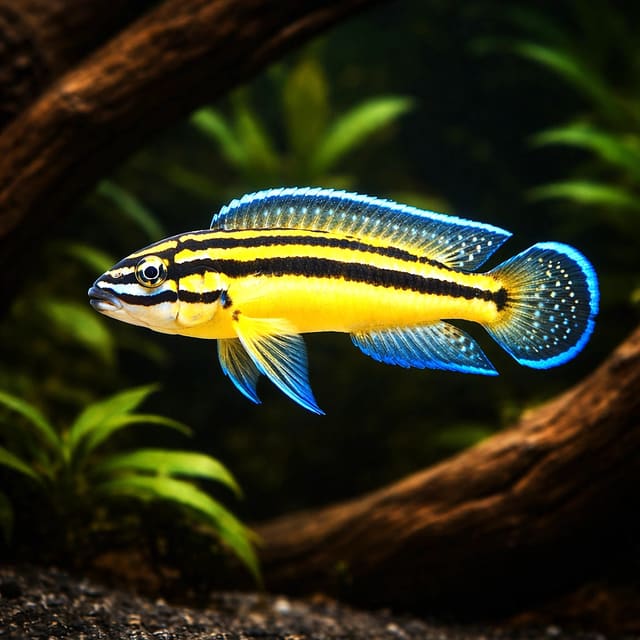
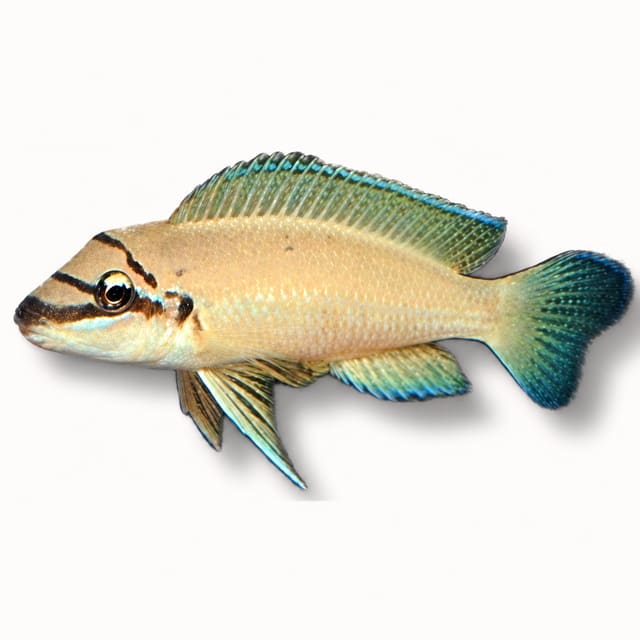
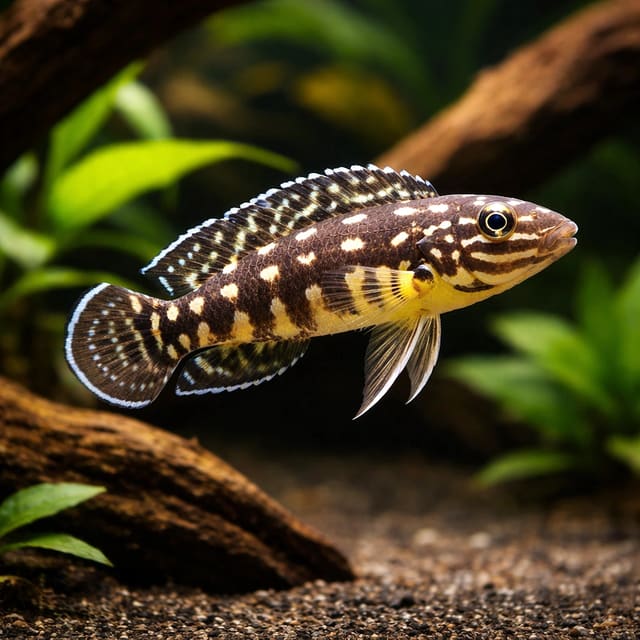
Every proposed combination still depends on aquarium dimensions, group sizes, sex ratio and individual behaviour. Compare the care requirements of Ophthalmotilapia ventralis Kambwimba, Blue Neon Paracyprichromis and Marlier's Julie as related Tanganyika examples, not as automatic tank-mate approvals.
Wild records describe plankton feeding, while specialist observations also report grazing aufwuchs: algae, diatoms and the small organisms living among them. In the aquarium, use a varied diet of appropriately sized quality cichlid granules or flakes, with some algae or spirulina content, supplemented by small frozen or live foods such as Cyclops, Daphnia or Artemia.
Offer modest portions that are eaten promptly, normally once or twice daily according to fish size and condition. Avoid making rich, high-fat or heavy animal-protein foods the staple. Watch that subordinate fish receive food without having to cross a dominant male's territory, and remove uneaten food before it affects water quality.
Ophthalmotilapia boops is a maternal mouthbrooder. A territorial male prepares and defends a sand nest, often associated with a flat rock, and displays the yellow lappets at the ends of his elongated pelvic fins. After spawning, the female carries the developing eggs and fry in her mouth without help from the male.
Breeding behaviour can intensify aggression. Provide visual breaks and a route away from the male's territory, and monitor a holding female so she is not repeatedly harassed. The sale of an unsexed fish does not promise a future breeding pair.
Add this fish only to a mature aquarium with stable temperature, pH, GH and KH. Before opening the box, test the aquarium and make sure ammonia and nitrite are zero. Keep the lights low during introduction, follow the acclimation instructions supplied with the order and observe breathing, posture and feeding closely during the first week.
Live fish are packed in oxygen-filled bags inside an insulated box, with a heat pack when conditions require it, and travel on a tracked service with a licensed live-animal courier. Read the full delivery and Live Arrival Guarantee terms before ordering, including the requirement for someone to receive the parcel and the same-day evidence needed if there is a problem.
Ophthalmotilapia boops is the accepted scientific spelling. 'Opthalmotilapia' is a common trade misspelling that may still appear in historical catalogues, but it is not the accepted genus name.
No. One quantity buys one unsexed fish in the selected size. The listing does not guarantee sex, a bonded pair or adult male colour.
FishBase records a maximum of about 15 cm total length. Mature females are commonly smaller, around 12 cm, while males develop the more extended pelvic fins.
A tank around that volume can reach the minimum footprint quoted by some experienced keepers, but it leaves limited margin for a social group and territorial behaviour. This page recommends about 300 litres and at least 120 cm length for a one-male group, with more space when keeping multiple males.
Not necessarily. Juveniles and females are generally silver-grey, and the intense dark-and-blue pattern is associated mainly with mature displaying males. Colour and sex are not guaranteed at dispatch.
Use small quality cichlid foods with some algae or spirulina content, supported by modest portions of Cyclops, Daphnia, Artemia or similar small invertebrate foods. Variety and portion control are more useful than a rich protein-heavy diet.
No reviews for this item yet. Bought one? Honest reviews only, good or bad.
What customers say about ordering from us
Easy website plenty of info on fish your buying great to pick a time slot
TRACEY DURRANT · 7 Oct 2026
Got some lovely fish thank you
Kevin Mackie · 7 Oct 2026
Reviews of our shop, collected by Judge.me, an independent third-party review collector. Newest first.