Moderate
Blue Agassiz’s Dwarf Cichlid (Apistogramma agassizii)
24–27°C · pH 5.5–7 · 75L
£15.99

A striking, compact dwarf cichlid with subtle blue facial markings and engaging behavior, ideal for a peaceful South American biotope setup. Moderate care, semi-aggressive. 24-28C, pH 5.0-7.0.
Adult size is the maximum length this species reaches at full maturity (scientific sources). The livestock you receive will be younger and smaller — pick a size above for the actual shipping size. Product-photo provenance and any image-specific limitations are stated on the listing.
Apistogramma eunotus
Save when buying multiple fish. Each quantity is one fish; sex and pair formation are not guaranteed unless the selected variant explicitly states them.
Confirm your email, then we’ll send an availability message for this exact item if it returns within 180 days.
This request is only for this product—no newsletter or other promotions. A mail-provider retry may very rarely duplicate the same availability message. Unconfirmed addresses are removed after 48 hours. See our privacy policy.
A striking, compact dwarf cichlid with subtle blue facial markings and engaging behavior, ideal for a peaceful South American biotope setup. Moderate care, semi-aggressive. 24-28C, pH 5.0-7.0.
Adult size is the maximum length this species reaches at full maturity (scientific sources). The livestock you receive will be younger and smaller — pick a size above for the actual shipping size. Product-photo provenance and any image-specific limitations are stated on the listing.

Cichlids are a family of roughly 1,800 accepted species, not one care type. Before buying, identify the exact species and source, then compare adult measurement, usable tank dimensions, social system, territory, tested water, diet and an exit plan. No family-wide minimum tank, water range or tank-mate list is safe.
Maintain these water conditions for optimal health and vibrant colors
The Blue Cheek Dwarf Cichlid (Apistogramma eunotus) is a striking and compact South American dwarf cichlid native to blackwater and clearwater tributaries of the Amazon Basin, particularly in Peru. This beautiful species is renowned for its subtle blue facial markings, engaging behaviour, and fascinating breeding biology. Available for sale UK from specialist retailers like Tropical Fish Co, this freshwater fish for sale UK is ideal for planted aquarium fish setups and peaceful biotope aquariums.
Reaching just 4cm in adult size, the Blue Cheek Dwarf Cichlid is perfectly scaled for smaller aquariums where their intricate behaviours and subtle beauty can be fully appreciated. Males develop impressive finnage and enhanced coloration during breeding, while females provide intensive parental care that's fascinating to observe. This apistogramma for sale UK thrives in soft, acidic water and is best suited to intermediate fishkeepers who can maintain stable water parameters and provide appropriate tankmates.
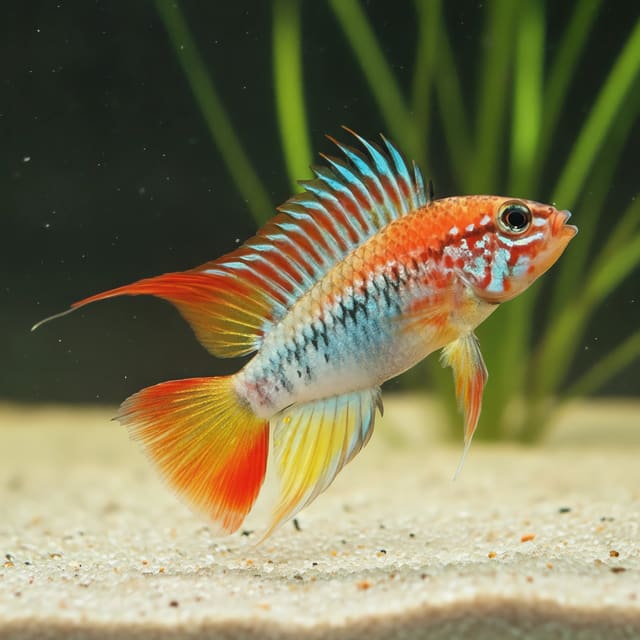
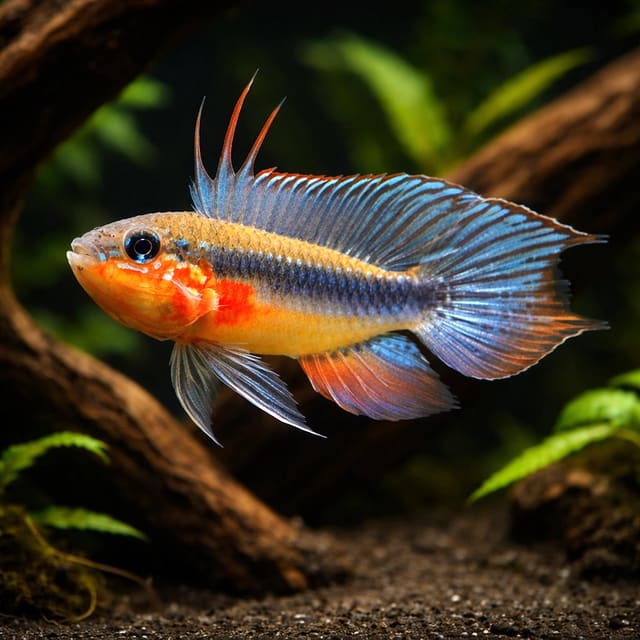
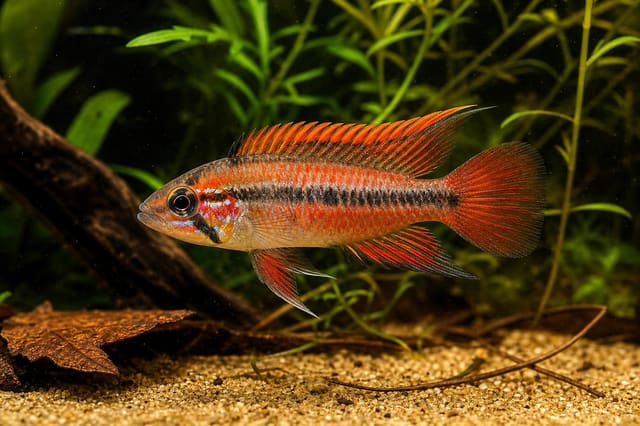
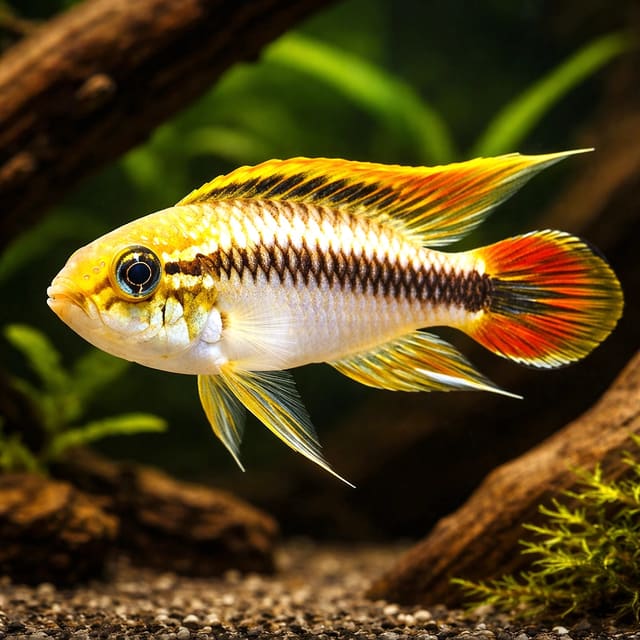
Apistogramma eunotus displays elegant proportions typical of smaller Apistogramma species, with a streamlined body, proportionally large eyes, and delicate finnage. The species is named for the distinctive blue or turquoise markings on the cheeks and gill covers that give it its common name. Males develop more intense coloration during breeding, showing golden-yellow to orange body colours overlaid with electric blue highlights on the face and anterior body.
Extended dorsal and caudal fins in males feature red or orange edging, particularly prominent during courtship displays. The body is marked with subtle horizontal striping and iridescent scales that catch light beautifully under subdued aquarium lighting. Females are smaller and more modestly coloured, typically displaying yellow-brown base tones with darker markings.
When in breeding condition, females develop intense yellow coloration, particularly around the head and belly regions, signalling their readiness to spawn. At 4cm adult size, these dwarf apistogramma are ideally suited to nano and medium-sized aquariums where their subtle beauty and fascinating behaviours can be appreciated up close.
Apistogramma eunotus inhabits slow-moving blackwater and clearwater tributaries and small forest streams throughout the Amazon Basin in South America, with particular concentration in Peru and adjacent regions. These environments are characterised by extremely soft, acidic water with pH often dropping below 6.0, heavily stained with tannins from decomposing organic matter.
The substrate consists of fine sand or silt covered with thick accumulations of fallen leaves, submerged branches, and extensive root systems from overhanging rainforest vegetation. Water movement is minimal, with temperatures remaining consistently warm throughout the year between 24-28°C. Dense overhead canopy creates deeply shaded conditions, resulting in dim lighting that these fish have evolved to thrive in.
During the wet season, fish may move into flooded forest areas where they forage among leaf litter and submerged vegetation for small invertebrates, insect larvae, and microorganisms. These seasonal habitat expansions provide abundant food resources and spawning opportunities. Replicating these conditions as closely as possible in the aquarium ensures optimal health, natural behaviours, and breeding success.
A minimum 75-litre aquarium is recommended for a pair or small harem group of Apistogramma eunotus, with larger tanks of 100+ litres suitable for community setups with compatible tankmates. The aquarium should authentically replicate blackwater biotope conditions with fine sand substrate, extensive driftwood arrangements creating sheltered areas, and generous quantities of leaf litter covering portions of the tank floor.
Indian almond leaves, oak leaves, or beech leaves are ideal additions, releasing beneficial tannins that stain the water a natural tea colour while providing hiding places and grazing surfaces for beneficial microorganisms. Dense planting around the perimeter and back of the aquarium is essential—use soft-water adapted species including Cryptocoryne varieties, Java Fern, Anubias, and floating plants such as Amazon Frogbit to diffuse lighting and create security.
Leave open sandy areas in the foreground where fish can display, forage, and establish territories. Subdued lighting is crucial; aim for dim, dappled conditions similar to their shaded forest stream habitat, achieved through floating plants or dimmed fixtures. Provide multiple small caves or sheltered spawning sites using coconut shells, small terracotta pots, slate arrangements, or driftwood hollows positioned throughout the lower levels of the tank.
Filtration should be efficient but gentle—sponge filters work excellently in smaller tanks, while canister filters with spray bar output suit larger setups. Avoid strong currents that will stress these fish. Perform weekly water changes of 20-30% with soft, temperature-matched, dechlorinated water to maintain pristine conditions essential for health.
Apistogramma eunotus is a carnivore requiring a varied, protein-rich diet to maintain optimal health, the distinctive blue cheek coloration, and breeding condition. Quality micro-pellets formulated specifically for carnivorous dwarf cichlids should form the dietary base, supplemented regularly with frozen and live foods including daphnia, brine shrimp, bloodworms, mosquito larvae, and other small insect larvae.
Live foods are particularly valuable for conditioning breeding pairs and enhancing the vibrant colours males display during courtship. Live cultures of blackworms, grindal worms, micro worms, white worms, and freshly hatched brine shrimp are enthusiastically accepted and provide excellent nutrition. Frozen alternatives should be thoroughly thawed and rinsed before feeding to remove preservatives and excess nutrients.
Feed small portions 2-3 times daily, offering only what can be consumed within 2-3 minutes to prevent water quality degradation. During breeding periods, increase feeding frequency to 3-4 times daily with varied protein sources to support egg production and the energy demands of parental care. Avoid overfeeding and remove any uneaten food promptly, as the soft, acidic water conditions these fish require can deteriorate quickly with excess organic waste.
The Blue Cheek Dwarf Cichlid exhibits fascinating cichlid behaviours including territoriality, elaborate courtship rituals, and intensive parental care, all compressed into a compact 4cm package. Males establish and defend small territories centred around preferred caves or sheltered areas, particularly during breeding periods. Their semi-aggressive temperament is primarily directed at rival males rather than other species, though breeding pairs will defend their spawning area vigorously.
Females are more peaceful and secretive outside breeding periods, often remaining hidden among plants and leaf litter until they feel secure. Once established, females become more confident, exploring the aquarium and interacting with males during courtship. Males perform spectacular displays to attract females and warn rivals, including fin-spreading, body-tilting, rapid colour intensification, and gentle herding of females toward selected spawning sites.
These fish spend most time in the lower third of the aquarium, investigating caves, sifting through leaf litter for food particles, and patrolling established territories. They're moderately active but greatly appreciate calm environments without excessive water movement, bright lighting, or boisterous tankmates that cause stress. Best kept as a male with 2-3 females in tanks of 100+ litres, or as a proven pair in smaller species setups of 75 litres.
Top Tip: Create optimal breeding conditions by performing a series of cool water changes (22-23°C) over 2 weeks, then gradually increasing temperature to 26-27°C while maintaining soft water (pH 5.5-6.0). This mimics the seasonal transition from dry to wet season in their natural habitat and often triggers spawning behaviour within days.
Apistogramma eunotus is compatible with small peaceful tetras including Cardinal Tetras, Rummy Nose Tetras, Green Neon Tetras, and Ember Tetras that occupy mid-to-upper water layers without competing for territory. Small rasboras such as Harlequin Rasboras, Lambchop Rasboras, or Chili Rasboras are suitable, as are peaceful dwarf pencilfish species including Nannostomus marginatus or N. eques.
Corydoras catfish make excellent bottom-dwelling companions, sharing similar soft-water requirements and occupying different ecological niches. Choose smaller species like C. habrosus, C. pygmaeus, or C. hastatus for best compatibility. Otocinclus catfish are ideal for planted tanks, grazing on algae and biofilm without interfering with the Apistogramma. Small peaceful livebearers may work in larger, well-planted tanks, though their preference for harder water makes them less ideal.
Avoid large aggressive cichlids that will stress or prey upon these small fish, fin-nipping barbs such as Tiger Barbs or Serpae Tetras, fast boisterous community fish like Danios that create constant disturbance, very small fry or shrimp that may be eaten, and other territorial bottom-dwelling cichlids in cramped tanks where territories will overlap. Multiple male Apistogramma require tanks of 150+ litres with ample visual barriers to prevent constant confrontation.
Apistogramma eunotus is a cave spawner best bred in soft, acidic water with pH 5.0-6.5, very low hardness (0-3 dGH), and temperature around 26-27°C. Condition pairs on varied, high-quality foods including abundant live and frozen options for 2-3 weeks before attempting to spawn. Provide multiple small caves, extensive leaf litter, subdued lighting, and excellent water quality to encourage natural breeding behaviour.
Females select a suitable cave—often the smallest, most sheltered option available—and spend considerable time cleaning the interior surfaces before spawning. Males court females persistently with elaborate displays, spreading fins to maximum extension and performing body undulations. Once the female is receptive, spawning occurs inside the chosen cave, with 50-100 small eggs laid on the ceiling or walls.
The female provides all direct brood care, guarding eggs with extraordinary intensity and fanning them continuously to ensure oxygenation and prevent fungal growth. Males defend the broader territory but should not enter the spawning cave; if the male harasses the brooding female excessively, consider removing him temporarily. Eggs hatch in 2-3 days at 26°C, and fry become free-swimming after 5-7 days.
The female shepherds fry closely, moving them to different locations if threats are perceived and defending them fiercely. Initial fry foods include infusoria, liquid fry food, and microworms, progressing to newly hatched brine shrimp after 4-5 days. Maintain pristine water quality with gentle daily water changes of 10-15% using very soft, temperature-matched water. Parents may consume fry if stressed, so minimize disturbance and provide ample cover during the critical first two weeks.
When you buy freshwater tropical fish online from Tropical Fish Co, you're choosing a specialist retailer committed to providing healthy, carefully selected livestock. Our Apistogramma eunotus specimens are quarantined, fully acclimatised to UK water conditions, and feeding confidently on varied foods before dispatch. Each fish is individually inspected to ensure excellent health, proper coloration, and overall quality.
We provide expert guidance on dwarf cichlid tank mates, Apistogramma tank mates selection, water parameter management specific to soft-water species, and detailed tank setup advice for South American biotope aquariums. Fast, secure delivery throughout the UK ensures your rare tropical fish UK arrive safely with minimal stress, carefully packaged to maintain stable temperatures during transit. Our dedicated customer support team is always available to answer questions about feeding, breeding, and long-term care of your Blue Cheek Dwarf Cichlid. All livestock is backed by our comprehensive health guarantee, giving you complete confidence when you purchase from Tropical Fish Co.
No reviews for this item yet. Bought one? Honest reviews only, good or bad.
What customers say about ordering from us
I have a small group of long finned mountain minnows. So was delighted to be able to order ten of this variety to increase the genetics in my tank . The ones I recieved are healthy but it’s to early to give a verdict on wether they are of a long finned type since they are small currently.
Gordon Walker · 23 Sept 2026
100% success travel and "installation". Pleased with quality of purchase. The Siamese fighter a bit "shy" so have not yet seen him at his best yet but looking good. Happy customer. GG
George E Garratt · 21 Sept 2026
Reviews of our shop, collected by Judge.me, an independent third-party review collector. Newest first.