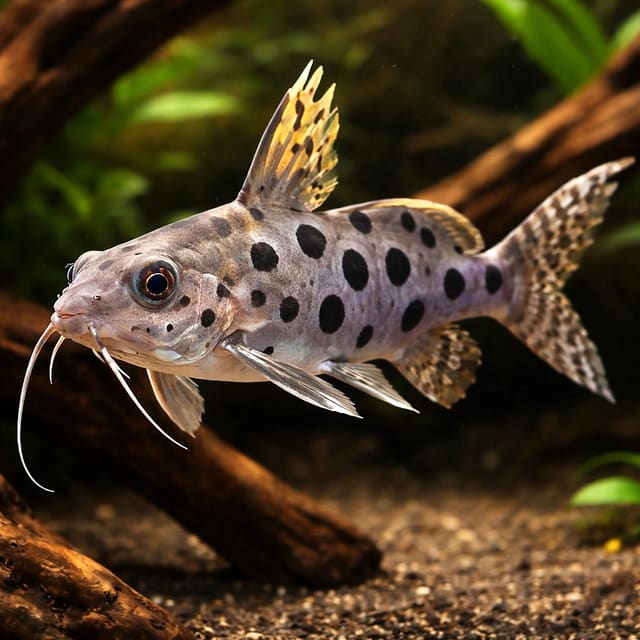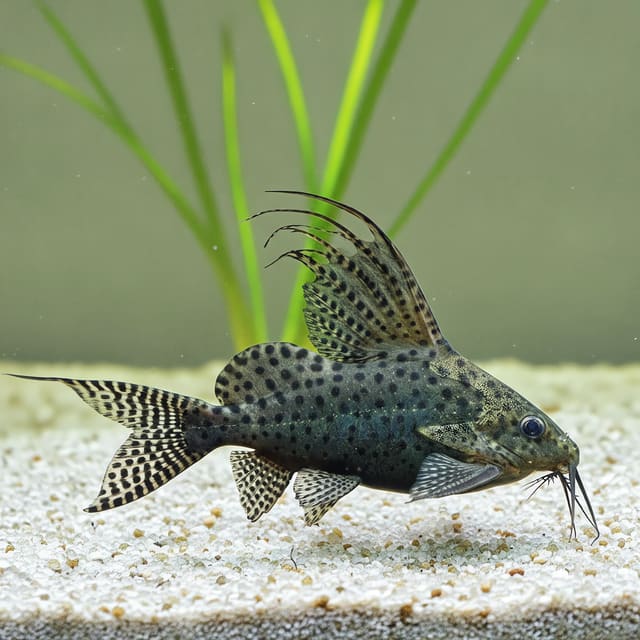
Featherfin Synodontis (Synodontis eupterus)
22–26°C · pH 6.2–7.5
£6.99

A hardy, nocturnal Lake Tanganyika catfish with striking granular texture and fascinating upside-down behavior. Moderate care, peaceful. 24-27C, pH 7.8-9.0.
Adult size is the maximum length this species reaches at full maturity (scientific sources). The livestock you receive will be younger and smaller. Product-photo provenance and any image-specific limitations are stated on the listing.
Synodontis granulosus
Shoaling fish: kept in a group they feel safer, stay calmer and show their best colour.
Confirm your email, then we’ll send an availability message for this exact item if it returns within 180 days.
This request is only for this product—no newsletter or other promotions. A mail-provider retry may very rarely duplicate the same availability message. Unconfirmed addresses are removed after 48 hours. See our privacy policy.
A hardy, nocturnal Lake Tanganyika catfish with striking granular texture and fascinating upside-down behavior. Moderate care, peaceful. 24-27C, pH 7.8-9.0.
Adult size is the maximum length this species reaches at full maturity (scientific sources). The livestock you receive will be younger and smaller. Product-photo provenance and any image-specific limitations are stated on the listing.
Maintain these water conditions for optimal health and vibrant colors
Synodontis granulosus is a striking Lake Tanganyika catfish renowned for its distinctive granular body texture and fascinating upside-down swimming behaviour. This hardy endemic species brings the unique character of African Rift Lake cichlid communities to specialized aquariums, available for sale UK through Tropical Fish Co. Reaching just 3.5cm at maturity, it ranks among the smaller Synodontis species, making it suitable for moderate-sized tanks with appropriate hard, alkaline water chemistry. The species' nocturnal habits and peaceful disposition make it an excellent choice for aquarists seeking to diversify Tanganyikan biotope aquariums beyond cichlids.
The most striking feature of Synodontis granulosus is the granulated or tuberculated texture that covers much of the body, giving this species its scientific name. These raised bumps create a rough surface that distinguishes it from smooth-bodied catfish and likely serves as sensory function or defensive adaptation. Base coloration ranges from grey-brown to darker charcoal, often with lighter ventral regions and irregular mottling that provides camouflage against rocky substrates. The adipose fin is prominent, and three pairs of barbels extend from the mouth region—maxillary barbels are notably long and highly sensitive. As with most Synodontis, sharp locking spines arm the dorsal and pectoral fins, producing the characteristic "squeaking" sound when manipulated.
Synodontis granulosus is endemic to Lake Tanganyika, occurring throughout much of the lake's extent across Democratic Republic of Congo, Burundi, Zambia, and Tanzania. This ancient rift lake features extremely stable, hard, alkaline water chemistry—quite different from typical tropical aquarium parameters. The species inhabits rocky shorelines and intermediate depth zones (5-20 meters) where crevices and caves provide daytime retreats from both predators and intense equatorial sunlight. The lake's substrate consists of rocks, shells, and sand, with minimal vegetation except algae covering stone surfaces. Water is exceptionally clear with high mineral content and excellent oxygenation from the lake's vast surface area and wind-driven circulation.
Replicate Lake Tanganyika conditions with a minimum 60-litre aquarium, though larger is always preferable. Build extensive rockwork structures creating multiple caves, crevices, and territories using inert rocks such as limestone, tufa, or ocean rock that won't leach harmful substances. Substrate should be fine sand or crushed coral that supports the required alkaline pH. Avoid driftwood and botanical materials that acidify water—these are inappropriate for Rift Lake biotopes. Lighting can be moderate to bright, as the species will retreat during daylight regardless. Filtration must be robust with excellent oxygenation; powerheads or wavemakers can create gentle water movement mimicking lake circulation. Hardy plants tolerant of hard water such as Anubias or Vallisneria can be included but aren't essential.
Lake Tanganyika species require specific water chemistry quite different from standard tropical setups. Maintain temperature between 24-27°C—avoid exceeding 27°C as oxygen solubility decreases with temperature. The pH must be alkaline: 7.8-9.0, with 8.0-8.5 being ideal. Hardness should be correspondingly high (10-20 dGH or higher) to replicate the lake's mineral-rich water. Ammonia and nitrite must remain at zero, whilst nitrates should be kept below 20ppm through regular 25% weekly water changes with appropriately conditioned replacement water. Excellent oxygenation is crucial—use powerheads or airstones to maintain dissolved oxygen near saturation. Buffer capacity should be high to prevent pH crashes; crushed coral substrate and Rift Lake salt mixes help stabilize chemistry.
Synodontis granulosus is an opportunistic omnivore that naturally feeds on invertebrates, insect larvae, small crustaceans, and organic detritus. In captivity, provide a varied sinking diet as the foundation: high-quality catfish pellets or omnivore wafers fed daily, supplemented 3-4 times weekly with frozen or live foods including bloodworms, mysis shrimp, brine shrimp, and chopped crustaceans. Occasional plant matter such as spirulina-based foods or blanched vegetables provides dietary balance. Feed during evening hours to accommodate nocturnal habits—target feeding near their cave retreats ensures they receive adequate nutrition without excessive competition from diurnal cichlids. Avoid overfeeding, as decomposing food rapidly degrades water quality in alkaline environments.
This peaceful catfish exhibits the classic inverted swimming posture that characterizes many Synodontis, particularly when grazing algae from the underside of rocks or cave ceilings. The species is predominantly nocturnal, remaining hidden during bright hours and emerging at dusk to forage across rocky territories. They are non-aggressive and rarely display territorial behaviour, making them suitable for community Lake Tanganyika setups. The characteristic squeaking or croaking sounds produced by pectoral spine articulation can occasionally be heard, particularly when stressed or during competitive interactions. Activity peaks during feeding time and throughout the night, when they patrol substrate and rockwork searching for food particles.
Synodontis granulosus thrives alongside other Lake Tanganyika fish of appropriate size and temperament. Suitable companions include small to medium peaceful cichlids such as Neolamprologus multifasciatus, N. brevis, or Julidochromis species that occupy rocky territories without excessive aggression. Other Synodontis species of similar size can coexist provided the aquarium offers adequate floor space and hiding places. Avoid keeping with very small fish under 2cm that might be consumed during nocturnal hunting. Exclude highly aggressive territorial cichlids that might trap and harass the catfish in caves, and avoid soft-water species that cannot tolerate the required alkaline chemistry.
Captive breeding of Synodontis granulosus is uncommon and challenging, with limited documentation of successful spawning in home aquaria. Sexual dimorphism is subtle, though mature females may appear slightly more robust when gravid. Breeding likely requires a large mature aquarium, excellent water quality, and careful conditioning with protein-rich live foods. Spawning behaviour is not well-documented for this specific species, though some Synodontis practice mouthbrooding or even brood parasitism with cichlids. If spawning occurs, eggs and fry are vulnerable to predation and may require removal to separate rearing tanks. Fry would initially require microscopic live foods before accepting larger fare such as newly hatched brine shrimp and microworms.
Tropical Fish Co supplies healthy, quarantined Synodontis granulosus that have been carefully acclimated to appropriate water chemistry and are feeding confidently on prepared diets. Each catfish is hand-selected for vitality, proper body condition, and characteristic granular texture, ensuring you receive robust specimens ready to thrive in Rift Lake aquariums. Our specialist knowledge of Lake Tanganyika species means we can provide expert guidance on water chemistry, compatible tankmates, and long-term care. With premium packaging and tracked UK delivery, your new catfish arrive safely in peak condition. We're committed to sustainable sourcing and ethical fishkeeping, working only with responsible suppliers who prioritize fish welfare and conservation of threatened lake ecosystems.
No reviews for this item yet. Bought one? Honest reviews only, good or bad.
What customers say about ordering from us
I have a small group of long finned mountain minnows. So was delighted to be able to order ten of this variety to increase the genetics in my tank . The ones I recieved are healthy but it’s to early to give a verdict on wether they are of a long finned type since they are small currently.
Gordon Walker · 23 Sept 2026
100% success travel and "installation". Pleased with quality of purchase. The Siamese fighter a bit "shy" so have not yet seen him at his best yet but looking good. Happy customer. GG
George E Garratt · 21 Sept 2026
Reviews of our shop, collected by Judge.me, an independent third-party review collector. Newest first.