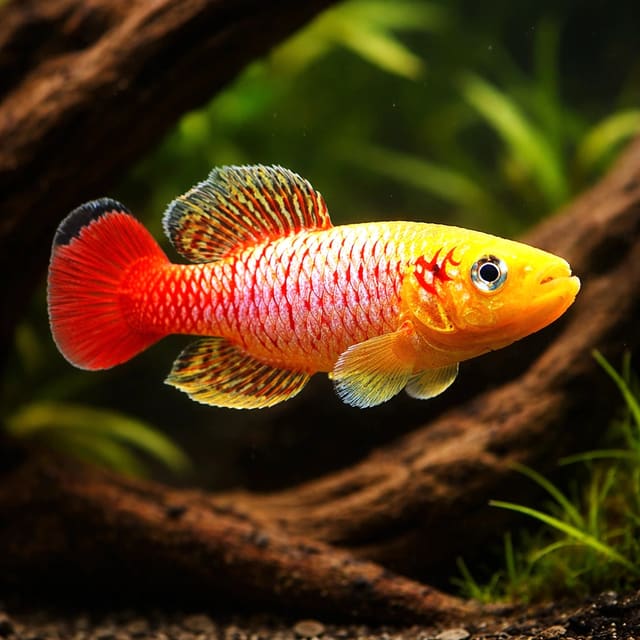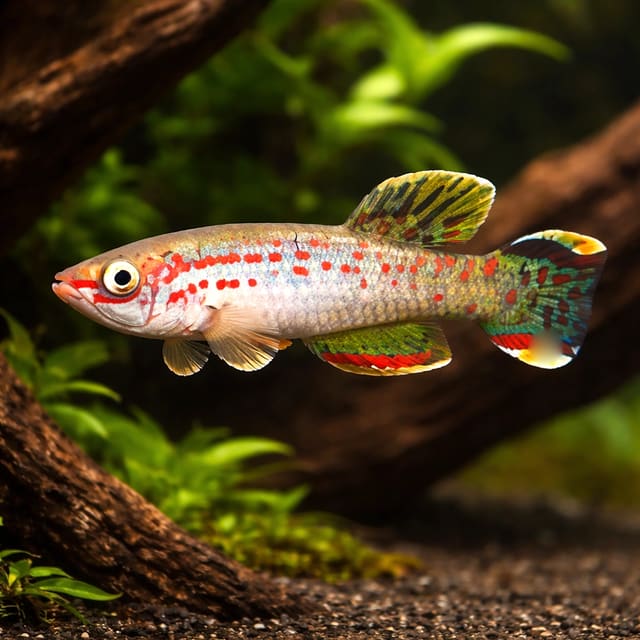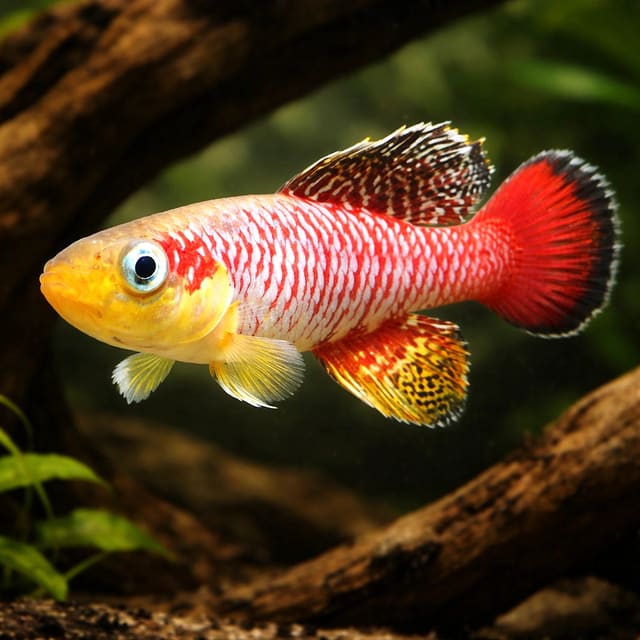
Gunther's Nothobranch (Nothobranchius guentheri)
22–25°C · pH 6–7
£11.99

A stunning, short-lived annual killifish with brilliant color forms and fascinating egg-incubation breeding behavior. Difficult care, semi-aggressive. 22-26C, pH 6.0-7.5.
Adult size is the maximum length this species reaches at full maturity (scientific sources). The livestock you receive will be younger and smaller. Product-photo provenance and any image-specific limitations are stated on the listing.
Nothobranchius eggersi
Save when buying multiple fish. Each quantity is one fish; sex and pair formation are not guaranteed unless the selected variant explicitly states them.
Confirm your email, then we’ll send an availability message for this exact item if it returns within 180 days.
This request is only for this product—no newsletter or other promotions. A mail-provider retry may very rarely duplicate the same availability message. Unconfirmed addresses are removed after 48 hours. See our privacy policy.
A stunning, short-lived annual killifish with brilliant color forms and fascinating egg-incubation breeding behavior. Difficult care, semi-aggressive. 22-26C, pH 6.0-7.5.
Adult size is the maximum length this species reaches at full maturity (scientific sources). The livestock you receive will be younger and smaller. Product-photo provenance and any image-specific limitations are stated on the listing.
Maintain these water conditions for optimal health and vibrant colors
Brilliantly coloured and famously short-lived, Egersi's Notobranch (Nothobranchius egersi) is an annual killifish for the specialist. It reaches just 3.5cm and lives roughly a single season - around a year - which is part of what makes it such an absorbing fish for keepers drawn to its extraordinary life cycle and intense colour.
This is a difficult-level species that asks for understanding rather than gadgetry. It lives in the middle region of soft to moderately hard, slightly acidic to neutral water and feeds as a carnivore on small live and frozen foods. Stability and cleanliness count for a great deal with annuals, and its breeding revolves around eggs that go through an incubation period - a fascinating but demanding process.
Semi-aggressive and prone to becoming territorial, it is at its best in a dedicated, carefully managed setup rather than a general community tank.
An annual killifish rewards a keeper who works with its biology rather than against it. A 40-litre or larger tank, carefully managed and kept clean, suits it best, with the water held between 22 and 26°C, a pH of 6.0 to 7.5 and hardness from 5 to 15 dGH. Stability matters enormously, and the difficult-care rating reflects how unforgiving these fish are of slipping water quality.
As a carnivore it depends on small live and frozen foods to fuel its fast, intense life. Its breeding centres on eggs that pass through an incubation period, a remarkable process that defines the annual lifestyle and is much of the reason specialists find this fish so compelling despite a lifespan of only about a year.
It is best kept in a species-only setup; if tank mates are used at all, restrict them to very small, peaceful species in a carefully planned tank. Avoid large or boisterous fish, fin-nippers, fast competitive feeders, aggressive cichlids, most shrimp and very small invertebrates, and community fish that need long-term stable mixed-species tanks. This fish is dispatched via a licensed live-animal courier, protected by our live arrival guarantee.
No reviews for this item yet. Bought one? Honest reviews only, good or bad.
What customers say about ordering from us
I have a small group of long finned mountain minnows. So was delighted to be able to order ten of this variety to increase the genetics in my tank . The ones I recieved are healthy but it’s to early to give a verdict on wether they are of a long finned type since they are small currently.
Gordon Walker · 23 Sept 2026
100% success travel and "installation". Pleased with quality of purchase. The Siamese fighter a bit "shy" so have not yet seen him at his best yet but looking good. Happy customer. GG
George E Garratt · 21 Sept 2026
Reviews of our shop, collected by Judge.me, an independent third-party review collector. Newest first.