Advanced
Gunther's Zanzibar Gold Nothobranch (Nothobranchius guentheri)
22–25°C · pH 6–7
£10.99

Endangered Brazilian annual killifish supplied 3-4 cm. Best for expert keepers in a covered species setup at 20-24 C with soft, clean water and live/frozen foods.
Adult size is the maximum length this species reaches at full maturity (scientific sources). The livestock you receive will be younger and smaller. Product-photo provenance and any image-specific limitations are stated on the listing.
Simpsonichthys boitonei
Save when buying multiple fish. Each quantity is one fish; sex and pair formation are not guaranteed unless the selected variant explicitly states them.
Confirm your email, then we’ll send an availability message for this exact item if it returns within 180 days.
This request is only for this product—no newsletter or other promotions. A mail-provider retry may very rarely duplicate the same availability message. Unconfirmed addresses are removed after 48 hours. See our privacy policy.
Endangered Brazilian annual killifish supplied 3-4 cm. Best for expert keepers in a covered species setup at 20-24 C with soft, clean water and live/frozen foods.
Adult size is the maximum length this species reaches at full maturity (scientific sources). The livestock you receive will be younger and smaller. Product-photo provenance and any image-specific limitations are stated on the listing.
Maintain these water conditions for optimal health and vibrant colors
The older Cynolebias name is kept here as supplier and hobby-search context, because many aquarists still meet this fish under that label.
This is a specialist Brazilian annual killifish, not a routine community-tank filler. It is supplied at 3-4 cm and should be planned as a compact, covered species setup with soft, clean water, gentle flow and small live or frozen foods. FishBase gives the adult planning size at around 5.5 cm total length, while our stock records list up to about 6 cm, so the supplied fish are juveniles or young adults rather than the full adult size.
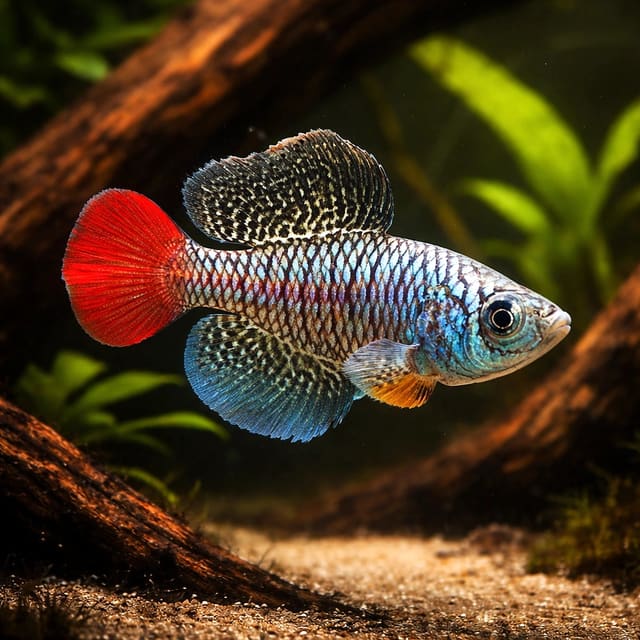
The original reference image for this SKU shows the fish as a compact, deep-bodied annual killifish with a wine-red to maroon body, many pale blue-white pearly spots, darker unpaired fins and a clear lyretail outline. The dorsal and caudal fins carry pale edging and spotted patterning, giving the male a high-contrast look even against a simple source-photo background.
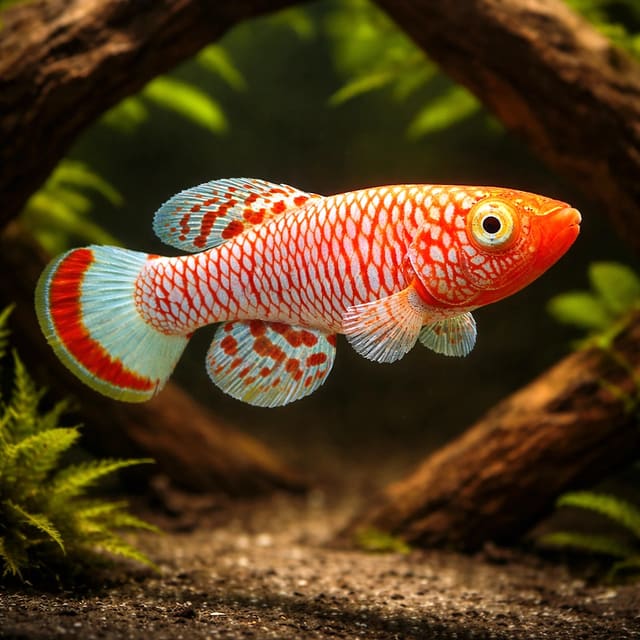
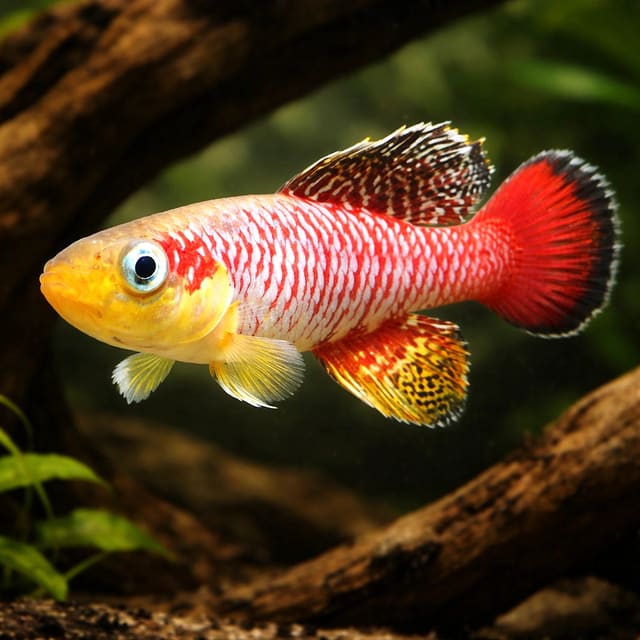
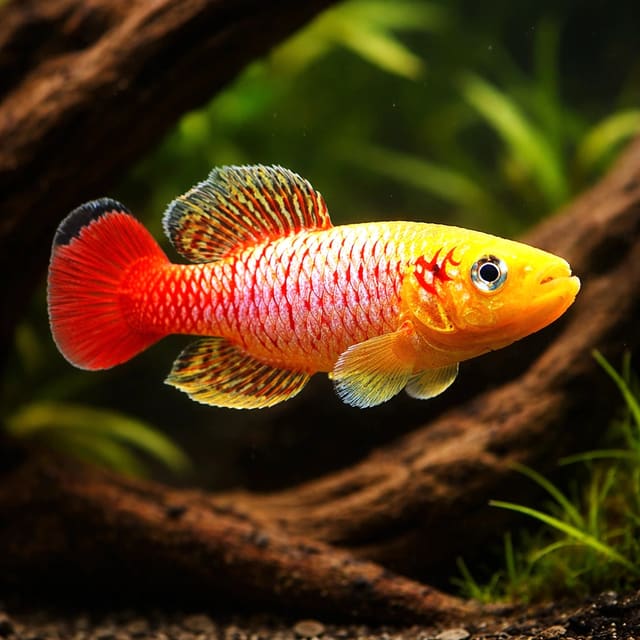
The existing scene images remain in the gallery as supporting aquarium views, but the source photo is the factual reference image for this listing.
Simpsonichthys boitonei is a South American annual killifish from Brazil. FishBase places it in the upper Parana River basin, and specialist killifish indexing treats it as a Class 3 South American annual. These fish are adapted to seasonal waters where adults grow, mature and spawn quickly while the habitat is wet.
The annual life cycle matters in the aquarium. Adults spawn into the bottom substrate, and the eggs survive a damp incubation period before hatching when water returns. That is why this fish deserves specialist wording: the setup is not large, but the care is precise. A keeper should be ready for small live foods, frequent water-quality checks, a secure lid and a breeding plan if the line is to be maintained beyond the adult fish's naturally short seasonal rhythm.
Use a quiet, species-first aquarium of around 40 litres for a pair or small group. A dark base, leaf litter, Java moss, fine-rooted plants and floating cover help the fish settle and show better colour. Flow should be gentle rather than forceful. The tank must be covered tightly, because killifish can jump through small gaps.
For breeding, include a removable container or area of peat fibre, coco coir or similar soft spawning medium. This makes egg collection and damp incubation more controlled. Keep the layout simple enough to maintain, because small specialist aquariums can lose water quality quickly if uneaten food or waste is allowed to build up.
The previous warm 22-26 C style of guidance is not the best target for this species. FishBase lists 24 C aquarium temperature, our stock records give 20-24 C, and Killi.co.uk breeder notes report moderately soft, acidic water at 20-23 C. Eggs should not be kept too warm during incubation.
This is a small carnivorous annual killifish. Feed daphnia, newly hatched or adult brine shrimp as size allows, mosquito larvae, grindal worm, small blackworm, finely chopped bloodworm and other appropriately sized live or frozen foods. Some individuals may learn to accept tiny prepared foods, but live and frozen foods should remain the foundation for condition, colour and breeding readiness.
Offer modest portions once or twice daily and remove leftovers. The fish is not built to compete with fast community feeders, so feeding access is one of the main reasons a species setup works better.
Brashnikov's Lyretail is peaceful in the sense that it is not a predatory or boisterous fish, but it still deserves a specialist setup. Males may display, females need cover, and the group benefits from visual breaks. It is best kept species-first, especially if breeding is part of the plan.
Avoid large fish, fin nippers, fast barbs and tetras, pushy livebearers, hard-water specialists, aggressive cichlids and small ornamental shrimp that may be eaten. A calm pair or trio in a well-covered aquarium is a cleaner plan than placing this endangered annual killifish into a busy mixed display.
FishBase records Simpsonichthys boitonei as a bottom spawner with about two months of incubation. Killi.co.uk breeding notes describe peat or similar spawning substrate, moderately soft acidic water, and an incubation period around eight weeks, with caution not to keep the eggs too warm.
Condition adults with live foods, let them spawn into the soft medium, then store the collected medium damp rather than submerged. When the incubation period is complete, re-wet the medium and start fry on tiny foods such as infusoria and newly hatched brine shrimp. This is one of the most rewarding parts of keeping annual killifish, but it is a real project rather than a casual extra.
Livestock orders are packed for the weather and sent by suitable live-animal courier service when conditions are safe. The product page, cart and checkout show current stock and delivery options, while the Live Arrival Guarantee applies when the delivery requirements are followed. This gives buyers clear trust information without forcing repetitive sales phrases into the care text.
Identity and care were checked against FishBase, American Killifish Association, GBIF/Catalogue of Life, Killi.co.uk breeding notes and our stock records. The listing keeps the supplier's Cynolebias boitonei name visible while using Simpsonichthys boitonei as the customer-facing scientific name.
No reviews for this item yet. Bought one? Honest reviews only, good or bad.
What customers say about ordering from us
I have a small group of long finned mountain minnows. So was delighted to be able to order ten of this variety to increase the genetics in my tank . The ones I recieved are healthy but it’s to early to give a verdict on wether they are of a long finned type since they are small currently.
Gordon Walker · 23 Sept 2026
100% success travel and "installation". Pleased with quality of purchase. The Siamese fighter a bit "shy" so have not yet seen him at his best yet but looking good. Happy customer. GG
George E Garratt · 21 Sept 2026
Reviews of our shop, collected by Judge.me, an independent third-party review collector. Newest first.