Advanced
Gunther's Zanzibar Gold Nothobranch (Nothobranchius guentheri)
22–25°C · pH 6–7
£10.99

Endangered Brazilian annual killifish supplied 3-4 cm. Best for experienced keepers in a covered species setup at 22-26 C with soft, clean water and live/frozen foods.
Adult size is the maximum length this species reaches at full maturity (scientific sources). The livestock you receive will be younger and smaller. Product-photo provenance and any image-specific limitations are stated on the listing.
Hypsolebias flammeus
Save when buying multiple fish. Each quantity is one fish; sex and pair formation are not guaranteed unless the selected variant explicitly states them.
Confirm your email, then we’ll send an availability message for this exact item if it returns within 180 days.
This request is only for this product—no newsletter or other promotions. A mail-provider retry may very rarely duplicate the same availability message. Unconfirmed addresses are removed after 48 hours. See our privacy policy.
Endangered Brazilian annual killifish supplied 3-4 cm. Best for experienced keepers in a covered species setup at 22-26 C with soft, clean water and live/frozen foods.
Adult size is the maximum length this species reaches at full maturity (scientific sources). The livestock you receive will be younger and smaller. Product-photo provenance and any image-specific limitations are stated on the listing.
Maintain these water conditions for optimal health and vibrant colors
The older Cynolebias name is retained here as supplier and hobby-search context, and Simpsonichthys flammeus is also seen in older annual-killifish literature.
This is a specialist Brazilian annual killifish, supplied at 3-4 cm. It is not a general community-tank filler; it is best for experienced keepers who can provide a covered species aquarium, small live or frozen foods, stable warm water and a planned spawning medium. FishBase gives the adult planning size at about 6 cm total length, so the supplied fish should be treated as young stock with more growth and colour still to come.
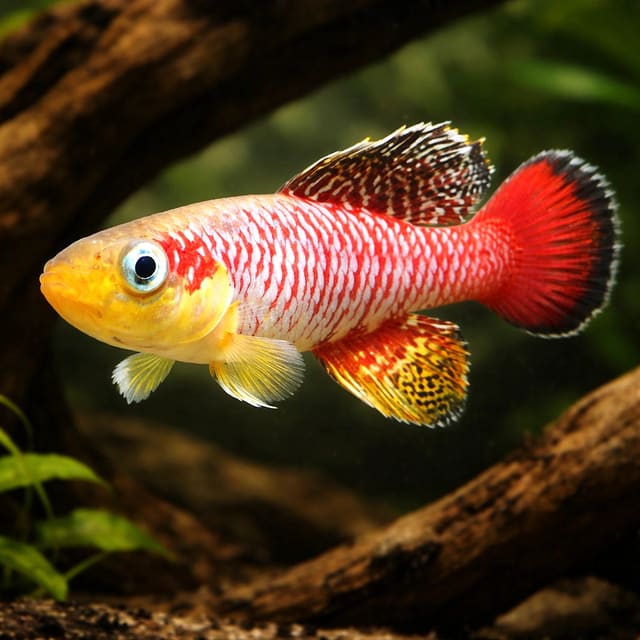
The original reference image for this SKU shows a compact, deep-bodied annual killifish with a pale yellow to greenish upper body, blue-green lower body, orange-red spotting across the back and flanks, and a bold blue to violet anal and caudal area. The anal and caudal fins show barred patterning, and the male has the vivid, flame-like colour that gives the fish its trade name.
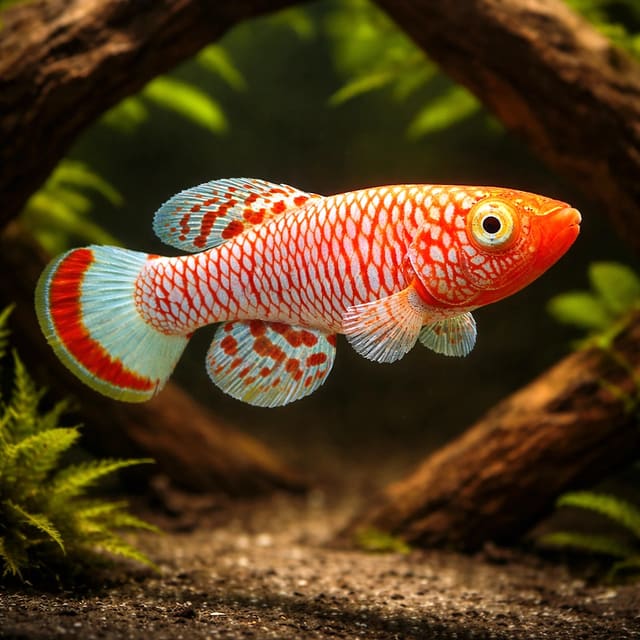
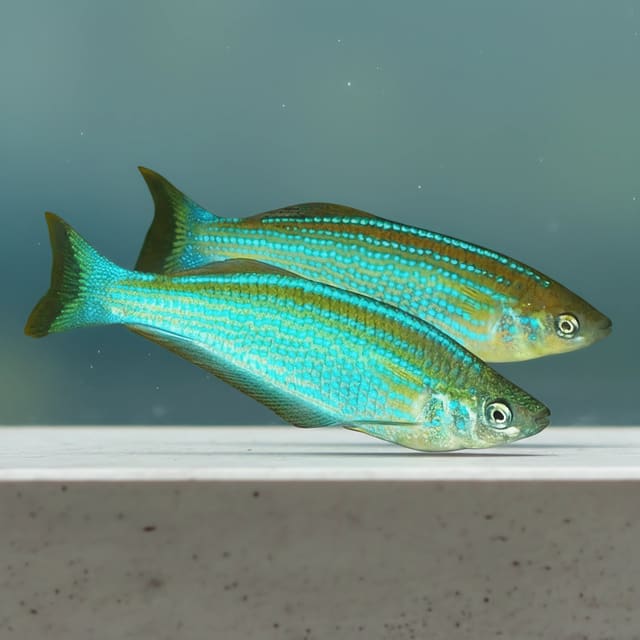
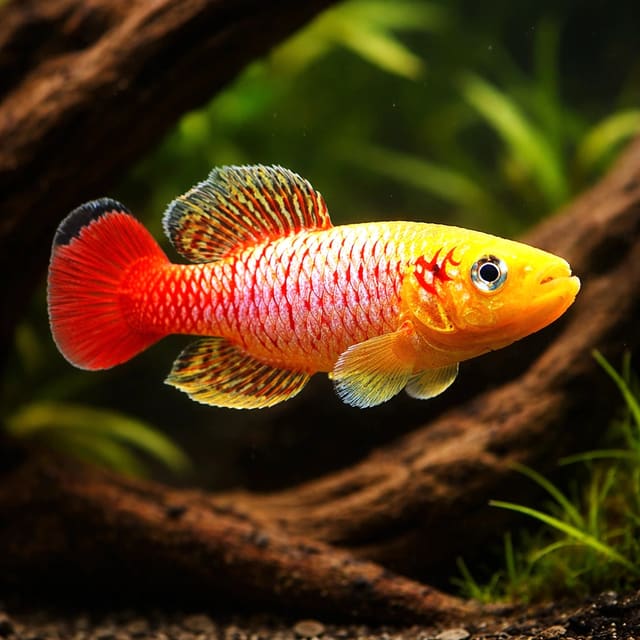
The existing aquarium-scene images remain in the gallery as supporting views, but the reference photo is the factual reference for this listing.
Hypsolebias flammeus is a South American annual killifish from Brazil. FishBase places it in the Tocantins River basin, and Wikispecies records the type locality as a marsh near the junction of the Rio Bezerra and Rio Parana at Arraias, Tocantins. Killi Club de France also places the species in the South American annual group and gives Brazil as its distribution.
Annual killifish are shaped by temporary habitats. In nature, adults grow, feed and spawn while seasonal water is available. Eggs remain in the bottom substrate through the dry phase and hatch when water returns. In the aquarium this means the fish needs more than a decorative planted tank: it needs a managed, species-first setup with suitable spawning media and stable, clean water.
Plan a minimum 40-litre aquarium for a pair or carefully watched small group. A tight-fitting lid is essential because killifish are capable jumpers, especially when newly settled or startled. Use gentle filtration, such as an air-driven sponge filter, and avoid hard current. Floating plants, fine-leaved plants, moss, leaf litter and dark background cover all help the fish feel secure and show better colour.
For substrate, keep the display easy to clean and provide a removable spawning box, jar or tray containing peat fibre or well-rinsed coco coir. This keeps maintenance practical and makes egg collection less disruptive. The fish will appreciate calm edges and cover more than open bright water, so subdued lighting is usually better than a hard, exposed aquascape.
This is a difficult-care species because stability matters. Avoid sudden changes, heavy feeding without cleanup, or busy tankmates that force the fish to compete. Warm, clean, lightly acidic to neutral water is a better target than chasing constant chemical adjustment.
Feed as a small carnivorous annual killifish. Live and frozen foods are strongly preferred: newly hatched or small brine shrimp, daphnia, cyclops, mosquito larvae, bloodworm and other fine invertebrate foods are all useful. Some individuals may learn prepared foods, but dry food should not be the main plan for conditioning or breeding.
Offer small portions once or twice daily and remove waste quickly. The fish is small, so good feeding is about quality and consistency rather than large meals. A varied live/frozen diet also supports colour, body condition and courtship behaviour.
Flameus Pearl Fish are generally peaceful, but they are best treated as a species aquarium project. Males may display strongly to one another, and annual killifish can be outcompeted by fast-feeding community fish. Keeping them on their own, or as a carefully watched pair or trio, makes it much easier to manage feeding, breeding and stress.
Avoid large fish, fin-nippers, aggressive cichlids, fast barbs, busy livebearers and any species that need very different water. This listing is written for keepers who want to maintain the fish well, not simply add a rare name to a mixed tank.
FishBase records Hypsolebias flammeus as a bottom spawner with an incubation period around four months. In practice, that means the spawning medium is usually removed, checked and stored damp rather than submerged. Keep peat or coco coir moist but not waterlogged, sealed from drying out, and warm enough for normal development.
South American annual killifish egg incubation varies by species, temperature and the keeper's method. A patient test-hatch approach is safer than assuming every egg is ready on the same day. This is one reason the fish is labelled difficult: the adult care is manageable, but breeding and fry work require planning and observation.
Your fish will be packed for live-animal courier delivery, with oxygen, insulation and dispatch timing chosen around weather and livestock welfare. On arrival, dim the lights, float the bag to equalise temperature, and acclimate slowly to the prepared aquarium. The Live Arrival Guarantee applies when the delivery and acclimation instructions are followed.
This listing was checked against FishBase for current name, distribution, size, temperature, bottom-spawning and aquarium difficulty; Wikispecies for older name combinations and type-locality context; Killi Club de France for South American annual and Brazil context; Encyclopedia of Life for freshwater habitat and adult-size confirmation; our stock records for supplied size, image, stock and original care range.
No reviews for this item yet. Bought one? Honest reviews only, good or bad.
What customers say about ordering from us
I have a small group of long finned mountain minnows. So was delighted to be able to order ten of this variety to increase the genetics in my tank . The ones I recieved are healthy but it’s to early to give a verdict on wether they are of a long finned type since they are small currently.
Gordon Walker · 23 Sept 2026
100% success travel and "installation". Pleased with quality of purchase. The Siamese fighter a bit "shy" so have not yet seen him at his best yet but looking good. Happy customer. GG
George E Garratt · 21 Sept 2026
Reviews of our shop, collected by Judge.me, an independent third-party review collector. Newest first.