Advanced
Gunther's Zanzibar Gold Nothobranch (Nothobranchius guentheri)
22–25°C · pH 6–7
£10.99

A South American annual killifish with long feathered finnage, supplied at about 4-6 cm. Best in a covered species-first setup with soft spawning substrate.
Adult size is the maximum length this species reaches at full maturity (scientific sources). The livestock you receive will be younger and smaller. Product-photo provenance and any image-specific limitations are stated on the listing.
Pterolebias longipinnis
Shoaling fish: kept in a group they feel safer, stay calmer and show their best colour.
Confirm your email, then we’ll send an availability message for this exact item if it returns within 180 days.
This request is only for this product—no newsletter or other promotions. A mail-provider retry may very rarely duplicate the same availability message. Unconfirmed addresses are removed after 48 hours. See our privacy policy.
A South American annual killifish with long feathered finnage, supplied at about 4-6 cm. Best in a covered species-first setup with soft spawning substrate.
Adult size is the maximum length this species reaches at full maturity (scientific sources). The livestock you receive will be younger and smaller. Product-photo provenance and any image-specific limitations are stated on the listing.
Maintain these water conditions for optimal health and vibrant colors
The Featherfin Panchax (Pterolebias longipinnis) is a South American annual killifish with a slender body, long flowing fins and a specialist life history. It is also known as the Common Featherfin Panchax, but it should not be treated like an ordinary surface panchax. This species is linked to seasonal freshwater habitats, grows quickly and uses bottom substrate for spawning, with eggs adapted to survive a dry resting period.
Our current fish are supplied at about 4-6 cm. Adults can reach around 12 cm total length, so this is not a tiny nano killifish. It is peaceful by predator standards, but it is still a carnivorous annual killifish that deserves a covered, calm, species-first aquarium or very careful tank-mate choices. Choose it when you want an unusual annual-killifish project with strong visual impact rather than a plug-and-play community fish.
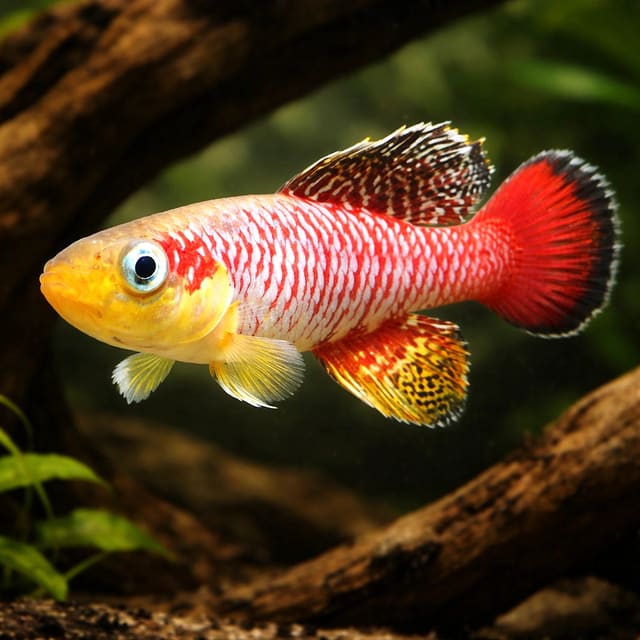
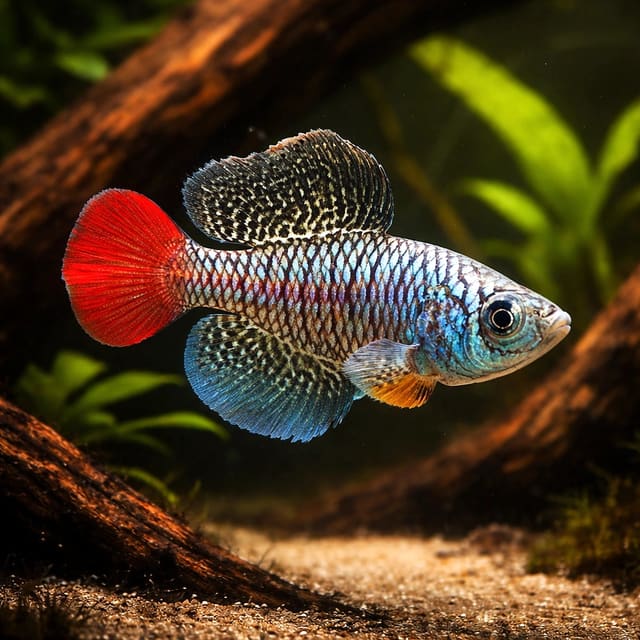
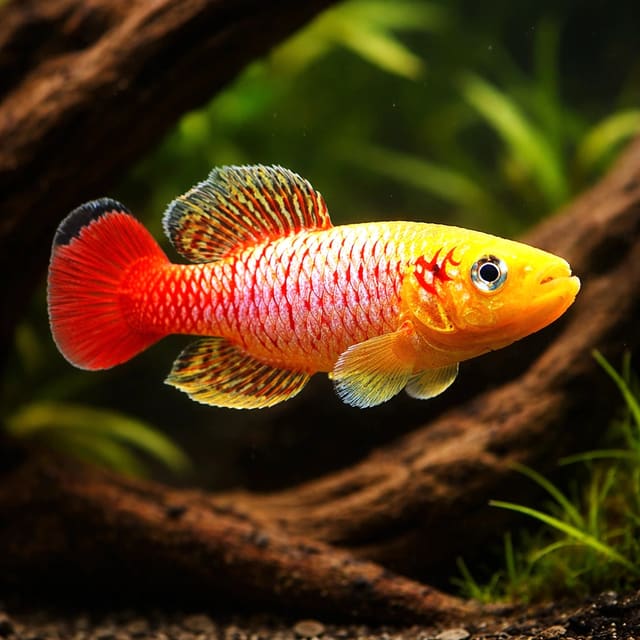
The original reference photo shows a long, elegant fish with a reflective pink-peach body, blue-white speckling, a darker broad rear fin area, yellowish lower fins and a bright metallic eye. The name Featherfin makes sense when you look at the extended unpaired fins: the fish has a long, trailing profile that stands out strongly against plants, leaf litter and darker backgrounds.
Because the source photo is exact for this SKU, it should be used as the trust image. The existing gallery can still help customers imagine the fish in a planted aquarium, but it should support the real photo rather than replace it.
Pterolebias longipinnis is recorded from South America, including the Amazon and Paraguay River basins. FishBase describes it as a freshwater, benthopelagic species and records a diet of worms, crustaceans, insects and smaller fish. Specialist killifish references place it among the South American annual killifish, a group associated with temporary or seasonal waters where adults may live quickly and eggs carry the population through harsher periods.
Aquarium Glaser notes imports from Paraguay and describes the natural pattern clearly: in the wild, fish may live only a few months as water dries, while eggs remain in the bottom of the former water body until rain returns. In aquaria, with permanent clean water and steady feeding, fish can live longer than that, but the seasonal breeding strategy still shapes the care.
Use a covered aquarium of at least 80 litres for a pair or small group. A tight lid matters because killifish can jump, especially during feeding, display or disturbance. The layout should combine open swimming room with planted edges, leaf litter, roots and soft visual breaks. Keep the water movement gentle and avoid a tank that is all hard current and bare glass.
Unlike a mop-spawning surface panchax, this species benefits from a soft spawning zone. Experienced keepers often use peat fibre, coir, fine spawning media or a removable container of soft substrate so eggs can be collected and incubated separately. If you are keeping the fish only for display, the same soft, shaded layout still helps them settle and show natural behaviour.
A practical everyday range is 22-26 C, pH 6.5-7.5 and low to moderate hardness. FishBase lists pH 6.5-7.0 and 5-8 dGH, while keeper reports show successful maintenance and breeding across nearby ranges when water is clean and stable. Avoid extreme water, sudden swings and poor oxygenation.
Annual killifish are often fast-growing and food-driven, so water quality must keep up with feeding. Keep ammonia and nitrite at zero, use regular partial water changes, and remove uneaten food from the substrate. If using peat or leaf litter, monitor the tank rather than assuming dark water is automatically clean.
This is a carnivorous species. Offer small live and frozen foods such as mosquito larvae, daphnia, brine shrimp, bloodworm, whiteworm, grindal worm and suitably sized chopped meaty foods. Good quality soft granules can be accepted by some individuals, but they should support a varied diet rather than replace it.
Feed small portions once or twice daily and watch body condition. Young fish can grow quickly, but heavy feeding without maintenance will damage water quality. The best routine is generous variety, clean water and careful observation. Fish that are preparing to spawn usually benefit from richer live and frozen foods.
Featherfin Panchax are generally not aggressive community bullies, but they are specialist predatory killifish. Males may display and spar, especially in cramped quarters or when females and spawning sites are limited. A species-first setup is the safest choice for behaviour, breeding and feeding control.
If you try tank mates, choose calm fish too large to be eaten, with similar water needs and no habit of nipping long fins. Avoid tiny nano fish, fry, small shrimp, fin-nippers, rough cichlids and very fast feeders that will dominate every meal. For breeding, skip community tank mates and keep the group in a dedicated covered aquarium.
Pterolebias longipinnis is an annual substrate spawner. The old text suggested ordinary plant or mop spawning, but the better fit is bottom spawning into peat or similar soft media. FishBase notes bottom spawning and about three months of egg incubation, and hobby reports commonly use peat or comparable substrate.
Condition adults with live and frozen foods, provide a removable spawning container, then collect and incubate eggs according to annual-killifish practice. Fry need tiny first foods and careful water quality. This is not the easiest route for a beginner, but for a patient keeper it is exactly what makes the species special.
Your Featherfin Panchax is packed for live-fish courier delivery with oxygen, insulation and weather-aware dispatch timing. The product page now includes the original reference photo for this SKU, while the existing images remain as supporting aquarium-context visuals. First-time customers can use WELCOME10 at checkout, and eligible livestock orders are covered by our Live Arrival Guarantee.
If you are comparing killifish options, choose this species for a larger South American annual killifish with dramatic finnage and substrate-spawning behaviour. Choose smaller Nothobranchius species when you want compact East African annuals, or Pachypanchax and Epiplatys species when you want non-annual surface killifish.
No reviews for this item yet. Bought one? Honest reviews only, good or bad.
What customers say about ordering from us
I have a small group of long finned mountain minnows. So was delighted to be able to order ten of this variety to increase the genetics in my tank . The ones I recieved are healthy but it’s to early to give a verdict on wether they are of a long finned type since they are small currently.
Gordon Walker · 23 Sept 2026
100% success travel and "installation". Pleased with quality of purchase. The Siamese fighter a bit "shy" so have not yet seen him at his best yet but looking good. Happy customer. GG
George E Garratt · 21 Sept 2026
Reviews of our shop, collected by Judge.me, an independent third-party review collector. Newest first.