Gunther's Nothobranch (Nothobranchius guentheri)
22–25°C · pH 6–7
£11.99

A rare Brazilian annual killifish, now treated as Hypsolebias magnificus, supplied at about 2.5-3 cm. Best for experienced keepers in a quiet covered species aquarium with soft, clean water and live or frozen foods.
Adult size is the maximum length this species reaches at full maturity (scientific sources). The livestock you receive will be younger and smaller. Product-photo provenance and any image-specific limitations are stated on the listing.
Hypsolebias magnificus
Save when buying multiple fish. Each quantity is one fish; sex and pair formation are not guaranteed unless the selected variant explicitly states them.
Confirm your email, then we’ll send an availability message for this exact item if it returns within 180 days.
This request is only for this product—no newsletter or other promotions. A mail-provider retry may very rarely duplicate the same availability message. Unconfirmed addresses are removed after 48 hours. See our privacy policy.
A rare Brazilian annual killifish, now treated as Hypsolebias magnificus, supplied at about 2.5-3 cm. Best for experienced keepers in a quiet covered species aquarium with soft, clean water and live or frozen foods.
Adult size is the maximum length this species reaches at full maturity (scientific sources). The livestock you receive will be younger and smaller. Product-photo provenance and any image-specific limitations are stated on the listing.
Maintain these water conditions for optimal health and vibrant colors
The Magnificius Pearl Fish is a rare South American annual killifish now treated as Hypsolebias magnificus. The older name Cynolebias magnificus is still useful because it appears in our stock records and older aquarium literature, but the customer-facing listing should use the current name. This is a specialist fish for keepers who enjoy annual killifish behaviour, careful water quality and source-backed breeding detail rather than a busy mixed community display.
Our current stock is supplied at about 2.5-3 cm. That is a sale size, not the adult maximum. FishBase records males to about 5 cm total length, so plan the aquarium around a small but assertive annual killifish with a short, intense life cycle. It is best treated as a species-first project: a pair, trio or carefully managed small group in a calm covered aquarium, fed well and given the option to spawn naturally.
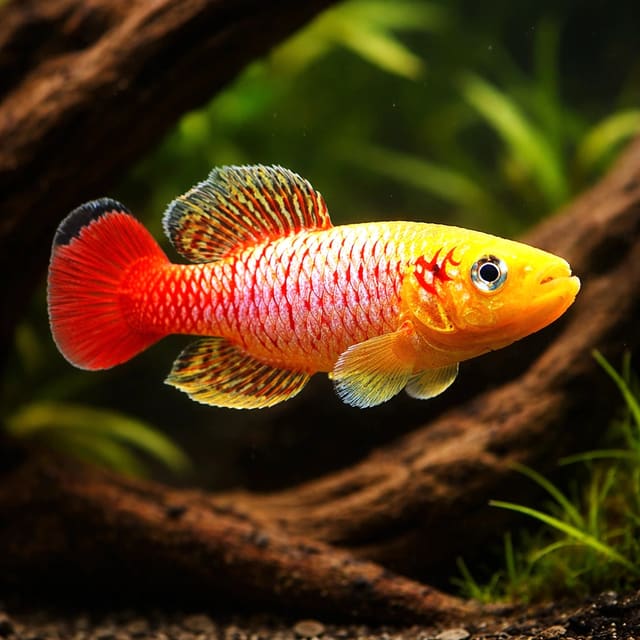
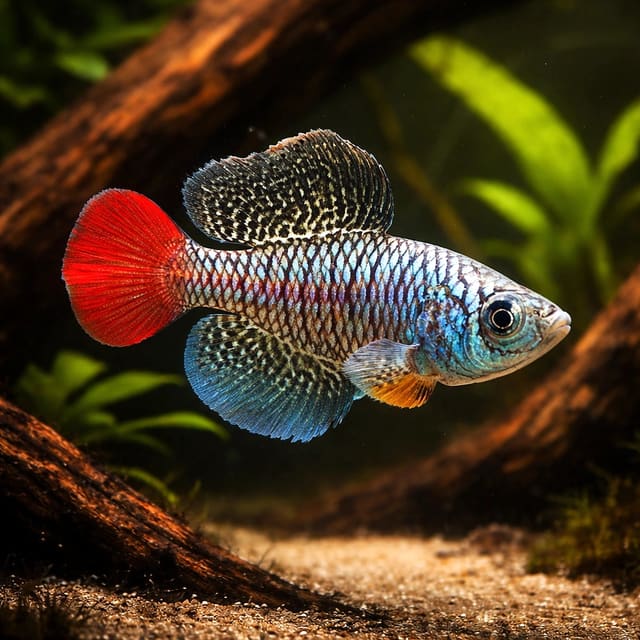
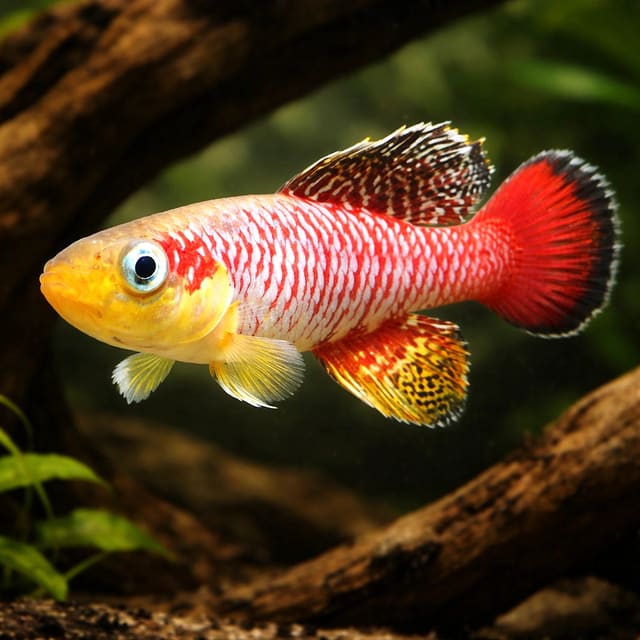
The fish in the source photo shows why this species has such a devoted following: a warm red to coral body, bright blue-green vertical markings, a pale spotted pattern across the dorsal, anal and tail fins, and strong contrast on the fin edges. Under subdued light, a dark base and healthy live plants, those metallic marks read as a jewel-like pattern rather than a flat red fish.
Males are the showier sex, especially when displaying. Females are usually quieter in colour and build, so do not expect every individual to look like a flaring male source photograph all day. Good condition, clean water, low stress and live or frozen foods make a real difference to colour and posture.
Hypsolebias magnificus is recorded from the middle Sao Francisco River basin in Brazil. Scientific work on the magnificus complex describes endangered seasonal killifishes associated with temporary pools in the Brazilian Caatinga, often in protected shaded pool habitats. These are not permanent river fish. They are adapted to waters that appear with seasonal rain and later dry out.
That annual life cycle shapes everything about their care. Adults grow, feed and spawn while water is present. Eggs are placed into the bottom substrate and survive a damp resting period when the habitat dries. FishBase lists this species as a bottom spawner with roughly five months egg incubation. In the aquarium, the fish may be small, but the biology behind it is demanding and fascinating.
Use a tightly covered aquarium. Annual killifish can jump, and a small gap is enough. For a pair or trio, aim for around 45 litres or more; use more space if keeping more than one male. The tank should feel quiet rather than crowded: fine sand, leaf litter, Java moss, floating plants, shaded areas and gentle filtration. Avoid strong flow. A sponge filter or low-flow internal filter is easier to manage than a powerful current.
Provide a removable peat, coco coir or fine spawning container if breeding is a goal. This keeps the display cleaner while giving the fish a suitable place to bury eggs. Keep the layout simple enough that you can check appetite, body condition and male behaviour every day. Small annual killifish reward close observation.
Use stable, clean water rather than chasing numbers. The practical range for this listing is 22-26 C, pH 6.5-7.0 and around 5-8 dGH. Keep ammonia and nitrite at zero and nitrate low with small regular water changes. Because this fish is often kept in smaller species setups, uneaten food and overstocking cause problems quickly. Stability matters more than dramatic adjustments.
This is a carnivorous annual killifish. Offer small live and frozen foods such as daphnia, brine shrimp, mosquito larvae, small bloodworm and other appropriately sized meaty foods. Many annual killifish condition best on live or frozen foods rather than dry food alone. Feed small portions and remove waste quickly, especially in a planted species tank with gentle filtration.
Keep Magnificius Pearl Fish species-first. Males may display strongly and can be territorial, especially in breeding condition. The safest tank mates are no tank mates at all, or only carefully chosen small, calm annual killifish in a larger setup with keeper experience. Avoid fast fish, fin nippers, large community fish, aggressive cichlids, shrimp and tiny invertebrates. The old community-tank wording was too broad for this species and has been removed.
Breeding is one of the main reasons to keep this fish. Condition adults with rich live and frozen foods, provide peat or coco coir, and collect the medium carefully if eggs are being incubated separately. The substrate should be damp rather than wet, labelled clearly and checked according to the expected incubation window. Fry are small and need suitable first foods, then newly hatched brine shrimp as soon as they can take it.
We ship live fish using live-animal courier methods and pack with the species, weather and journey in mind. Your Live Arrival Guarantee applies when the delivery terms are followed. Prepare a quiet, mature aquarium before ordering, dim the lights during acclimation and avoid adding this fish straight into a competitive community tank.
Care notes were checked against FishBase for the accepted name, size, temperature, distribution, bottom-spawning biology and Endangered status; ZooKeys work on the Hypsolebias magnificus complex for the rare seasonal-pool context; and our stock records for supplied size and exact source media.
No reviews for this item yet. Bought one? Honest reviews only, good or bad.
What customers say about ordering from us
I have a small group of long finned mountain minnows. So was delighted to be able to order ten of this variety to increase the genetics in my tank . The ones I recieved are healthy but it’s to early to give a verdict on wether they are of a long finned type since they are small currently.
Gordon Walker · 23 Sept 2026
100% success travel and "installation". Pleased with quality of purchase. The Siamese fighter a bit "shy" so have not yet seen him at his best yet but looking good. Happy customer. GG
George E Garratt · 21 Sept 2026
Reviews of our shop, collected by Judge.me, an independent third-party review collector. Newest first.