Hillstream Loach UK: The Complete 2026 Buying & Care Guide
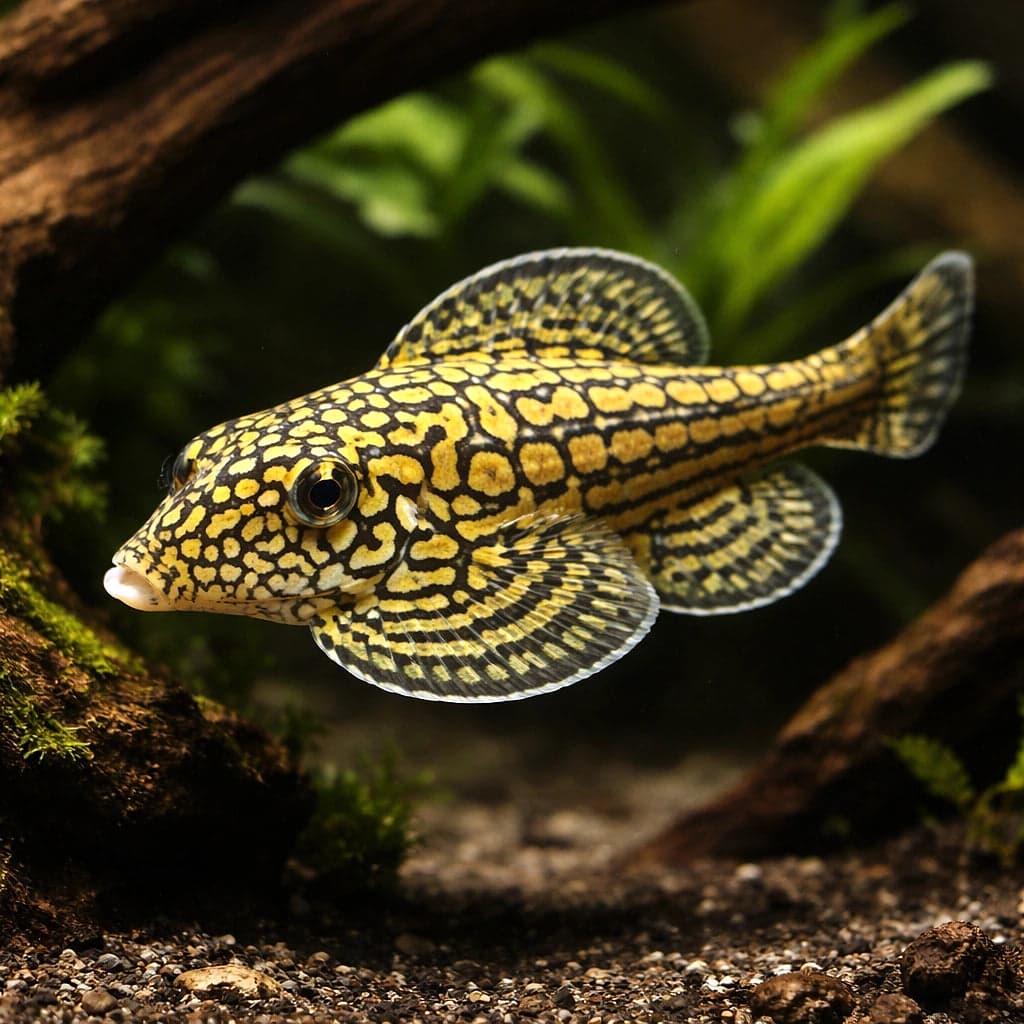
Hillstream loaches are specialist river-current fish from south-east Asia — sucker-shaped body, flat profile, grazes algae off rocks like a pleco but in cool, high-oxygen water. Keep in cool planted tanks at 20–24 °C with strong flow. 5 species currently in UK trade.
Why hillstream loaches aren't like any other aquarium fish
They look like plecos but aren't. They need water flow that would stress most fish. They prefer temperatures a discus keeper would consider dangerous. And they're one of the few tropical-trade species that UK tap-water conditions suit almost perfectly without any chemistry adjustment.
I'm Connor, the site's coldwater + native-UK specialist. I keep a dedicated Asian-stream biotope at home with four species of hillstream loach and a cool-tolerant tetra community. This is the guide I'd send to a friend who just saw a hillstream on Instagram and assumed it was a kind of pleco.
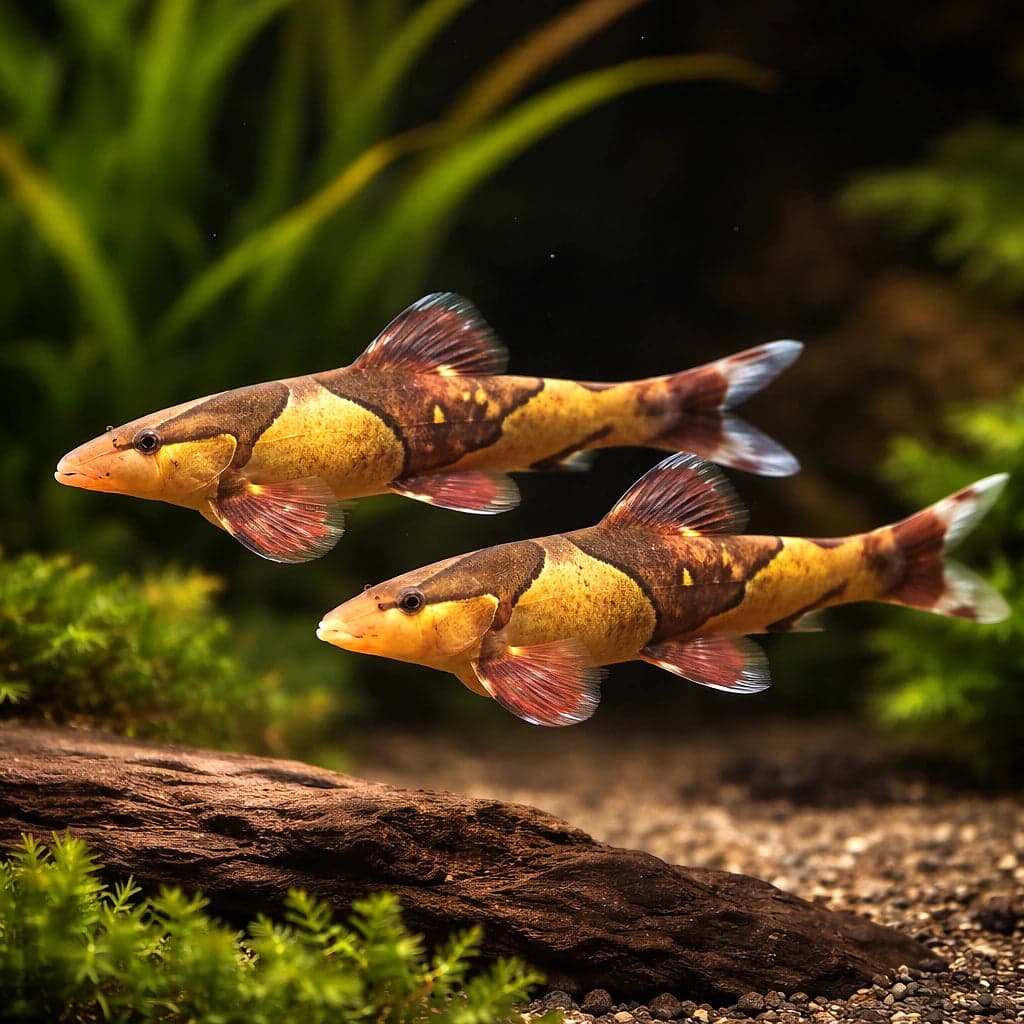
A Red Hillstream Loach (Sewellia lineolata) showing the flat, sucker-shaped body and the characteristic orange stippling that gives this species its common name. Photo: Tropical Fish Co warehouse.
Five facts most UK hillstream buyers never hear
- They're not plecos. Hillstream loaches belong to the Balitoridae + Gastromyzontidae families (Cypriniformes order) — completely unrelated to South American plecos (Loricariidae). Convergent evolution produced the similar sucker-body shape in both groups [?].
- Their "suction" is aided by body flattening. Hillstreams generate negative pressure against smooth surfaces using their flattened ventral profile + paired pectoral/pelvic fins, allowing them to hold position in 2+ m/s currents [?].
- Most imports come from Vietnam and Laos. The commercial trade is heavily Sewellia-biased because Vietnamese exporters have better supply networks than Chinese (Beaufortia) exporters [?].
- They can switch to atmospheric oxygen briefly. Unlike most gill-breathers, hillstreams tolerate several minutes out of water if their gills stay wet — an adaptation to occasional stranding during dry-season pool isolation.
- They're illegal to collect in the wild in China since 2007. Every Beaufortia and Pseudogastromyzon specimen in the UK trade is either farm-bred in South-East Asia or a legacy pre-2007 wild-caught import — almost never wild-caught today [?].
The 5 hillstream species in the UK trade
Head-to-head: hillstream loaches compared
| Species | Adult size | Pattern | Water preference | Price |
|---|---|---|---|---|
| Sewellia lineolata (Red) | 6 cm | Orange stippling on tan | 20–24 °C, soft | £20–£25 |
| Sewellia marmorata (Marbled) | 6–7 cm | Dark marbled cream | 20–24 °C, soft | £15–£20 |
| Beaufortia kweichowensis (Sucker-belly) | 7 cm | Bold black spots on cream | 18–24 °C, flexible | £15–£18 |
| Beaufortia leveretti (Chinese) | 6 cm | Fine speckling | 18–24 °C, flexible | £12–£15 |
| Pseudogastromyzon myersi (Panda) | 5 cm | Black + white bands | 20–24 °C | £12–£18 |
| Homaloptera ogilviei (Ogilvie's) | 8 cm | Banded body | 22–26 °C, warmer end | £9–£12 |
Beaufortia species tolerate warmer water better than Sewellia and are the honest recommendation if you keep a heated community tank that sits at 24–25 °C.
Tank setup — the non-negotiables
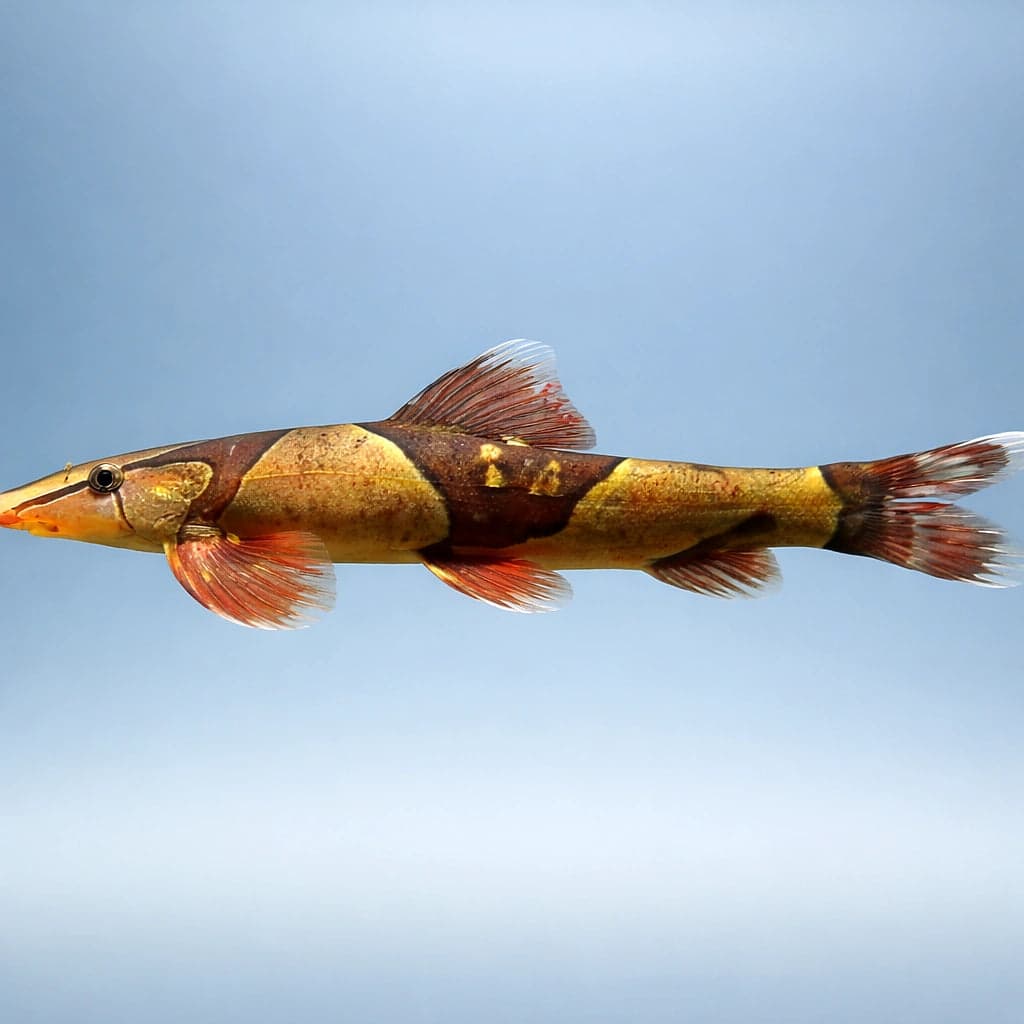
Side profile of the Red Hillstream Loach. The flat ventral and modified pectoral fins are how it holds position in currents that would wash most fish away. Photo: Tropical Fish Co warehouse.
Hardware checklist
- Long tank — 90 cm × 30 cm × 30 cm minimum. Don't use a 60 L cube. Length + surface area matter more than volume.
- Filter + powerhead combo — canister or HOB rated for 2× the tank size, plus a wavemaker or powerhead for extra flow. Total turnover 10–15× per hour [?].
- Smooth river pebbles — 3–6 cm rounded stones. Hillstreams graze biofilm off these. Avoid sharp gravel — damages their ventral profile.
- Open layout — no dense plants. Hillstreams want horizontal open space for swimming + grazing. Anubias or java fern tied to hardscape is fine; cabomba or vallisneria blocks flow.
- Sump or surface agitation — water MUST break the surface to maintain high O₂. Position filter outlet to disturb the surface OR add an airstone.
New hillstream keepers routinely install them in standard community tanks with canister filters sized for tetras and guppies. The fish survive 6–12 months before dying of cumulative hypoxic stress — and the keeper never knows why. If you can't commit to 10–15× turnover, don't keep hillstreams.
Tank mates that actually work
The cool-water requirement narrows the tank-mate pool considerably:
- White cloud mountain minnows — cool-water, peaceful, same biotope continent
- Danios (zebra, leopard, pearl) — tolerate the cool range
- Small rasboras (harlequin, chilli) — community-compatible
- Pygmy corydoras — similar substrate preference, peaceful
- Otocinclus — cool-tolerant algae partner
- Amano shrimp — safe adult shrimp, similar habitat preference
Avoid: Discus, angelfish, most cichlids (temperature mismatch), tiger barbs (aggressive toward slow-moving hillstreams).
Watch: a high-flow hillstream tank in action
Flow + oxygen diagnostic table
Most hillstream deaths in UK tanks come from insufficient flow or low dissolved oxygen — both preventable, both hard to spot until the fish are already declining. Here's the diagnostic matrix:
| Observed behaviour | Flow/O₂ status | Action |
|---|---|---|
| Actively grazing all tank surfaces | Healthy | Maintain current setup |
| Parked at filter outlet | Needs more flow | Add powerhead or reposition filter |
| Clinging to glass near surface | Low dissolved O₂ | Add airstone, increase surface agitation |
| Hiding under wood 90% of time | Flow too weak OR stressed | Measure flow rate (target 10×/hour) |
| Gasping at surface | Critical hypoxia | Immediate airstone + 30% water change |
| Not feeding for 48+ hours | Environment wrong | Review flow + temperature simultaneously |
| Skin discolouration | Substrate abrasion (if sharp) or disease | Check substrate; medicate if needed |
Flow-rate calculation
Target turnover: 10–15× tank volume per hour. Example:
| Tank volume | Minimum flow (L/h) | Typical setup |
|---|---|---|
| 60 L | 600–900 | HOB filter 600 L/h + small powerhead |
| 90 L | 900–1,350 | Canister 900 L/h + powerhead 500 L/h |
| 120 L | 1,200–1,800 | Canister 1,200 L/h + wavemaker |
| 180 L | 1,800–2,700 | Large canister + 2× powerheads |
Look at your filter's spec sheet for rated L/h. Reduce by ~30% for real-world flow vs spec (cartridges + media reduce throughput). Hillstreams are the one fish in UK trade where 'over-filtered' isn't a problem.
Pre-purchase checklist — any hillstream
- 90 L+ long-format tank (90 × 30 × 30 cm preferred)
- Filtration rated for 10× turnover minimum
- Substrate is smooth river pebbles, not sharp gravel
- Water temperature 20–24 °C (stable, not drifting)
- Group of 3–5 intended (never solo; never 2 males)
- Tank cycled 6+ weeks with zero ammonia/nitrite
- Feeding plan beyond algae — sinking wafers + vegetables
Skip any of these and hillstream survival drops noticeably over 3–6 months [?].
UK hillstream community
- Fishkeeping.co.uk has a dedicated Loaches subforum where experienced keepers trade breeding reports + species IDs
- Loaches.com (international but UK-active) — the definitive species ID database for every loach family
- Practical Fishkeeping runs an annual "species spotlight" feature on hillstreams every 2–3 years
- Reddit r/AsianAquaria — small but growing, Asian-biotope focus
When your hillstream loaches arrive — our UK delivery protocol
Hillstream loaches are moderately hardy shippers but sensitive to dissolved oxygen loss during transit. Our protocol adds an extra oxygen-boost step compared to standard tropicals:
- Open in a quiet, cool room.
- Float the bag 20 minutes sealed.
- Drip-acclimate 45 minutes — hillstreams are TDS-sensitive and need a slower drip.
- Pour bag contents through a fine net into a bucket. Net the fish, discard bag water.
- Release into tank with flow already running at full spec.
- No feeding 24 hours. Offer sinking algae wafers on day 2.
Live arrival guarantee: photograph unopened bags within 2 hours. Full refund/replacement at our cost.
Ready for more?
For related species guides, see the kuhli loach care guide for the other UK trade loach specialist, or the otocinclus care guide for the small tropical algae specialist.
Comparing algae crews? The Siamese algae eater guide and the ancistrus pleco guide together form the full algae-control toolkit that a hillstream doesn't provide on its own.
Shopping the full range? The loaches & oddballs hub has everything in this genus group currently in stock.
Frequently asked questions
Related guides
Amano Shrimp UK: Algae-Eating Specialist Every Planted Tank Needs
Amano shrimp (Caridina multidentata) — the algae crew every UK planted tank needs. Why they can't breed in freshwater, what they actually eat, welfare-first delivery.
Ancistrus Pleco UK: The Complete 2026 Bristlenose Guide
Everything UK aquarists need to buy and keep bristlenose plecos — size, tank mates, colour morphs (albino, longfin, super red, L-number). The only pleco that fits a 90 L tank.
Angelfish UK: Species Biology, Welfare & The Colour Strains In Stock
Angelfish (Pterophyllum scalare) — South American cichlid biology, pairing behaviour, strain genetics, UK welfare requirements, and the 10 colour strains we ship.