Angelfish UK: Species Biology, Welfare & The Colour Strains In Stock

Angelfish are mid-sized South American cichlids — 12 to 15 cm adults, not the small community fish their juvenile shop appearance suggests. They need tall tanks (120 L+), form aggressive pairs during breeding, and show dramatic colour strain variation. 10 strains currently in UK trade.
What you actually buy when you buy an angelfish
A juvenile angelfish in a UK shop tank is 2–4 cm from nose to tail, priced at £4–£10, and looks like a peaceful community fish. In six to eight months that same fish is 10–12 cm body height, territorial during breeding, and needs a tank that no one quite warns you about at the point of sale.
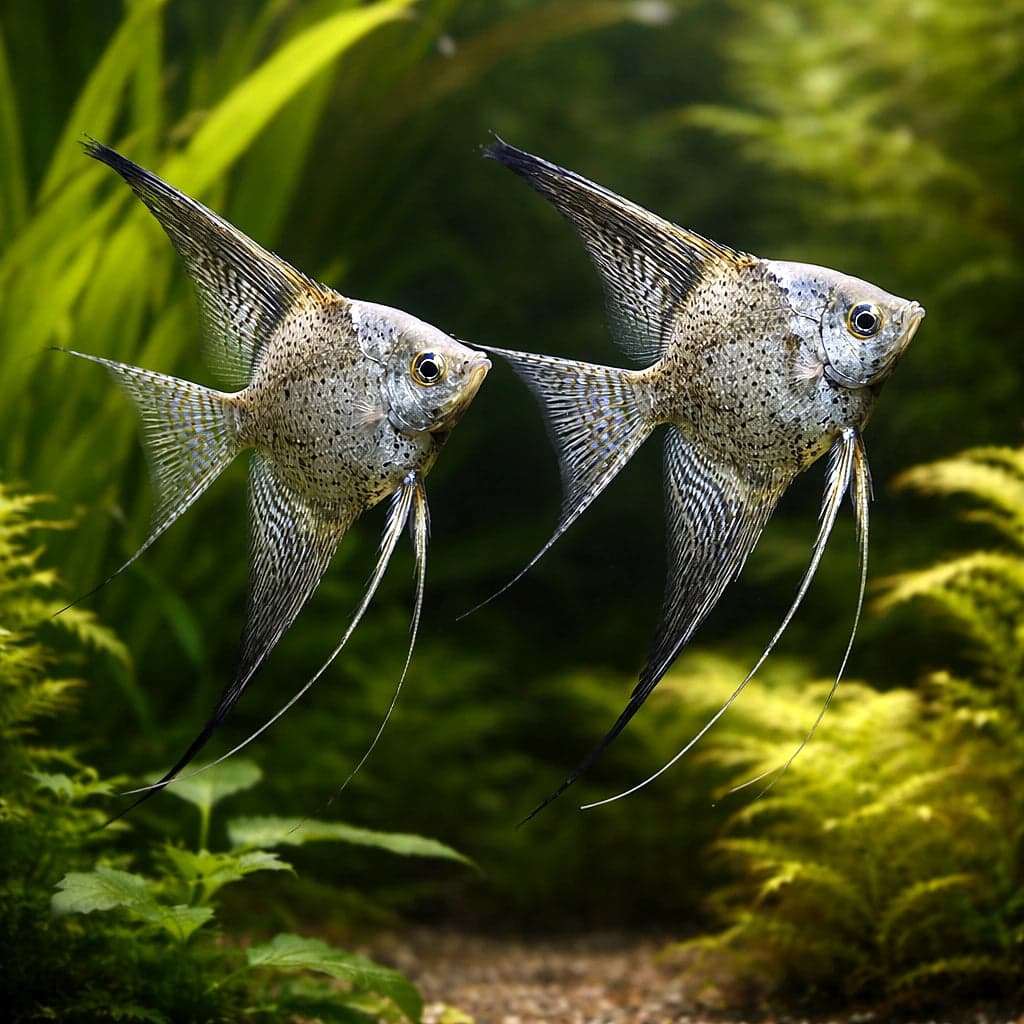
Pterophyllum scalare is a freshwater cichlid from the Amazon basin [?]. Adults reach 12–15 cm body height (the vertical disc measurement — horizontally they're narrower). They've been in the ornamental fish trade since the 1920s, and the commercial strain work that produces every colour variety you see in UK shops dates back to the 1950s [?].

A Marble Angelfish showing the classic disc-shaped body and trailing ventral fins. The marble pattern is the most commonly available colour strain in UK retail. Photo: Tropical Fish Co warehouse.
I'm Priya Ramesh, the site's cichlid + discus specialist. Angelfish share Amazon-biotope requirements with the discus I breed commercially, and I've kept breeding pairs alongside the discus rack since 2015. This is the guide I'd write for someone who's made the common UK mistake of planning an angelfish community tank in a 60 L.
The welfare argument — tank size is not a preference
UK welfare guidance on aquarium fish tank sizes is explicit: stocking density must allow normal behaviour, normal growth, and normal social structure [?].
For angelfish specifically:
- Stunting is the consequence of undersized tanks — angels grow to a size constrained by their tank volume, but the constraint causes skeletal deformity and shortened lifespan, not peaceful dwarfing.
- Aggression increases in tight spaces — adult angels without defensible territory harass tank mates and each other constantly.
- Breeding stress — unpaired adults in small groups form unstable hierarchies. One pair emerges, the other fish get chased into corners.
The welfare floor for a single adult angelfish is 120 L. For a pair, 200 L. For a group, 400 L+. These numbers aren't arbitrary — they're the tank sizes where observed behaviour in captivity matches natural behaviour [?].
The UK aquarium trade doesn't enforce tank-size requirements at the point of sale, but reputable shops refuse to sell angels without asking about the tank they're going into. If you get to the shop counter with angelfish in a bag and nobody asks what tank they're going into, that's a shop operating at the lower end of the welfare scale. Buy elsewhere next time.
The colour strains — 70 years of selective breeding, one species
Head-to-head: the angelfish strains in UK trade
| Strain | Pattern | Hardiness | UK price |
|---|---|---|---|
| Silver (wild-type) | Silver with 4 vertical bars | Hardiest | £4–£8 |
| Marble | Irregular black and silver swirls | Very hardy | £8–£12 |
| Gold | Yellow-gold body | Hardy | £6–£10 |
| Black | Deep uniform black | Moderate | £10–£18 |
| Zebra | Bold horizontal stripes | Hardy | £8–£14 |
| Koi | Red-orange + white + black (like koi carp) | Moderate | £15–£35 |
| Dalmatin / Spotted | White with small black spots | Hardy | £8–£12 |
| California | White body with light patterning | Hardy | £9–£14 |
| Ghost | Translucent silver with reduced pigment | Moderate | £6–£12 |
| Veil-tail (any colour) | Extended trailing fins | Fragile (fin damage) | £8–£30 |
Hardiness ranking comes from UK hobby observation, not a single peer-reviewed source. For a first angelfish tank, start with Silver or Marble; move to rarer strains once you've had angels thriving for 12+ months.
Behaviour — what a group of angelfish actually does
A California Angelfish. The white-bodied strain with reduced pigmentation — popular in planted tanks where colour contrast works best against dark substrate. Photo: Tropical Fish Co warehouse.
A group of juvenile angelfish (5–7 cm body height) in a 200 L tank spends its days swimming in loose formation, pausing to investigate plants and hardscape, rising to the surface when food appears. They're curious, individual-seeming fish — you learn to tell them apart within a few weeks because they develop different feeding positions and personalities [?].
Around 6–8 months, something changes. Two fish start spending more time together. They groom each other's pectoral fins. They drive other angels away from a specific spot in the tank — usually a broad leaf or a vertical rock surface. They've pair-bonded [?].
Once a pair forms, the rest of the tank becomes unsafe for the non-pair angels. In a 400 L with six total angels, the remaining four can usually find corners to hide in. In a 200 L with four angels, the non-pair pair (if it forms) will be relentlessly harassed. In a 120 L with two angels, if they pair they're peaceful; if they don't, one dominates and the other slowly declines.
The practical rule: buy juveniles in a group of 6 in a 200 L+ tank, let a pair form naturally over 6–9 months, rehome the unpaired four to another community tank, and keep the pair as a breeding or display pair in their now-their-territory tank.
Breeding pair dynamics
A formed angelfish pair is one of the more interesting behavioural displays in home aquaria. Once bonded, the pair:
- Selects a spawning site — usually a broad flat surface (amazon sword leaf, slate, a terracotta pot propped vertically)
- Cleans the site obsessively for 2–5 days before spawning
- Spawns — female deposits 200–800 eggs in neat rows, male fertilises each pass
- Tends the eggs — both parents fan water over eggs, remove infertile eggs (which turn white and fungal)
- Wigglers hatch at 36–48 hours — parents move wigglers to "holding pits" dug in the substrate
- Free-swimmers emerge at 5–7 days — parents lead the fry in tight swarms around the tank
- Fry become independent at 3–5 weeks — parents often spawn again at this point
First-time pairs often eat their own eggs — it's normal for the first 2–3 spawns to fail before the pair settles into reliable parenting.
Tank setup — the 5 things an angelfish tank needs
- Vertical height. Angelfish are disc-shaped — shallow tanks stress them even at the right volume. Minimum 45 cm tank height, 60 cm preferred.
- Soft, slightly acidic water. pH 6.5–7.2 is ideal for breeding; 7.0–7.5 tolerates for non-breeding keeping [?]. Hard UK water (12+ dGH) stresses them over months — consider blending RO water.
- Stable temperature. 26–28 °C, stable within ±1 °C daily. Angelfish are sensitive to temperature swings — invest in a good thermostat-controlled heater.
- Planted or hardscape-rich layout. Broad-leaved plants (amazon sword, anubias), vertical rockwork, or driftwood give them territorial anchors. A bare tank stresses them.
- Moderate flow. Gentle current along the tank length. Strong flow stresses their disc-shaped bodies.
Watch: an adult angelfish community in action
Tank mates that work with adult angelfish
Safe companions:
- Cardinal tetras — acceptable risk in 200 L+ tanks because cardinals are the larger of the Amazon schooler species. In smaller tanks they get eaten.
- Corydoras — cory species are armoured and generally ignored. Panda cory, sterbai, bronze work well.
- Bristlenose plecos — compatible algae workers, different feeding zone.
- Rummy-nose tetras — larger schoolers than neons; survive the adult angel predation zone.
- Other South American cichlids (rams, keyholes) in 400 L+ tanks with defined territories.
Risky/avoid:
- Neon tetras and ember tetras — eaten by adult angels. Juvenile period only.
- Guppies — eaten.
- African cichlids — wrong water chemistry, aggressive.
- Male bettas — territorial conflict with angel adults.
- Puffers and other aggressive oddballs — shreds angel trailing fins.
First-year growth + care calendar
An angelfish you buy at 3 cm in month 0 is a 10 cm sub-adult by month 12. Here's what changes month-by-month — use it to plan tank upgrades, feeding adjustments, and the point where community-tank-mates become risky.
| Month | Body size | Key care change | Tank-mate risk |
|---|---|---|---|
| 0 (arrival) | 2–3 cm | Quarantine 2 weeks in separate tank | None — too small |
| 1 | 3–4 cm | Tropical flake + micro-pellet 2×/day | None |
| 3 | 5–6 cm | Add frozen bloodworms 2×/week | Neons still safe |
| 6 | 7–8 cm | Sub-adult cichlid pellets | Neons become food |
| 9 | 9–10 cm | Signs of pair-bonding begin | Small tetras all at risk |
| 12 | 10–12 cm | Full sub-adult, breeding possible | Community compatibility ends |
| 18 | 12–15 cm | Full adult, breeding pairs stable | Species tank only |
| 24+ | 15 cm max | Peak condition, continuous spawning | — |
The decision point is month 6–8: this is when you either commit to a dedicated 200 L+ tank or re-home the angels to someone who has one. Juveniles in a community tank stop being juvenile regardless of how often you tell yourself "I'll upgrade the tank next year."
Pre-purchase welfare checklist — any angelfish, anywhere
Tick all 7 before you put money down:
- You have a 120 L+ tank cycled for 6+ weeks (or 200 L+ if buying a pair)
- Tank height ≥ 45 cm (angels are disc-shaped)
- Stable temperature 26 °C ± 1 °C
- Water parameters tested zero ammonia, zero nitrite, under 20 ppm nitrate
- No fish in the tank smaller than 4 cm adult size (will be eaten at month 6)
- Broad-leaved plants or vertical hardscape for territory
- Backup plan for rehoming unpaired adults when pairs form
If you can't tick all seven, the angelfish either won't thrive or will cause welfare problems for tank mates within 6 months [6].
UK angelfish community
- British Cichlid Association (BCA) — the UK's primary cichlid-keeping organisation. Runs shows, publishes standards for judging ornamental angelfish strains [?]
- Angelfish Society UK — smaller hobby-specific group, breeder swaps at meets
- FBAS Cichlid section — UK-wide club meets
- Facebook "UK Angelfish Keepers" — 5K+ members, breeder trades + strain photography
- r/Cichlid + r/Aquariums — UK-active
Our welfare-first delivery protocol
Angelfish are hardier shippers than most tropical fish due to body size but sensitive to temperature swings in winter.
- APHA-compliant live-animal carrier (licensed live-animal courier)
- Double-insulated polystyrene with 2× heat packs in winter (vs standard 1× for smaller fish)
- Bag sized to adult size — never cramped
- Species-isolated quarantine 7 days minimum before shipping
- Drip acclimation protocol included with every shipment
- Live Arrival Guarantee — full refund/replacement on photographed DOA within 2 hours
If you're buying your first angelfish and you have a 60 L community tank, don't buy angels. Buy harlequin rasboras, a pair of honey gouramis, ember tetras, or a male betta sorority. All of these work beautifully in 60 L. Angelfish don't. Buying a juvenile angel with a plan to upgrade later is the exact mistake the welfare guidance is designed to prevent [?].
Ready for more?
For the care-guide deep-dive, see our angelfish care guide — it covers breeding setups, water chemistry tuning, and year-one health markers.
Compatible species: the cardinal tetra buying guide covers the community-fish companion, and the ember tetra guide covers the smaller schooler that works with juvenile angels.
Full range: South American cichlids hub has every Amazon-biotope cichlid in stock. Broader cichlid keeping: the cichlid care guide.
Frequently asked questions
Related guides
Amano Shrimp UK: Algae-Eating Specialist Every Planted Tank Needs
Amano shrimp (Caridina multidentata) — the algae crew every UK planted tank needs. Why they can't breed in freshwater, what they actually eat, welfare-first delivery.
Ancistrus Pleco UK: The Complete 2026 Bristlenose Guide
Everything UK aquarists need to buy and keep bristlenose plecos — size, tank mates, colour morphs (albino, longfin, super red, L-number). The only pleco that fits a 90 L tank.
The 10 Best Beginner Tropical Fish for UK Aquariums
The 10 best beginner tropical fish for UK aquariums — hardy, peaceful, tolerant of UK tap water, and widely in stock. Picked by a 15-year aquarist, not a copywriter.