Siamese Algae Eater UK: The Complete 2026 Planted-Tank Guide
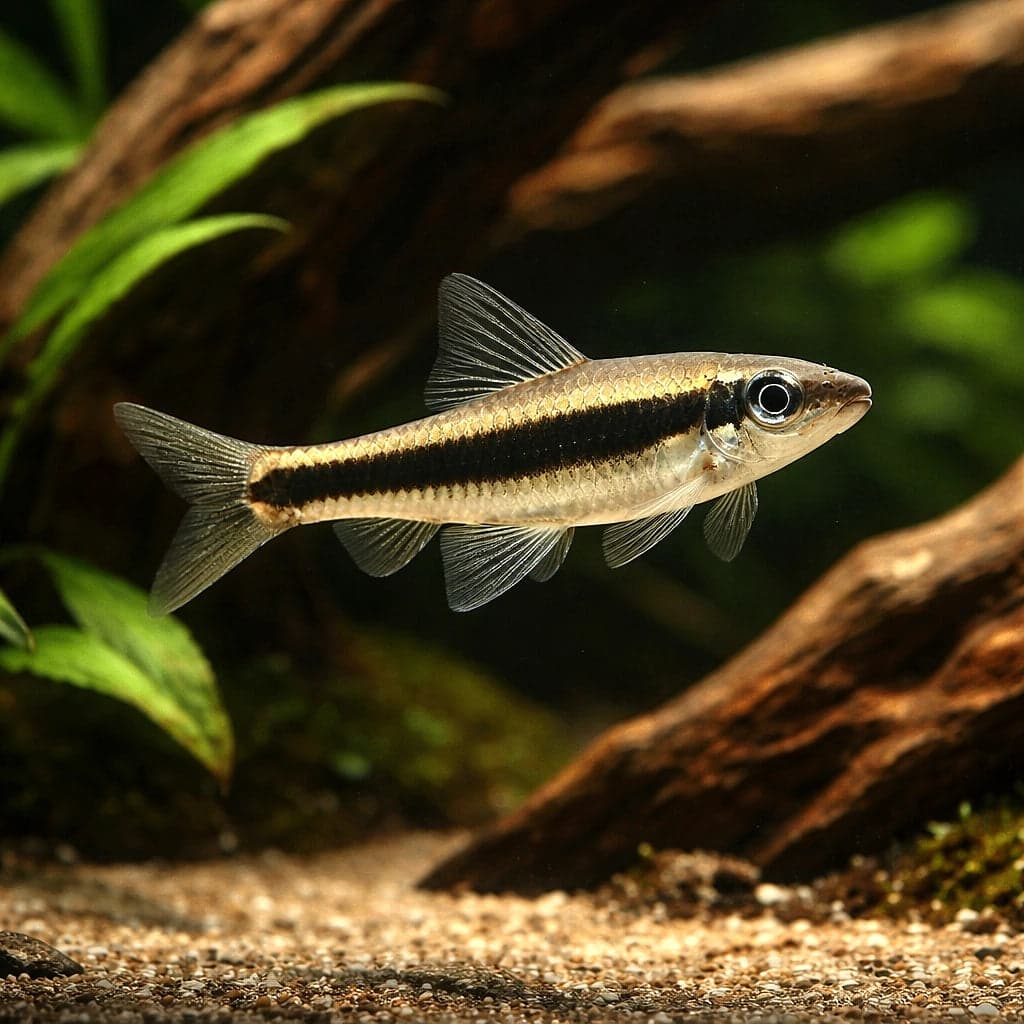
The real Siamese algae eater (Crossocheilus oblongus) is the only fish that reliably eats black beard algae in planted tanks — but most UK shops sell false SAEs (flying foxes, red-tail sharks) that look similar but don't eat BBA. How to spot the real one + the five best algae-eating species for a UK planted tank.
Why this page exists — and why every other SAE guide gets the basics wrong
Most "Siamese algae eater" Google results are written by people who have never identified the species in person. They confuse four similar-looking fish, recommend groups that don't work, and skip the single crucial fact about the species: it's the only fish that eats black beard algae.
I'm James. I've run planted tanks with SAEs through two BBA outbreaks and one hair-algae surge. This is the version of the guide I'd send to a friend who just bought a CO₂ rig and is seeing the first black tufts on their driftwood.

A Silver Flying Fox (Epalzeorhynchos kalopterus). Note the yellow and black fin markings — the immediate tell that separates this from the real Siamese algae eater, whose fins are clear. Photo: Tropical Fish Co warehouse.
Five facts most "SAE buying guides" miss
- "Siamese algae eater" used to mean four different species. The taxonomic revision in 2019 split what was historically sold as a single species into multiple distinct species — Crossocheilus oblongus, C. siamensis, C. atrilimes, and several others [?]. Most UK stock is now confirmed C. oblongus.
- SAEs are the only fish that eats black beard algae. Not exaggeration — it's genuinely the only species in the UK freshwater trade that grazes BBA. This is the main reason planted aquascapers keep them [?].
- Real SAEs have NO colour on their fins. Their fins are clear or very pale grey. If you see red, yellow, orange, or strong black markings on the dorsal, tail, or pectoral fins — it's a false SAE [?].
- They can live 10 years. Well-kept adults in a stable planted tank routinely reach 10 years old [?].
- They tolerate the full UK tap-water range. Hardness from 5 to 20 dGH and pH from 6.5 to 8.0 [?], which means every UK postcode's tap water works [?].
How to tell a real Siamese algae eater from a fake one
This is the single most important section of the page.
Head-to-head: the four fish sold as "Siamese algae eater" in UK shops
| Species | Tail stripe? | Fin markings? | Eats BBA? | Adult size | UK price |
|---|---|---|---|---|---|
| Real SAE (Crossocheilus oblongus) | ✓ Extends through tail | None (clear fins) | ✓ Yes | 14–16 cm | £25–£35 |
| Flying Fox (Epalzeorhynchus kalopterus) | ✗ Stops at tail base | Yellow/red on dorsal + tail | ✗ No | 14 cm | £5–£8 |
| False Siamensis (C. langei) | Extends partway into tail | Some black on dorsal | Partial | 12 cm | £10–£15 |
| Red-tail Shark (Epalzeorhynchos frenatum) | ✗ Solid black body, red tail | Solid red tail | ✗ No | 15 cm | £4–£8 |
The single diagnostic is the tail stripe + fin colouration. If the stripe stops at the tail base, it's not the real SAE. If the fins have colour markings, it's not the real SAE.
The black beard algae problem — why you bought this guide
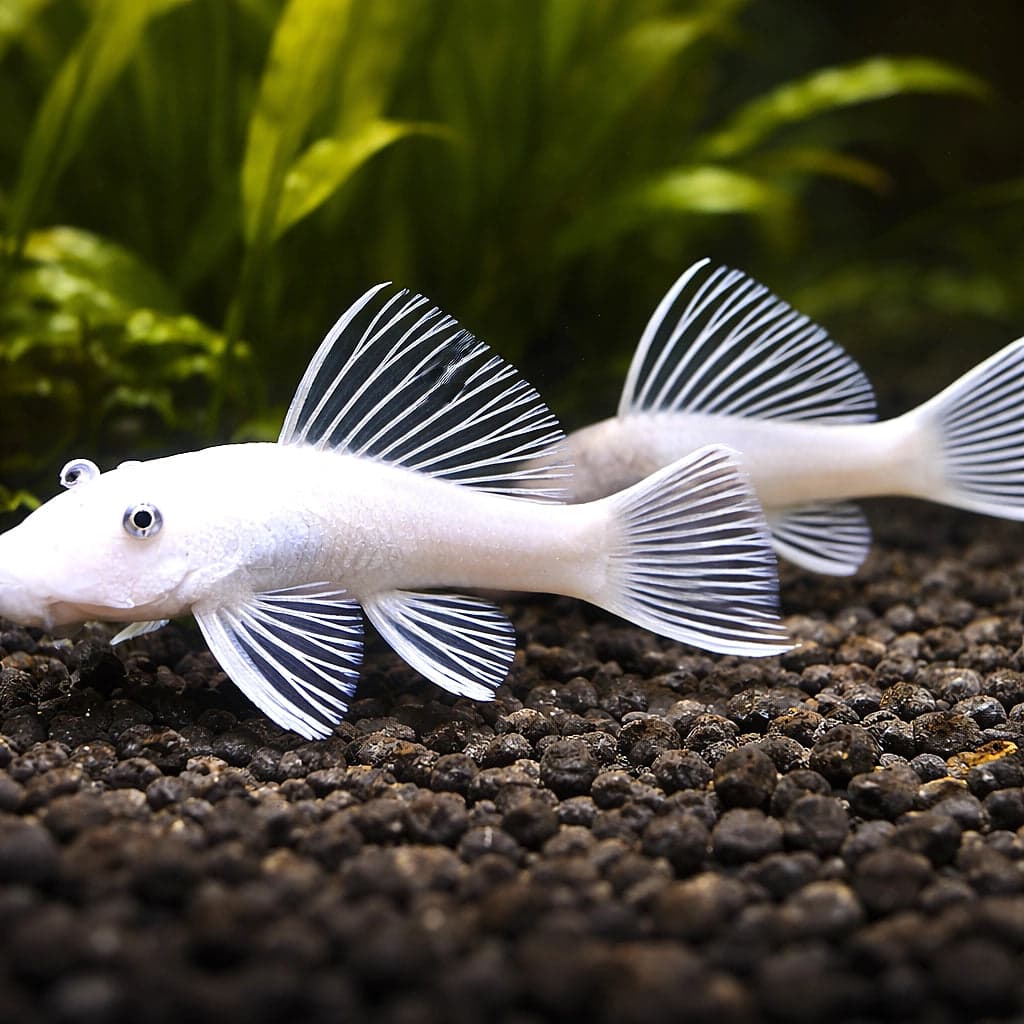
A Snow White Bristlenose Pleco. Plecos and SAEs work in tandem — plecos handle green algae and biofilm, SAEs handle BBA [?]. Neither species alone controls everything in a planted tank. Photo: Tropical Fish Co warehouse.
What BBA actually is
Black beard algae is a red algae (Audouinella / Compsopogon complex) that appears as dark tufts on driftwood, plant leaves, and filter outlets. It loves moving water and thrives in tanks where CO₂ is unstable or where flow patterns create dead spots.
The biological control options (ranked)
- Real Siamese algae eater — the only species that actually eats it. Expect 2–4 weeks to clear a visible outbreak.
- Amano shrimp — will nibble BBA when very hungry; not reliable, but they chew down the early-stage tufts.
- Everything else on the internet — myth. Bristlenose plecos, otocinclus, ramshorn snails, flying foxes, cherry shrimp: all ignore BBA [?].
Chemical control alternative
Excel / liquid carbon (Seachem Flourish Excel, APT Fix) kills BBA on contact when spot-treated with a syringe. Works but kills mosses and vallisneria if overdone. Most aquascapers combine: an SAE for ongoing control + Excel spot-treatment for stubborn patches.
Tank size and stocking
Minimum tank: 120 L for a single SAE. Recommended: 200 L+ for a pair or group.
Stocking guide by tank size:
- 120 L planted — 1 SAE + full community below (tetras, shrimp, corydoras, otocinclus) — the classic single-SAE planted setup
- 180 L planted — 1 SAE + 2 L-number plecos OR a pair of dwarf cichlids — still solo for the SAE, larger community around it
- 250 L+ planted — 5 SAEs + any compatible community — the first tank size where keeping them in a group works
Watch: a mature planted tank with an SAE grazing
Tank mates for a Siamese algae eater
SAEs work well with almost anything peaceful. The rules are:
- No fin-nippers — barbs will nip the SAE's dorsal
- No territorial species — red-tail sharks, blue rams, and adult bettas will fight a settled SAE
- Nothing small enough to eat — fry from livebearers will be picked off
Safe community pairings:
- Schooling tetras — cardinals, embers, harlequin rasboras, neons all work well. The SAE ignores water-column fish.
- Corydoras catfish — different feeding zone (substrate), no conflict.
- Otocinclus — different algae preference, different feeding zone. Excellent partnership.
- Amano shrimp — safe in large enough tanks. Juvenile shrimp may be snacked on.
- Bristlenose pleco — compatible if the tank is 180 L+. Below that, territorial overlap becomes an issue.
When your SAE arrives — our UK delivery protocol
SAEs ship well. Their body size and low stress response mean they tolerate the 14–20 hour overnight courier journey better than smaller, more delicate tetras.
- Open in a quiet room, lights dim.
- Float the bag 20 minutes sealed.
- Drip-acclimate 40 minutes at 1–2 drops per second.
- Net into the tank.
- Lights off 2 hours — SAEs need to find their preferred hiding spot before lights come on.
- No feeding for 24 hours. They'll start grazing on whatever algae is in the tank within 48 hours.
The single most common mistake I see: new planted-tank keepers buy 3 SAEs because "they shoal". They don't. In a group of 3 one dominates and the other two hide behind the heater and starve. Either buy ONE for any tank under 250 L, or buy FIVE+ for a tank 250 L+ [?].
Ready for more?
Looking at the other algae specialists? See our ancistrus pleco guide for the best biological control on green algae, or the otocinclus care guide for the nano-tank glass-cleaner. The amano shrimp care guide covers the invertebrate half of the algae crew.
Shopping for the full planted-tank algae stack? Start at the catfish & plecos hub.
Frequently asked questions
Related guides
Amano Shrimp UK: Algae-Eating Specialist Every Planted Tank Needs
Amano shrimp (Caridina multidentata) — the algae crew every UK planted tank needs. Why they can't breed in freshwater, what they actually eat, welfare-first delivery.
Ancistrus Pleco UK: The Complete 2026 Bristlenose Guide
Everything UK aquarists need to buy and keep bristlenose plecos — size, tank mates, colour morphs (albino, longfin, super red, L-number). The only pleco that fits a 90 L tank.
Angelfish UK: Species Biology, Welfare & The Colour Strains In Stock
Angelfish (Pterophyllum scalare) — South American cichlid biology, pairing behaviour, strain genetics, UK welfare requirements, and the 10 colour strains we ship.