Guppies in the UK: The Complete 2026 Buying & Care Guide
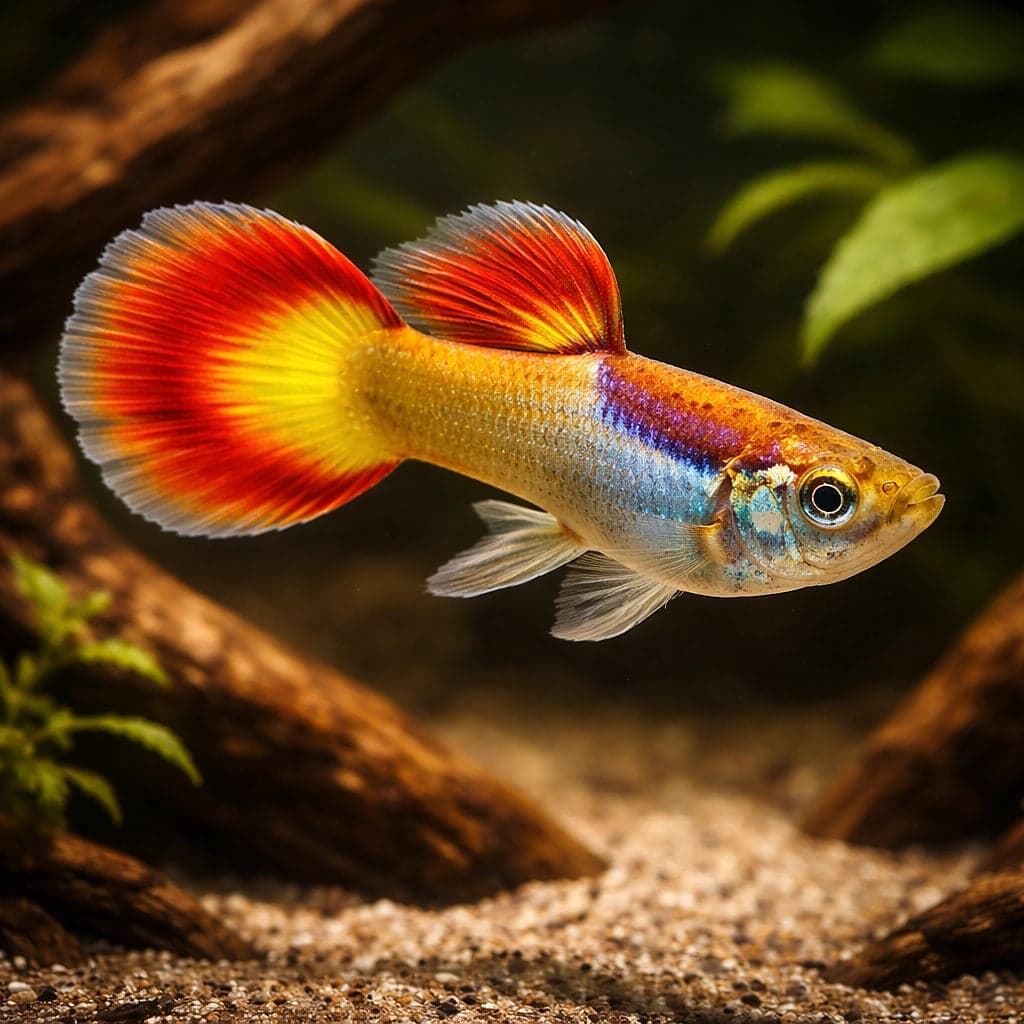
Guppies are the UK's most beginner-friendly tropical fish — hardy, tolerant of hard UK tap water, and available in dozens of colour strains. 60-litre minimum for a group of 6–8 males, 90-litre for a breeding trio. Plan for fry if you buy mixed sexes.
Why a guppy page, when every site on Google has one?
Because most guppy guides on Google are copy-paste garbage written by people who've never kept the fish. Neon tetra lifespan claims, wild-habitat descriptions written from Wikipedia, and "easy care" stuck in the meta description with no actual beginner-specific advice.
I'm Tom, I keep guppies in my flat right now, and I lose exactly zero fish a year because I get the three decisions above right. This is the version of the guide I'd send to someone on my YouTube channel DMs asking "should my first tank be guppies?".
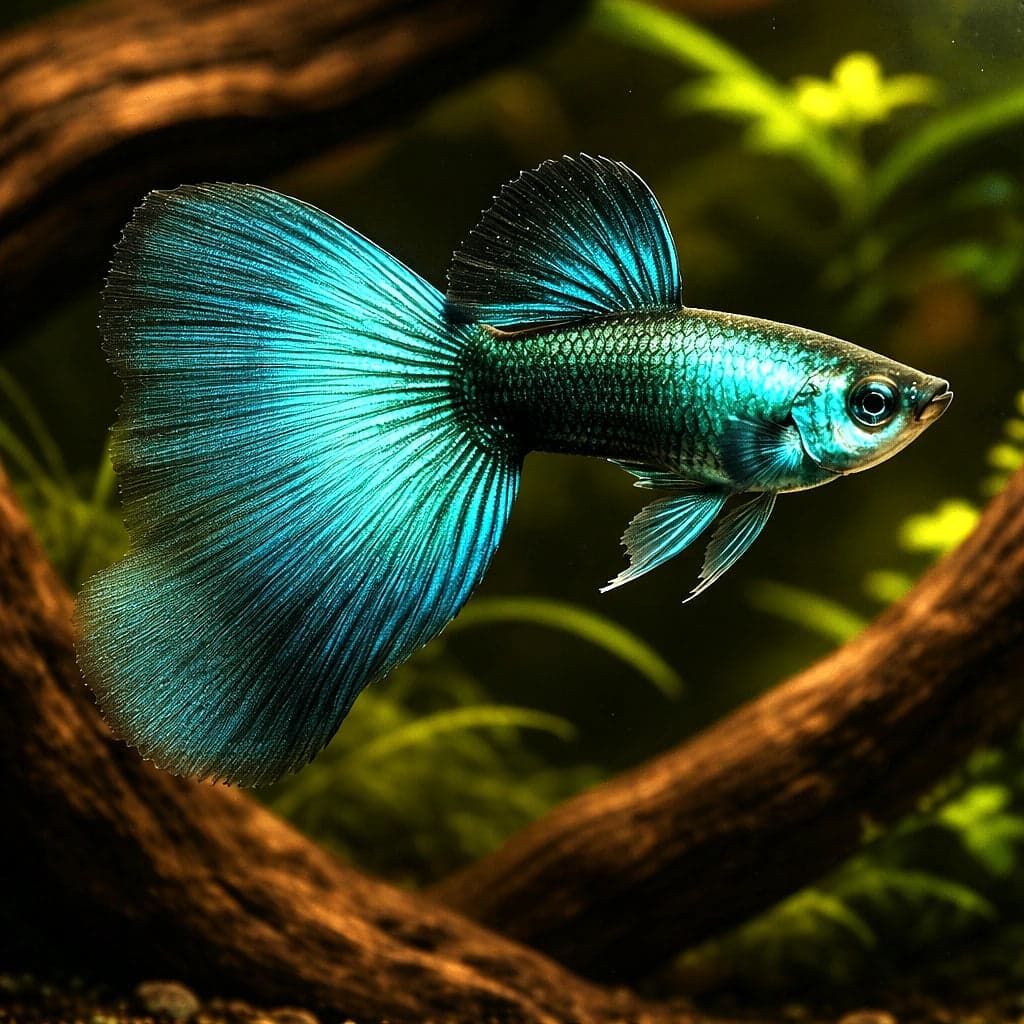
Green Moscow male — the darker end of the colour spectrum. One of the 12+ guppy colour strains currently in our holding tanks. Photo: Tropical Fish Co warehouse.
Five facts most UK guppy guides never mention
- Guppies have been the UK's top-selling tropical since 1908. They were the first ornamental tropical fish imported in commercial volume to Britain, via the Liverpool docks from Trinidad and Venezuela. Every sales ranking since has kept them in the top 3 [?].
- Female guppies store sperm for up to 8 months. A female that was in a mixed tank at any point in the last 8 months can drop fry without a male present. This is why "I separated the sexes and they still bred" keeps happening to beginners [?].
- The colour on males is sexually selected, not accidental. The reason guppies have such absurd colour diversity is that females actively choose brighter males — and the predation pressure in the wild selects against them. Tank-bred guppies under zero predation get WILDER colours each generation [?].
- Pure-strain Endlers are now almost extinct in the UK trade. The original Poecilia wingei discovered in Venezuela in 1975 is now rarely available pure — most "Endlers" sold in UK shops are endler × guppy hybrids because the two freely interbreed.
- Guppies tolerate more UK tap chemistry than any other tropical fish. FishBase lists their pH range as 7.0–8.5 and hardness range as 8–25 dGH [?]. Almost every UK postcode's tap water sits comfortably inside that range [?].
Male-only vs mixed — the decision that shapes everything
The biggest regret I see from beginner guppy keepers isn't tank size or water parameters — it's choosing a mixed-sex group without thinking about what that means.
Every adult female guppy in a UK pet shop has almost certainly been in a mixed tank. She's pregnant. She will drop 20–60 fry within four weeks of you bringing her home. And because females store sperm for up to 8 months [?], she'll drop again, and again, every 30–45 days for the rest of her life — even if you never add another male.
The three ways this usually goes wrong
| Decision | What the beginner expects | What actually happens |
|---|---|---|
| Buy 3 males + 3 females "for balance" | A small peaceful community | 50+ fry in 6 weeks, tank overstocked, water quality crashes |
| Buy mixed, plan to sell fry | Easy side-income | No aquarium shop buys hobbyist fry — they get market-rate from commercial farms |
| Buy all-female "for peace" | Calm group | Every female drops fry in the first 4 weeks anyway (stored sperm) |
The simple rule
- Display-tank only → buy 6–8 males. All colour, no fry, no drama.
- Intentional breeding project → buy a 1:2 ratio. Accept you'll need a separate grow-out tank.
- Wanted fry accidentally → set up a 30 L grow-out. Then thin the colony back down to all-males once the current females age out.
How many guppies do you need?
The short version: six male guppies is the minimum that looks and behaves like a school. Smaller groups get chased off by tank mates, hide behind the heater, and lose colour.
- 60 L planted — 6–8 male guppies + 6 cherry shrimp + 1 pleco or pair of Corydoras
- 90 L planted — 10–12 guppies + 6–8 corydoras + 1 centrepiece (honey gourami or bristlenose)
- 120 L planted — breeding colony (6 males + 12 females) OR two schooling species together
Fancy vs wild-type — which guppy is right for your tank?
Two philosophies sell guppies in the UK, and they look completely different in a tank.
Head-to-head: the two philosophies of guppy-keeping
| Attribute | Fancy-strain guppies | Wild-type / Endler guppies |
|---|---|---|
| Adult male size | 3.5–4 cm | 2–2.5 cm |
| Tail fin | Huge, flowing | Short, functional |
| Colour | Huge colour variation, bred for patterns | Bright but compact colour patches |
| Lifespan | 2 years (compressed by inbreeding) | 3+ years |
| Suitable for nano tanks (30–40 L) | No — too much finnage | Yes — perfect |
| Price each | £2.50–£12 (show-strains) | £3–£6 |
| Breeds true to strain | Some lines yes, many hybridise | Endlers yes, if kept pure |
For a first tank — fancies look more impressive on day one. For a long-term tank — wild-types age better and stay sharper.
Watch: what a stable guppy community tank looks like
The clip below is our warehouse 90 L livebearer display. The rule we follow in this tank: 8 male guppies + 4 platies + 6 corydoras + a dozen cherry shrimp. No females of any fish. Everyone settles.
Tank mates that actually work
The golden rule for guppies: no fin-nippers, no predators. Their long fancy tails are an irresistible target for barbs, tetras, and even young angelfish.
- Corydoras habrosus, pygmaeus, or paleatus — the best guppy substrate mate. Ignores the water column, keeps the bottom tidy.
- Bronze or peppered corydoras — slightly bigger, still peaceful.
- Bristlenose plecos (up to 10 cm) — the algae specialist. A pair in a 90 L+ is ideal.
- Cherry or neocaridina shrimp — adults are safe. Shrimp fry will be picked off by guppies — acceptable population control.
- Honey gouramis — gentle centrepiece fish, similar water needs.
- Harlequin rasboras — peaceful schooler that stays mid-water out of guppy territory.
Avoid: Tiger barbs (fin-nip), male bettas (attack guppy tails in some lines), angelfish (eat adult guppies once grown), dwarf cichlids (territorial).
Rare and show-strain guppies in stock
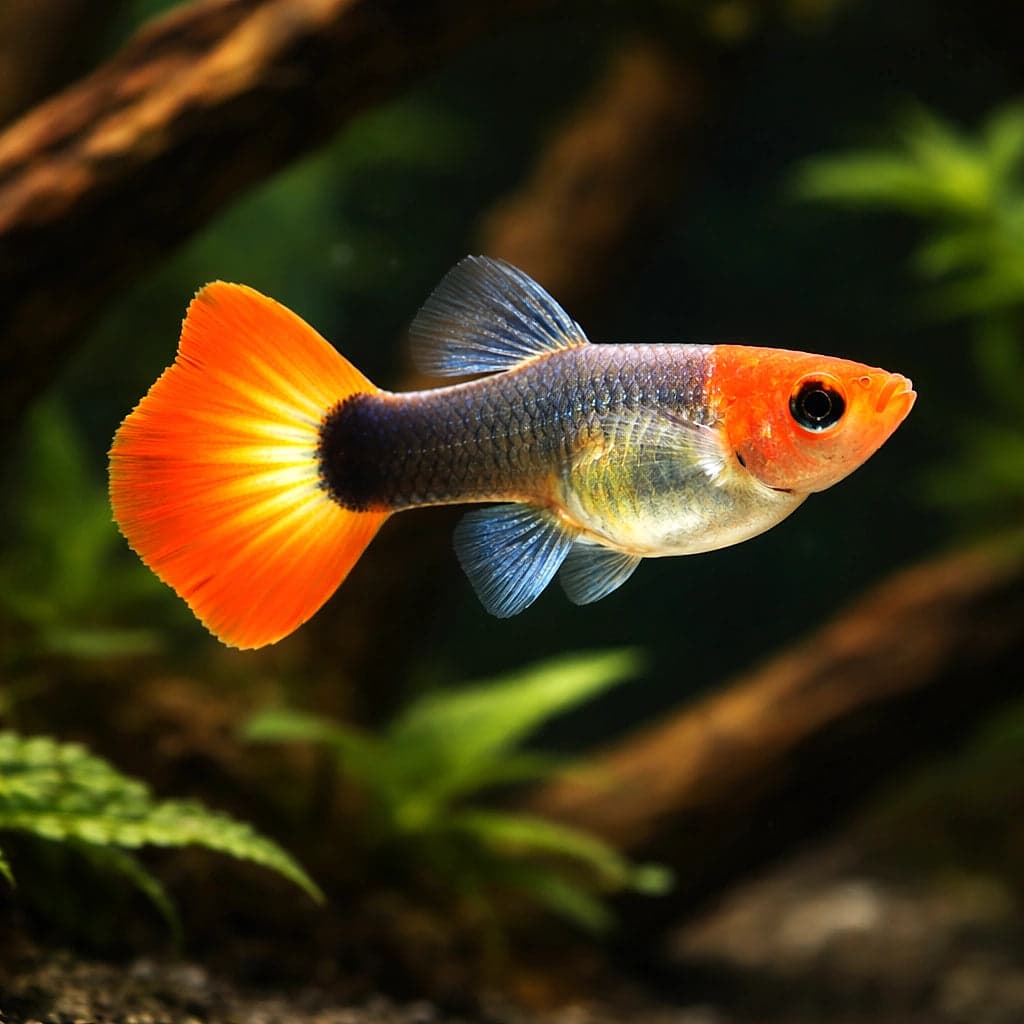
Female Red Cap guppy. Female strains carry the same genetic colour markers as males but with understated patterning. Photo: Tropical Fish Co warehouse.
If you're past the beginner stage and want rarer lines, we stock Moscow Blacks (female 6744 pictured in stock), albino strains, elephant-ear lines, and the occasional double-sword. These sell fast — check the livebearer hub weekly for the full refresh.
Guppy colour-strain genetics — what breeds true, what doesn't
If you want a stable colony of a specific colour strain, the genetics matter. Not every strain breeds true; mixing lines regresses quickly to wild-type brown-grey.
| Strain | Breeds true? | Mixing risk | Notes |
|---|---|---|---|
| Fire Red Cherry (wild-type red) | ✓ Dominant line | Low | Established trait, dominant |
| Moscow Black | Partial | High if mixed with non-Moscow | Recessive modifier, needs closed line |
| Endler's (pure Poecilia wingei) | ✓ Only with pure Endlers | Critical — hybridises with guppy | Keep species-separate |
| Half-moon tail | Partial | Moderate | Tail gene often throws mixed |
| Elephant Ear (pectoral modification) | Partial | Moderate | Dominant but incomplete penetrance |
| Albino / Gold | ✓ Recessive line | Low if closed | Shows only when both parents carry |
| German Sunset | Partial | High | Multiple modifiers; line-breed required |
| Green Moscow | Partial | High | Needs strict selection |
Single-strain tanks breed true. Mixed-strain tanks produce interesting F1 hybrids and then regress. The BLA club scene below is where serious strain-work happens in the UK — pure lines get traded at meets rather than through retail.
Colour-strain compatibility matrix
| Strain A → keeps with strain B? | Fire Red | Moscow Black | Endler | Fancy Mix |
|---|---|---|---|---|
| Fire Red | ✓ Same | ✗ Regresses | ✗ Hybrids | ✓ But weak breeds |
| Moscow Black | ✗ | ✓ Same | ✗ | ✗ |
| Endler | ✗ | ✗ | ✓ | ✗ |
| Fancy Mix | ✓ Generic | ✗ | ✗ | ✓ Mutt |
The horizontal axis is which strain you're adding; vertical is what's already in the tank. Most boxes are "no" — guppy genetics don't play well with mixing if you care about strain stability.
UK guppy community — clubs, forums, and friends
One thing Google rarely surfaces: buying guppies is a LOT more fun when you have people to share strains with. The UK has a surprisingly active guppy community once you know where to look.
Formal clubs
- British Livebearer Association (BLA) — runs meetups, publishes a strain-judging guide, hosts an annual show. The primary UK organisation for serious guppy and livebearer keepers [?].
- International Fancy Guppy Association (IFGA) UK chapter — for show-strain keepers competing at international standard.
- Federation of British Aquatic Societies (FBAS) — umbrella body covering ~70 regional UK fishkeeping clubs, many of which run dedicated livebearer sections.
Where the everyday community actually lives
- r/Aquariums + r/livebearers on Reddit — 2M+ members combined, helpful UK-specific threads every week
- "UK Aquarists" Facebook group — 40K+ members, quick answers on UK water chemistry and shop recommendations
- Fishkeeping.co.uk forum — smaller, older, higher signal-to- noise ratio than Facebook
- YouTube channels — Tom's own channel ("Tiny Tanks, Slow Pace") leans nano + beginner; Aquarium Co-Op is US-based but their livebearer advice translates directly
Finding local friends who breed guppies
If you want rare strains (Moscow blacks, dragon-skin, panda-pied), your best bet is the BLA meetups where hobbyists trade breeding pairs at cost rather than through commercial retail. A pair of pure-strain Moscow Blacks goes for £20–£40 at a club meet vs £60+ through specialist retailers.
When your guppies arrive — our UK delivery protocol
Guppies are one of the hardiest shippers in the hobby. Even so, the acclimation protocol matters — these are tank-bred fish that will have seen a narrow water-chemistry range their whole lives [?].
- Open in a dim, quiet room. Guppies stress less than cardinals on arrival but still benefit from low light.
- Float 15 minutes sealed. Temperature equalisation.
- Drip-acclimate 30 minutes. Guppies don't need the 45-minute deep drip that cardinals need — their tolerance is wider.
- Net into the tank. Don't pour the bag water in.
- Lights off 1 hour. Let them find cover.
- No feeding for 12 hours. Resume normal feeding the next morning.
Live arrival guarantee: photograph the unopened bag within 2 hours if any fish arrive dead. We refund or replace at our cost.
What to look for when you buy live guppies
Healthy guppies tell you they're healthy before you buy. Here's the 30-second visual check:
- Fins upright and flowing. Clamped fins pressed against the body = stress or beginning of disease.
- Active mid-water swimming. Guppies park at the surface, not the bottom. Bottom-sitting = ammonia poisoning or swim-bladder issue.
- Bright, saturated colour. Washed-out colour = stress or poor husbandry at the supplier. Walk away.
- Straight spine. Curvature (scoliosis) is common in ornamental-bred guppies and shortens lifespan considerably.
- No white spots (ich) or velvet (gold dust). Check under bright tank lighting before buying.
My first guppies came from a pet-shop chain with 40 fish in a small overstocked tank. All six died within a month. The lesson — still true today — is that pet-shop chains buy from central wholesalers where one tank infection cross-contaminates every species in the shop. Specialist retailers quarantine species-by- species. It's a £5 price difference and a 10-fold survival difference on the first month.
Ready for more?
If you're new to the whole hobby, our best beginner tropical fish guide positions guppies alongside the other nine species I'd recommend for a first tank.
For a single-species deep-dive on guppy care, breeding, and strain genetics, the guppy care guide is where to go next. If you decide a nano tank suits your space better, consider Endler's livebearers as the sharper, smaller alternative.
Already know what you want? The full in-stock livebearer range is at the livebearers hub.
Frequently asked questions
Related guides
Amano Shrimp UK: Algae-Eating Specialist Every Planted Tank Needs
Amano shrimp (Caridina multidentata) — the algae crew every UK planted tank needs. Why they can't breed in freshwater, what they actually eat, welfare-first delivery.
Ancistrus Pleco UK: The Complete 2026 Bristlenose Guide
Everything UK aquarists need to buy and keep bristlenose plecos — size, tank mates, colour morphs (albino, longfin, super red, L-number). The only pleco that fits a 90 L tank.
Angelfish UK: Species Biology, Welfare & The Colour Strains In Stock
Angelfish (Pterophyllum scalare) — South American cichlid biology, pairing behaviour, strain genetics, UK welfare requirements, and the 10 colour strains we ship.