Black Phantom Tetra UK: Complete 2026 Buying & Care Guide
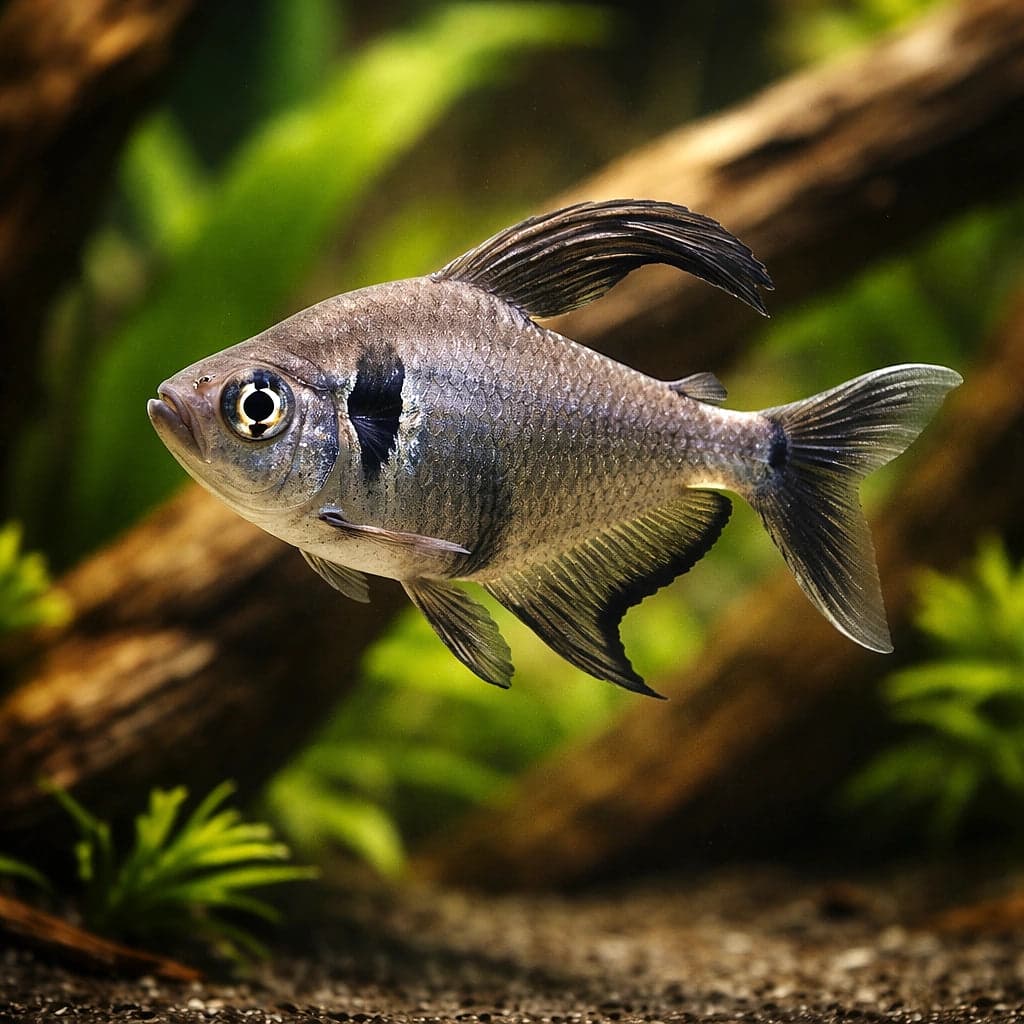
Black phantom tetras are the largest of the commonly-kept UK tetras at 4.5 cm — darker, bolder, and with more individual personality than neons or cardinals. Males display dramatically to each other without injury. 60 L minimum for a group of 8.
Why black phantom tetras are underrated
The UK aquarium hobby defaults to neon tetras and cardinal tetras for schooling displays. Phantoms are the underdog — less famous, more character per fish, and visibly bigger in a 60 L planted tank.
I'm Hannah. I've photographed black phantom tetras across four of my own display setups and at least a dozen aquascape contest entries. This guide is the case for phantoms — the species I'd recommend for anyone whose first fish choice would have been neons.

A Red Phantom Tetra (Hyphessobrycon sweglesi). Often mistaken for a separate species, it's the reddish-orange counterpart to black phantoms — same care, opposite colour palette. Photo: Tropical Fish Co warehouse.
Five facts most phantom-tetra buyers miss
- Black phantoms are 50% bigger than neons. At 4.5 cm adult size vs 3 cm for a neon tetra, phantoms give you visibly more fish per tank volume [?].
- Male displays are ritualised, not violent. The elaborate fin-flaring between males looks aggressive but is entirely symbolic — physiological markers show no stress-cortisol spikes during displays [?].
- Two species, same common name ambiguity. "Phantom tetra" commonly refers to black (H. megalopterus) or red (H. sweglesi) — they're different species that co-occur in the wild and freely school together in aquariums [?].
- They handle harder UK water than most South American tetras. The range 2–15 dGH covers almost every UK postcode [?], unlike cardinal tetras (≤10) which struggle in London + SE England.
- They're one of the few tetras that breeds on plants, not substrate. Egg-scattering onto fine-leaved plants rather than substrate scattering — useful for planted-tank breeding without a separate breeding tank [?].
Phantom vs neon vs cardinal — which schooler for your planted tank?
Head-to-head: the four most-popular UK schooling tetras
| Attribute | Black Phantom | Red Phantom | Cardinal | Neon |
|---|---|---|---|---|
| Adult size | 4.5 cm | 4 cm | 3.5–5 cm | 3 cm |
| Minimum tank | 60 L | 60 L | 60 L | 40 L |
| Water hardness | 2–15 dGH | 2–15 dGH | 1–10 dGH | 2–12 dGH |
| UK tap OK? | ✓ Yes | ✓ Yes | ✗ soft only | Maybe |
| Male display behaviour | ✓ Dramatic | ✓ Dramatic | ✗ | ✗ |
| Lifespan | 5 years | 5 years | 5–8 years | 2–3 years |
| Colour intensity | Silver + black | Red-orange | Red + blue | Red + blue |
| Beginner-friendly | Yes | Yes | Maybe | Yes |
Phantoms offer the UK hobbyist the best combination of hardy + hard-water tolerant + interesting behaviour. For pure visual impact in a soft-water tank, cardinals still win.
Sex ratio + group size — the display rule
Male black phantoms display to each other constantly when conditions are right. It's half the reason to keep them. But this only happens when:
- Group size ≥ 8. Fewer and the displays don't trigger.
- Male:female ratio 1:2. Male-heavy and males harass females. Female-heavy and males stop displaying.
- Mature tank — 8+ weeks cycled. New tanks suppress displays.
How to sex black phantom tetras
- Males — black dorsal fin extends longer and taller; body slimmer; active in mid-water.
- Females — rounder body (especially when carrying eggs); slightly reddish tint on belly; shorter dorsal fin.
Sex identification is possible at 2.5 cm+ body length, so juveniles in the shop tank can be sexed if you look closely.
Tank setup for a phantom display
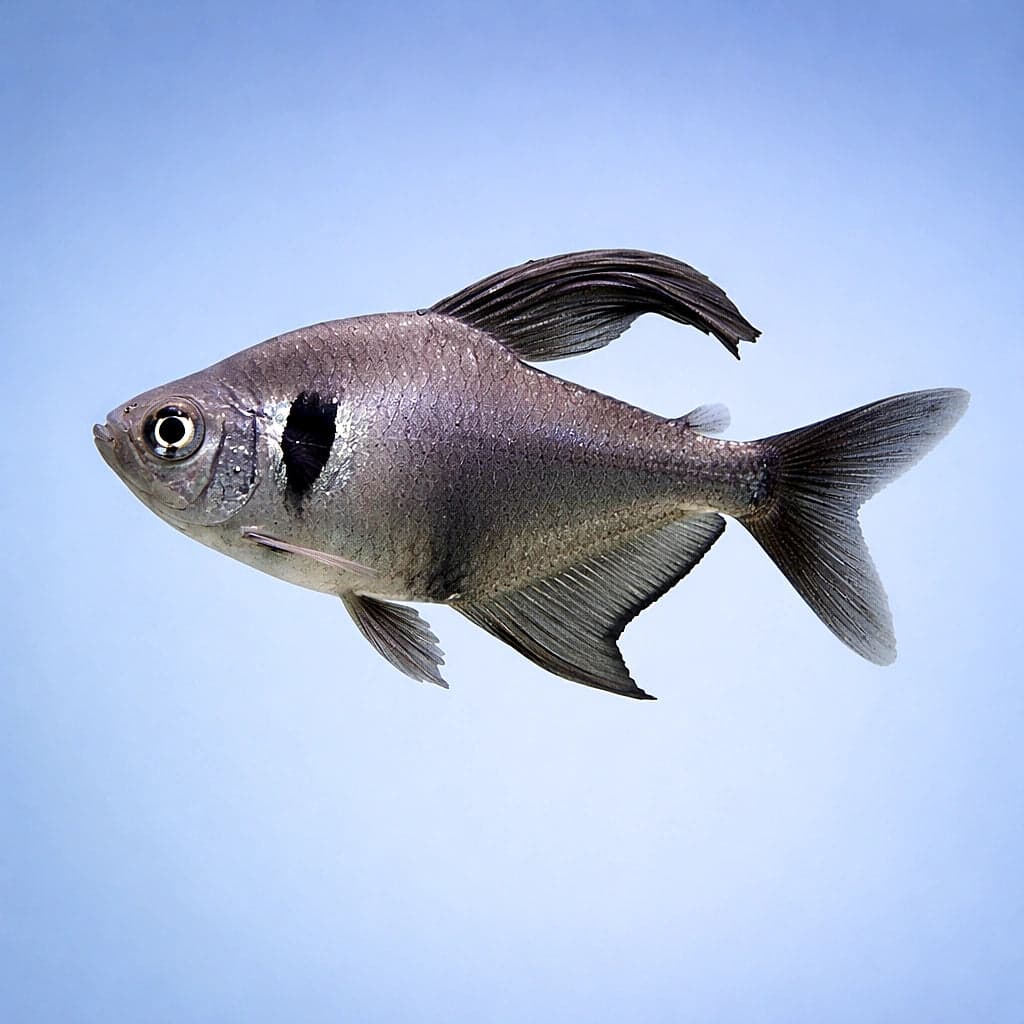
Side view of a Black Phantom Tetra showing the distinctive vertical black bar behind the gill plate — the key identification feature separating this from similar Hyphessobrycon species. Photo: Tropical Fish Co warehouse.
The 5 things that make a phantom display work
- 60 L+ tank with open mid-water swimming space
- Dense background planting (vallisneria, amazon sword, crypts) for males to break territory between
- Tannins (Indian almond leaf, driftwood leaching) — phantoms show deepest colour in tea-coloured water
- Gentle flow — avoid high-current filters
- Low-medium lighting — 6–8 hours/day. Phantoms wash out under bright tropical lighting
Watch: phantom tetras in a display tank
Tank mates that work
- Cardinal + ember tetras — same water preferences, different size classes, no conflict
- Harlequin rasboras — complementary colour palette (gold vs silver)
- Corydoras (habrosus, pygmaeus, paleatus) — substrate specialists, no overlap
- Amano shrimp — safe adult shrimp
- Honey gouramis — peaceful labyrinth-fish centrepiece
- Otocinclus — algae specialist, different zone
Avoid: Angelfish (eat adult phantoms once mature), tiger barbs (fin-nip), male bettas (aggressive to all small schoolers).
Male display behaviour — what to watch for
The male-to-male display is the most interesting behavioural feature of black phantom tetras, and timing it matters. Two displaying males perform a sequence that lasts 30–90 seconds and repeats multiple times a day in a healthy tank:
| Phase | What you see | Duration |
|---|---|---|
| Approach | Two males swim toward each other head-on | 5–10 sec |
| Fin-flare | Both males extend dorsal + anal + ventral fins fully | 10–30 sec |
| Lateral display | Males turn sideways, "sparring" parallel | 15–45 sec |
| Retreat | One male breaks off; both resume schooling | 2–5 sec |
Healthy displays happen 3–8 times/day. If you never see one, either your male:male ratio is wrong (too few males), the group is too small (under 8), or the tank is stressing them (check water quality).
Sex-ratio planning table
| Group size | Male:female ratio | Expected display frequency | Community suitability |
|---|---|---|---|
| 6 (minimum) | 2 : 4 | Low — barely triggers | Acceptable |
| 8 | 3 : 5 | Healthy | Good |
| 10 | 3 : 7 OR 4 : 6 | Peak visible behaviour | Excellent |
| 12+ | 4 : 8 OR 5 : 7 | Saturated display behaviour | Needs 90 L+ |
Avoid male-heavy ratios. 4 males + 4 females in a 60 L tank = constant chasing of females. Females outnumber males 2:1 or close to it for a peaceful, display-rich school.
Pre-purchase visual check
- Group size in shop tank — phantoms in groups of 3–4 will have been stressed recently; buy from a shop tank with 10+
- Colour — washed-out silver = recent stress; darker silver with visible black bar behind the gill = settled
- Active mid-water swimming — phantoms shouldn't hide. Healthy school moves together in the tank's middle third.
- Fin condition — trailing fins intact (not shredded). Shredded fins mean aggressive tank mates at the supplier.
UK tetra community
- FBAS Tetra Interest Group — hobby-focused tetra-specialist community
- Reddit r/Aquariums + r/PlantedTank — UK-active, quick answers on tetra species questions
- Facebook "UK Aquarium Plants + Fish" — breeder trades, occasional rare phantom lines
- Practical Fishkeeping features phantom tetras every 12–18 months — check archives for deep articles
When your phantoms arrive — delivery protocol
Phantoms ship moderately well. Slightly more sensitive than embers but hardier than cardinals.
- Quiet, dim unpacking.
- Float bag 15 minutes sealed.
- Drip-acclimate 30 minutes.
- Net into tank.
- Lights off 2 hours.
- No feeding for 24 hours.
Live arrival guarantee: photograph unopened bags within 2 hours of delivery. Replacement at our cost.
Ready for more?
For a deeper species comparison, our cardinal tetra guide covers the soft-water flagship, and ember tetras the nano-tank alternative. The best beginner tropical fish list positions phantoms alongside the other hardy community choices.
Shopping the full tetra range? See the tetras hub for everything in stock this week. Related care guides: the cardinal tetra care guide and the ember tetra care guide.
Frequently asked questions
Related guides
Amano Shrimp UK: Algae-Eating Specialist Every Planted Tank Needs
Amano shrimp (Caridina multidentata) — the algae crew every UK planted tank needs. Why they can't breed in freshwater, what they actually eat, welfare-first delivery.
Ancistrus Pleco UK: The Complete 2026 Bristlenose Guide
Everything UK aquarists need to buy and keep bristlenose plecos — size, tank mates, colour morphs (albino, longfin, super red, L-number). The only pleco that fits a 90 L tank.
Angelfish UK: Species Biology, Welfare & The Colour Strains In Stock
Angelfish (Pterophyllum scalare) — South American cichlid biology, pairing behaviour, strain genetics, UK welfare requirements, and the 10 colour strains we ship.