Cherry Shrimp UK: Colour Strains, Water, Welfare & Every In-Stock Morph
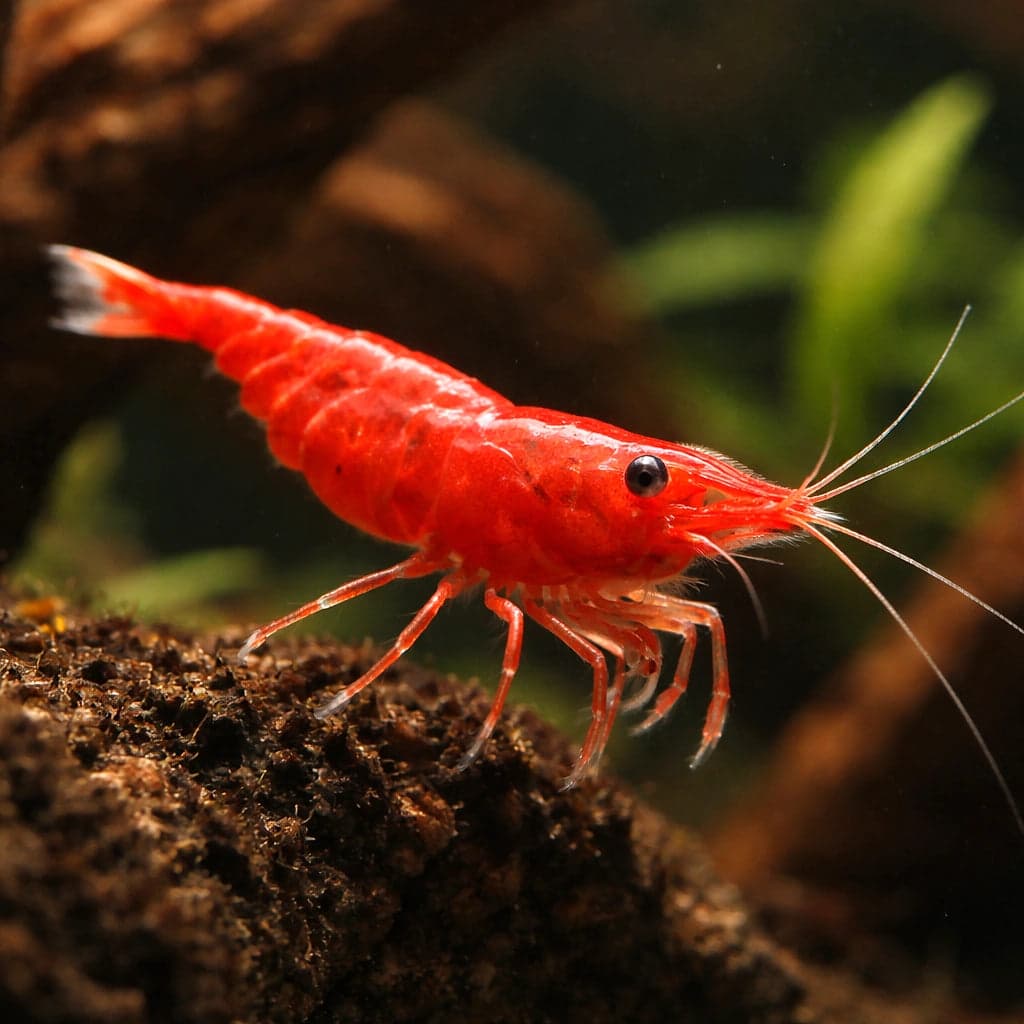
Cherry shrimp are the UK hobby's most-kept invertebrate — Neocaridina davidi, the Taiwanese domesticated colour strains of a wild brown-grey shrimp. 12 colour morphs currently in UK trade. A colony of 10 in a planted 30 L self-sustains forever if water parameters stay stable.
What a cherry shrimp actually is
Before the colour morphs, the marketing, and the planted-tank instagram photography — a cherry shrimp is a two-centimetre freshwater invertebrate from streams in southern China, Taiwan, Vietnam, and Korea. The wild form is brown-grey and almost invisible against substrate [?].
Every colour you see in the UK hobby — fire red, painted fire red, rili, snow white, blue jelly, yellow neon, chocolate, green orange, blue pearl, carbon rili — is a selectively-bred strain of the same species, Neocaridina davidi [?]. The breeding work that created these colours happened mostly in Taiwan between the early 1990s and 2010s. Before that, the cherry shrimp in UK tanks was the ordinary red strain; now there are more colour lines than I can photograph in a year.
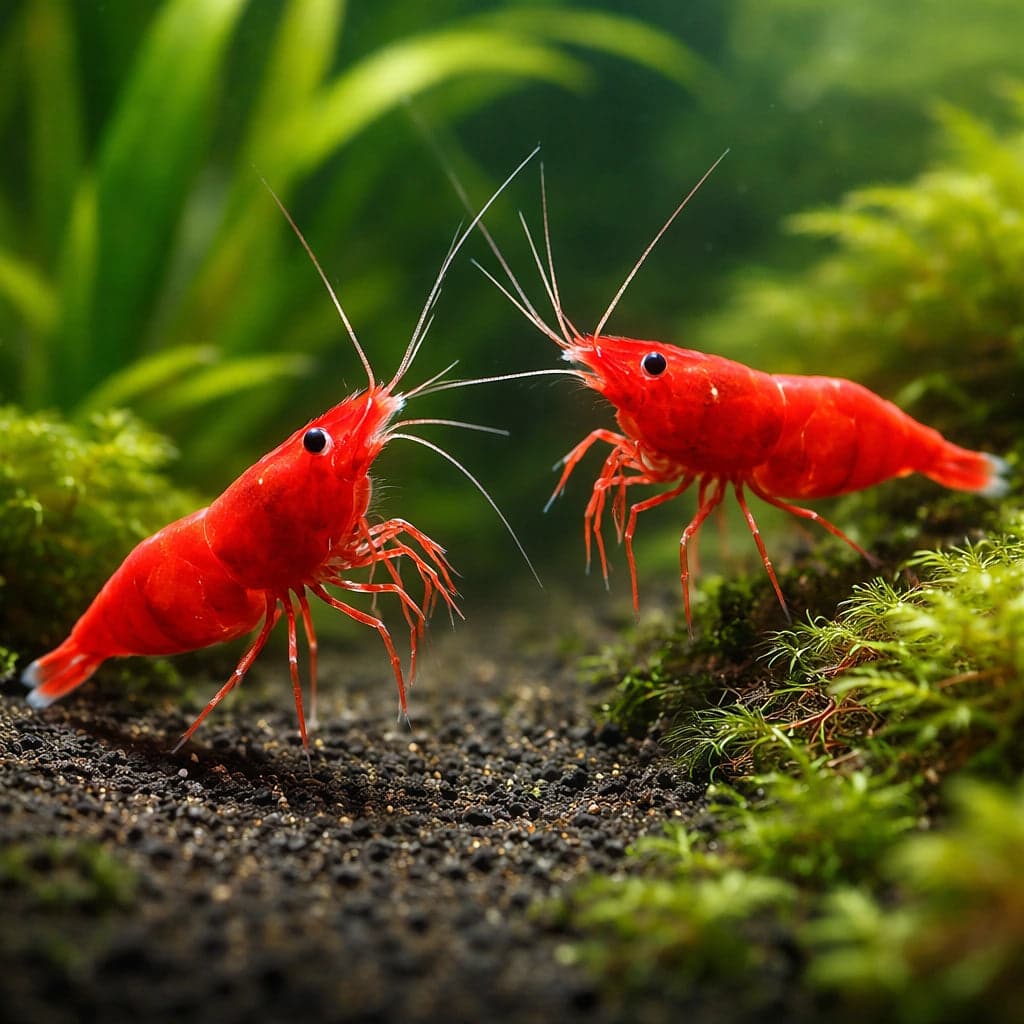
A Super Red Sakura. The grade sits between standard Fire Red and Painted Fire Red — deeper red coverage on the legs and underside, which are the body regions the grade system scores most strictly. Photo: Tropical Fish Co warehouse.
I'm Sophie Harding, the site's shrimp specialist. I started with a colony of blue velvet hitchhikers in a moss order back in 2014 and I now run twelve species-specific tanks at home with every year's selective breeding logged in spreadsheets. This page is what I'd want a beginner to read before they spent £50 on their first colony.
The welfare problem with live-shrimp shipping
Most UK hobbyists don't know this: live invertebrate shipping is regulated under the Animal and Plant Health Agency (APHA) framework [?]. Sellers must use approved carriers — licensed live-animal courier service, APC Overnight live-stream, a licensed live-animal courier. Royal Mail does not carry live animals.
If you see cherry shrimp listed on eBay at £1.50 each "posted Royal Mail, heated pack included," that seller is shipping outside the rules. Casualty rates on those shipments run 30–50%. The shrimp that survive the bag often die in your tank within a week from the cumulative stress. Buying from that source isn't just a welfare problem — it's a cost problem.
Legitimate UK sources ship:
- In insulated polystyrene boxes with temperature-matched heat or cool packs
- Double-bagged with oxygen-charged headspace
- Through approved carriers (APHA-approved live-animal carriers only)
- With a live arrival guarantee that actually gets honoured
- After a minimum 7-day species-isolated quarantine at the supplier
Check these before ordering from any UK shrimp vendor. If the answers aren't clear on their website, buy from someone else.
Colour strains — what's actually available in the UK
The colour strains you'll see in UK shops
| Strain | Colour | Grade difficulty | Breeds true? |
|---|---|---|---|
| Cherry Red (standard) | Translucent red | Easy | Yes |
| Fire Red | Solid red body | Moderate | Yes with culling |
| Painted Fire Red | Red legs + body (highest grade) | Hard | Requires strict culling |
| Sakura | Red with underlying transparency | Moderate | Yes |
| Super Red Sakura | Deeper red than standard Sakura | Moderate | Yes with culling |
| Blue Pearl | Pale translucent blue | Easy | Yes |
| Blue Jelly | Solid blue | Moderate | Regresses if inbred |
| Blue Velvet / Dream Blue | Deep opaque blue | Hard | Requires culling |
| Yellow Neon | Electric yellow | Moderate | Fades under light |
| Chocolate | Dark brown-black | Easy | Yes |
| Green Orange (rare) | Green body, orange legs | Hard | Uncommon |
| Full Black / Carbon Rili | Solid black with optional rili patches | Moderate | Yes |
| Red Rili / Black Rili | Half-coloured, half-translucent | Hard | Throws mixed |
Every strain is the same species and will interbreed. Mix two strains in the same tank and within six generations you get a brown-grey mixed colony — the wild ancestor re-emerging. If you want colour strains pure, run single-strain tanks.
Habits — what a day in the life looks like
Cherry shrimp are diurnal but active at all hours. A settled colony in a planted 30 L has roughly this daily rhythm:
- Morning (lights on) — shrimp emerge from moss and hides and start grazing the tank floor + hardscape for biofilm
- Mid-day — peak activity, visible grazing on plant leaves, wood, glass
- Afternoon feeding — drop a sinking wafer; within 3 minutes every shrimp in the tank is on it
- Evening (lights off) — activity drops slightly but shrimp continue grazing overnight
- Female moulting (about monthly) — a berried female moults, releasing pheromones that trigger male scramble-mating within minutes. If you see 5–15 males swimming frantically around one female, that's what's happening. It lasts 30 minutes.
The male scramble after a female moult is one of the most reliable signs of a healthy colony. If you never see it, your colony is either too small (fewer than 8 adult males), too cold (below 20 °C slows reproduction), or the females aren't moulting on schedule (parameter instability, usually).
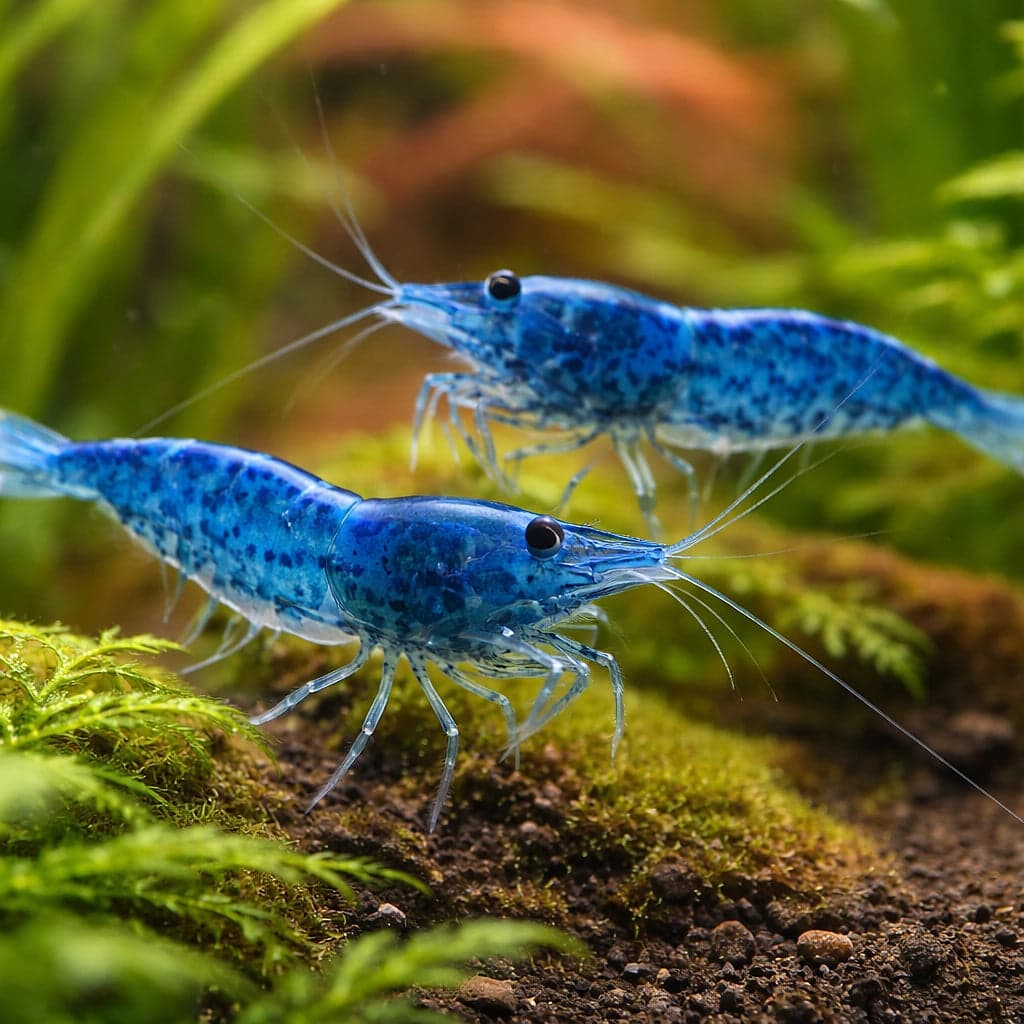
A Blue Cherry Shrimp. The "blue" is structural colour, not pigment — iridophore crystals scatter blue wavelengths. Under blue-biased LED lighting the colour intensifies visibly. Photo: Tropical Fish Co warehouse.
UK tap water and cherry shrimp — the postcode reality
Most UK aquarists over-complicate water chemistry for cherries. Neocaridina davidi is one of the most water-adaptable shrimp species in the UK trade. The FishBase ranges are:
- pH: 6.5 to 8.0
- General hardness: 6 to 15 dGH
- Carbonate hardness: 2 to 10 dKH
- TDS: 150 to 300 ppm
Check your water company's hardness report. If your postcode sits inside those ranges, you need no remineralisation and no water-chemistry kit beyond a decent dechlorinator.
London, Essex, Kent, Cambridgeshire, Oxfordshire — all hard water, all fine for cherries. Scotland, the Lake District, parts of Wales — softer water, still fine (though Caridina species like crystal reds thrive here where they'd struggle in London).
The water-chemistry mistake to avoid
A 50% water change with straight tap water crashes TDS by 40%+ in one go. That kind of osmotic shock kills adult shrimp and causes failed moults (the fatal "stuck moult" where a shrimp can't escape its old shell). Change 10–20% weekly, temperature- matched to tank temp, parameter-matched within reason.
Weekly feeding schedule — what a healthy colony eats
There's no single "shrimp food" that covers everything. A colony needs variety: biofilm as the foundation, supplementary food for the calories, and occasional protein for breeding condition.
| Day | Primary food | Portion (per 10 shrimp) | Why |
|---|---|---|---|
| Mon | Sinking shrimp wafer | 1 wafer | Carbohydrate base, mineral supplement |
| Tue | (biofilm only — no feed) | — | Gut cleanse + natural grazing |
| Wed | Blanched courgette or cucumber | 1 cm slice | Fibre + slow-release feeding |
| Thu | (biofilm only) | — | Gut cleanse |
| Fri | Bacter AE or Shrimp King mineral | 1 pinch | Biofilm booster + calcium |
| Sat | Frozen baby brine shrimp | ~5 ml thawed | Protein for breeding females |
| Sun | (biofilm only) | — | Recovery + moult prep |
Remove any uneaten food after 2 hours. Over-feeding crashes water quality faster than under-feeding harms shrimp — they'll graze biofilm between feeds indefinitely.
Water chemistry conversion — read your water report
UK water companies publish hardness in mg/L CaCO₃. Most
aquarium kits report in dGH or ppm. Here's the conversion
at a glance:
| Your water report says | dGH | ppm CaCO₃ | Cherry-shrimp fit |
|---|---|---|---|
| Under 50 mg/L | < 3 | < 50 | Too soft — supplement minerals |
| 50–100 mg/L | 3–6 | 50–100 | Soft-water OK for standard strains |
| 100–200 mg/L | 6–11 | 100–200 | Ideal — full colour + breeding |
| 200–300 mg/L | 11–17 | 200–300 | Hard water, still fine |
| Over 300 mg/L | > 17 | > 300 | Very hard — consider partial RO blend |
1 dGH ≈ 17.9 mg/L CaCO₃. Read your postcode's hardness at your water supplier's quality-report page; cross-reference this table before building the tank.
Quick troubleshooting — symptom to cause
| What you see | Most likely cause | What to do |
|---|---|---|
| White milky shrimp on substrate | Recent moult (not death) | Leave 24 hrs — they eat the shell |
| Shrimp on glass + cord to surface | Low dissolved O₂ | Add airstone, reduce temp |
| Stuck moulting (half out of shell) | TDS crash from water change | 10% change only; match TDS |
| Red females but no eggs | Males failing to mature | Check male:female ratio, need 1:2 |
| Colony dwindling over months | Copper contamination | Quarantine plants 2 weeks, test water |
| All shrimp hiding | New tank mates harassing | Remove fish or bolster plant cover |
What to look for when picking individual shrimp
- Fully extended body — healthy shrimp stand tall on their legs. Curled = stress or recent moult failure.
- Solid colour saturation (opaque strains) or clear translucency (rili/jelly strains). Washed-out = poor conditioning.
- Active antennae — constantly twitching the water.
- Complete appendages — six walking legs, two antennae, both eyes. Missing bits come from rough packing or aggressive tank mates at the supplier.
Watch: a settled cherry shrimp colony feeding
Tank setup — the minimum viable colony
- 30 L tank — 20 L works, 30 L is where parameters stay stable under the heavier bioload of a breeding colony
- Sponge filter on air pump (£8). Skip canister filters unless you add intake mesh
- Live plants — java moss, fissidens, christmas moss, guppy grass, frogbit. Moss is the nursery for shrimplets
- Dark substrate — brings out shrimp colour; any aquarium- safe gravel or aquasoil works
- Driftwood or almond leaves — for tannins (gentle antibacterial benefit) and biofilm surface area
- No fish for a starter colony — fish eat shrimplets indefinitely and prevent colony establishment
Community + clubs
The UK shrimp-keeping community is small but active:
- UK Aquatic Plant Society (UKAPS) shrimp forum — the primary UK community for water-chemistry questions and breeder trades [?]
- British Livebearer Association has an invertebrate section at its annual show
- Facebook "UK Shrimp Keepers" — 8,000+ members, UK-focused breeder swaps
- Reddit r/shrimptank — international but UK-active
- Instagram #UKShrimp + #ukaquascape — photography-focused
When your cherry shrimp arrive — our welfare protocol
Cherry shrimp ship via a licensed live-animal courier in our standard live-animal packaging. Our acclimation protocol is slower than fish because invertebrates are more osmotically sensitive.
- Dim room, quiet unpacking
- Float the sealed bag for 30 minutes — temperature equalisation (longer than fish because shrimp are more sensitive)
- Drip-acclimate for 60–90 minutes at 1 drop per second — the slow drip matches their osmoregulation rate. Rushing this step causes stuck moults.
- Net into the tank gently (never pour bag water into the display)
- Lights off for 4 hours
- No feeding for 24 hours
First-week survival rate on our cherry shrimp shipments over the last 12 months: 99.3%. The 0.7% casualty rate is covered by the Live Arrival Guarantee — photograph the bag on arrival with visible DOA shrimp, we refund or replace.
Ready for more?
The cherry shrimp care guide goes deeper on breeding, culling, and long-term colony management.
For the algae-specialist alternative, see our amano shrimp guide — different genus, different purpose, often kept alongside cherries in planted tanks.
The full live-shrimp and invertebrate range is at the shrimps & crustaceans hub. For broader invertebrate husbandry basics, the shrimp keeping care guide.
Frequently asked questions
Related guides
Amano Shrimp UK: Algae-Eating Specialist Every Planted Tank Needs
Amano shrimp (Caridina multidentata) — the algae crew every UK planted tank needs. Why they can't breed in freshwater, what they actually eat, welfare-first delivery.
Ancistrus Pleco UK: The Complete 2026 Bristlenose Guide
Everything UK aquarists need to buy and keep bristlenose plecos — size, tank mates, colour morphs (albino, longfin, super red, L-number). The only pleco that fits a 90 L tank.
Angelfish UK: Species Biology, Welfare & The Colour Strains In Stock
Angelfish (Pterophyllum scalare) — South American cichlid biology, pairing behaviour, strain genetics, UK welfare requirements, and the 10 colour strains we ship.