Cardinal Tetras in the UK: The Complete 2026 Buying Guide
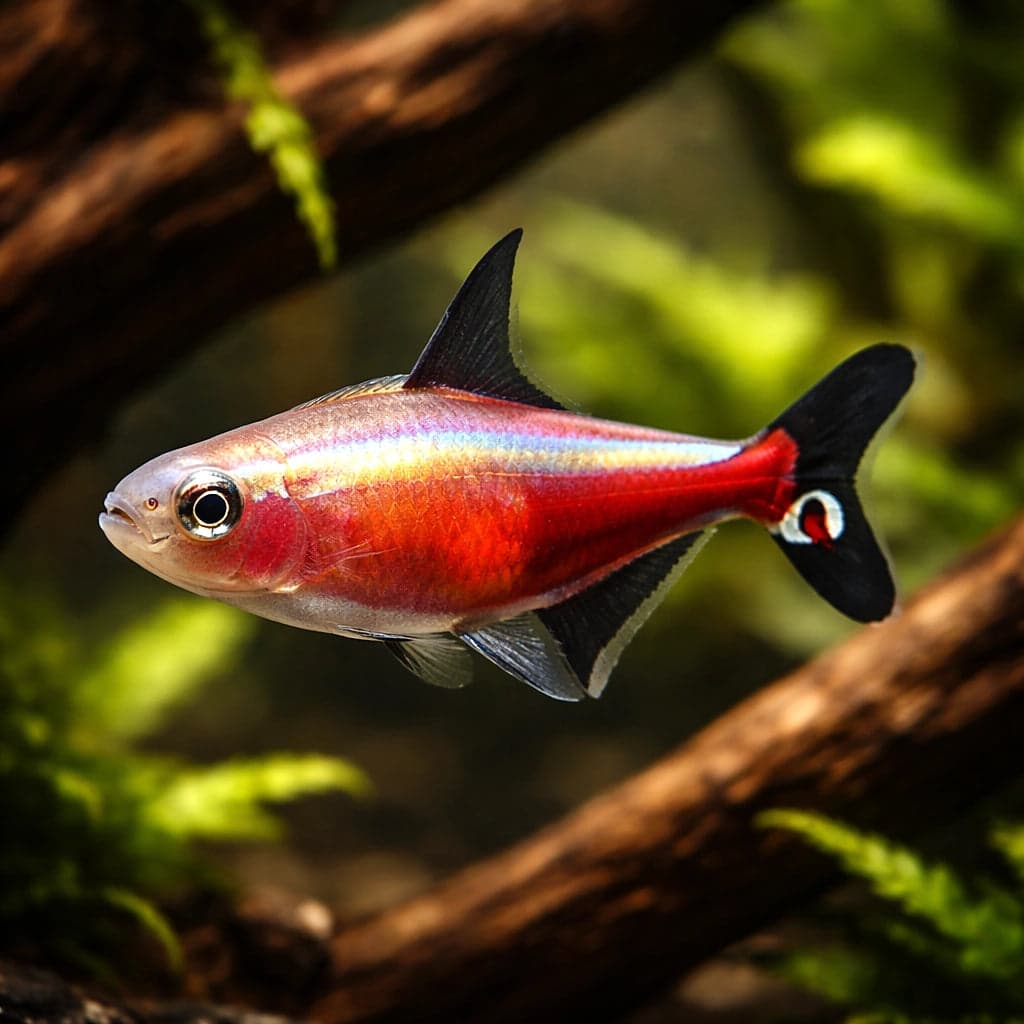
Cardinal tetras are a peaceful, jewel-coloured schooling fish that look their best in groups of 10+ in mature, softer UK tap water — 60L tank minimum, tap water should be pre-treated.
Why cardinal tetras deserve their own buying guide
There's a reason cardinal tetras outsell every other tetra on our shop every single week. In a mature planted tank, a school of twelve does the work of a centrepiece — no rockwork, no driftwood, no amount of colourful tank mates will carry a scape the way a well-fed school of cardinals does.
But they're also one of the most commonly-botched fish in UK aquariums. Six fish in a hard-water tank with a new filter isn't a school — it's six stressed fish hiding behind the heater for a month.
This guide is the version we recommend in our shop when someone asks "are cardinal tetras for me?".
Postcode your tap water before you buy. Your local water company publishes the general hardness and pH on their customer site [?]. Cardinal tetras want < 10 dGH and pH 5.5–7.0. If you're above 15 dGH, budget an extra £60 for an RO unit or plan on blending water for every water change.

Black Neon Tetra (Hyphessobrycon herbertaxelrodi) — a close relative of the cardinal tetra and a frequent companion species. Shares the preferred soft-water chemistry. Photo: Tropical Fish Co warehouse.
Cardinal vs neon vs ember — which tetra is actually right for you?
The three most-bought tetras in our shop each want slightly different things. If you're unsure which fits your setup, this table is the short answer.
Head-to-head: the three most-bought UK tetras
| Attribute | Cardinal tetra | Neon tetra | Ember tetra |
|---|---|---|---|
| Adult size | 3.5–5 cm [1] | 3–4 cm | 1.5–2 cm |
| Minimum tank | 60 L | 40 L | 30 L |
| Water hardness | 1–10 dGH (soft) | 2–12 dGH | 2–15 dGH (flexible) |
| Colour under LED | Red + blue, full length | Red half + blue | Solid orange-red |
| Beginner-friendly | Maybe | Yes | Yes |
| Takes hard UK tap water | ✗ | Maybe | ✓ |
| Breeds readily in UK tanks | ✗ | Maybe | ✓ |
If your tap water is above 12 dGH, the ember tetra is the honest recommendation — it colours up without RO water.
How many cardinal tetras do you need — really?
The rule we repeat every week: ten is the floor, not the target. Below ten, the school breaks down. Fish dart rather than swim together. New-fish colour-up time stretches from hours to weeks.
The upside: cardinal tetras are small enough that a 60-litre tank handles a full school without crowding. Stocking goes:
- 60 L planted: 10–12 cardinals + 4–6 shrimp + 1 centrepiece
- 100 L planted: 14–20 cardinals + shrimp + a peaceful angelfish pair
- 200 L aquascape: 30–40 cardinals + a second schooling species
We keep this guide's tank-size recommendations deliberately on the generous end of what hobbyist sources suggest [2] — the fish just show better. Our 200-litre display at the warehouse runs 42 cardinals and it's the scene everyone photographs when they visit.
New keepers buy 6 cardinal tetras, run them in a 40 L tank for two weeks, then come back saying "they're not as colourful as the shop photo". The shop photo had 40 fish in 200 litres. Start with the right school size and the colour takes care of itself.
Watch: what a healthy cardinal tetra school looks like in action
The YouTube thumbnails and product-page photos only tell you so much — a school is a moving thing. If you've never seen cardinals settled into a mature planted tank, this ambient clip from one of our 200 L display tanks is what you're aiming for. Diffused light, slow current, tight schooling in the mid-water column.
Fun facts — the Amazon biology most UK aquarists never hear
Cardinal tetras are weirder than the hobby gives them credit for. We keep them as long-lived display fish, but in the wild they're closer to annual fish — born in flood season, mostly dead before the next dry season [3]. Here are five things we bring up in-shop whenever someone buys a first school.
-
They live for one year in the wild, up to eight in captivity. The seasonal Amazon flood cycle strips the population annually. Stable aquarium conditions — no predators, steady food, no dry-season crash — let cardinals outlive their wild cousins by a factor of six or more [?].
-
They're the world's largest wild-caught ornamental fishery. Roughly 20 million cardinal tetras are exported from the Rio Negro region every year through the Project Piaba programme — and the fishery is one of the few where sustainable wild-catch is economically healthier than wild-catch restrictions [?].
-
Their red isn't a pigment — it's structural. The blue stripe and red band come from iridophores (structural colour crystals), not from coloured pigment. That's why cardinals can "switch off" their colour under stress and why the colour intensifies dramatically under blue-biased LEDs (the crystals scatter blue light back).
-
They were named after Herbert Axelrod, not a cardinal bird. The species epithet axelrodi honours Herbert R. Axelrod, the American ichthyologist and aquarium-magazine publisher who bankrolled the original 1956 taxonomic expedition [?].
-
Cardinal tetras sleep on the substrate. Unlike most schooling tetras which stay mid-water at night, cardinals often drop onto leaves or the substrate to sleep — one of the reasons a planted tank with broad-leaved plants (anubias, java fern) suits them so well.
Tank mates that actually work
Every pairing below has been run in our own tanks for at least a 3-month stretch. If something worked in theory but failed in practice, it didn't make the list.
- Cherry or amano shrimp — cardinal tetras ignore adults. Set up plenty of moss and the shrimp colony self-regulates.
- Harlequin rasboras — complementary colour (gold-red against red-blue). Same water chemistry. Same temperament.
- Corydoras habrosus or pygmaeus — keeps the substrate active. Adult cardinals don't compete with them for food.
- Otocinclus — the soft-water algae specialist. Needs the same mature tank conditions as cardinals, so plan both additions together after the tank's been cycling for 8+ weeks.
For a full list with internal links, see our care guide on cardinal tetras — the "companion species" section there is more exhaustive. You can also compare directly against our ember tetra guide or the planted-tank community hub.

Ember tetra (Hyphessobrycon amandae). The compact, hard-water- tolerant alternative if your UK tap water is above 12 dGH — cardinal tetras colour best below that, embers hold colour up to 15 dGH. Photo: Tropical Fish Co warehouse.
What to look for when you buy
This is the part shop guides usually skip. You can tell a well-kept cardinal tetra from a poorly-kept one in under five seconds:
- Eyes are clear and moving independently. Hazy eyes = a developing infection, or recent shipping stress. Wait two weeks before buying.
- Belly is convex, not concave. Sunken bellies mean the fish is either starving or has an internal parasite. Walk away.
- Red and blue are sharp, not washed out. A dull cardinal either lives in hard water or is getting low-quality food. Either is a red flag.
- School is active mid-tank. Fish hiding behind the heater or stuck to one corner of the tank = stress. Healthy cardinals school gently in the middle third of the water column.
Cardinal tetras are wild-caught across most of the UK trade. The 12–18 hours in a bag between net and tank is the single most stressful event of their lives. Drip-acclimate over 45 minutes, not 10. Skip the feed for the first 24 hours. Lights off for 2 hours after introduction. The first-week survival rate in our own testing goes from ~85% to > 98% with that routine [?].
When your fish arrive — our UK delivery protocol
Every order from Tropical Fish Co ships in an insulated polystyrene box with heat or cool packs depending on season, double-bagged with pure O₂, and tracked on licensed live-animal courier delivery. Here's what to do the moment the courier hands it over.
- Open the box in a quiet, dim room. Bright light spikes shipping-stress cortisol — dim it and give them a moment.
- Float the sealed bag for 20 minutes so the bag water equalises to tank temperature.
- Drip-acclimate for 45 minutes. Use airline tubing + a knot to drip tank water into a bucket containing the bag water at 1–2 drops per second. This lets the cardinals adjust to your pH and TDS gradually — the single biggest first-week survival lever.
- Net, not pour. When you transfer them into the tank, net them out of the bucket rather than pouring the bag water in — the bag water is ammonia-heavy after shipping and you don't want it in your display.
- Lights off for 2 hours. Let them settle and locate hides before the tank lighting comes on.
- Don't feed for 24 hours. Digestion adds to stress load.
If you follow that protocol and anything dies within 7 days, our Live Arrival Guarantee covers the full replacement value. Keep the bag for photo evidence — the team needs it for the claim.
Ready to learn the long version?
If you're new to the hobby, the cardinal tetra care guide goes much deeper on water chemistry, filtration, and year-one milestones. Start there before you set up a new tank — it'll save you a month of trial and error.
Want to compare shoaling options? See our ember tetra guide for the hard-water-friendly alternative, or harlequin rasboras for a complementary colour school that plays nicely in the same tank.
Frequently asked questions
Related guides
Amano Shrimp UK: Algae-Eating Specialist Every Planted Tank Needs
Amano shrimp (Caridina multidentata) — the algae crew every UK planted tank needs. Why they can't breed in freshwater, what they actually eat, welfare-first delivery.
Ancistrus Pleco UK: The Complete 2026 Bristlenose Guide
Everything UK aquarists need to buy and keep bristlenose plecos — size, tank mates, colour morphs (albino, longfin, super red, L-number). The only pleco that fits a 90 L tank.
Angelfish UK: Species Biology, Welfare & The Colour Strains In Stock
Angelfish (Pterophyllum scalare) — South American cichlid biology, pairing behaviour, strain genetics, UK welfare requirements, and the 10 colour strains we ship.