Ember Tetras in the UK: The Complete 2026 Buying Guide

Ember tetras are a 2 cm nano-tank schooling fish with saturated orange-red colour that holds in hard UK tap water — the honest alternative to cardinals for anyone in London, the Cotswolds, or the south-east. 30-litre minimum for a group of 10.
Why ember tetras deserve a dedicated buying guide
Because the internet's ember-tetra advice is almost always a translation of neon-tetra advice — and embers are a different fish. They're half the size. They tolerate wider water parameters. They live longer. They feed differently. And they thrive in tanks where a cardinal tetra would struggle.
I'm Hannah. I've photographed ember tetra schools on and off for seven years across tanks from 30 L nano jars to 120 L display aquariums. This guide is the version I'd write for a friend in London who just got a 40 L tank for their desk and needs advice that actually matches their tap water.

Two ember tetras from our current holding tank. The orange-red saturation here is the "mature-tank colour" — new arrivals look paler until they settle for a week. Photo: Tropical Fish Co warehouse.
Five facts about ember tetras most guides miss
- They were discovered in 1987. Compared to cardinals (1956) or neons (1936), ember tetras are a relatively recent addition to the hobby [?].
- They're named after Amanda Bleher. The species epithet amandae honours Heiko Bleher's mother Amanda, the legendary German ornamental-fish explorer. The "ember" common name came much later from the aquarium trade [?].
- Their orange colour is a warning signal in the wild. In their native Rio das Mortes habitat, the bright orange blends with the tannin-stained substrate but signals "I'm unpleasant to eat" to predators. In a tank — no predators — the colour shows at full saturation [?].
- They outlive neon tetras. 3–4 years for embers versus 2–3 for neons [?]. This is unusual for a smaller species — typically smaller tetras live shorter — and comes from their high adaptability across water chemistry.
- They tolerate harder UK water than any other "South American" tetra. Up to 15 dGH according to FishBase [?]. Compare to cardinals (≤ 10 dGH) and discus (≤ 8 dGH). Most UK tap water sits 10–25 dGH [?].
How to choose — ember vs neon vs cardinal
Head-to-head: the three most popular nano tetras
| Attribute | Ember Tetra | Neon Tetra | Cardinal Tetra |
|---|---|---|---|
| Adult size | 1.5–2 cm | 3–4 cm | 3.5–5 cm |
| Minimum tank | 30 L | 40 L | 60 L |
| Water hardness | 2–15 dGH | 2–12 dGH | 1–10 dGH |
| UK tap water OK? | ✓ Yes | Maybe | ✗ |
| Lifespan | 3–4 years | 2–3 years | 5–8 years |
| Beginner-friendly | ✓ Yes | Yes (mature tank) | Maybe |
| Planted-tank colour impact | High (orange) | Very high (red+blue) | Very high (full red+blue) |
| Price per fish | £2–£4 | £1.80–£3.50 | £2.50–£5 |
If your tank is under 60 L or your water is above 12 dGH — pick ember tetras. That covers about 70% of UK aquariums.
How many ember tetras do you need?
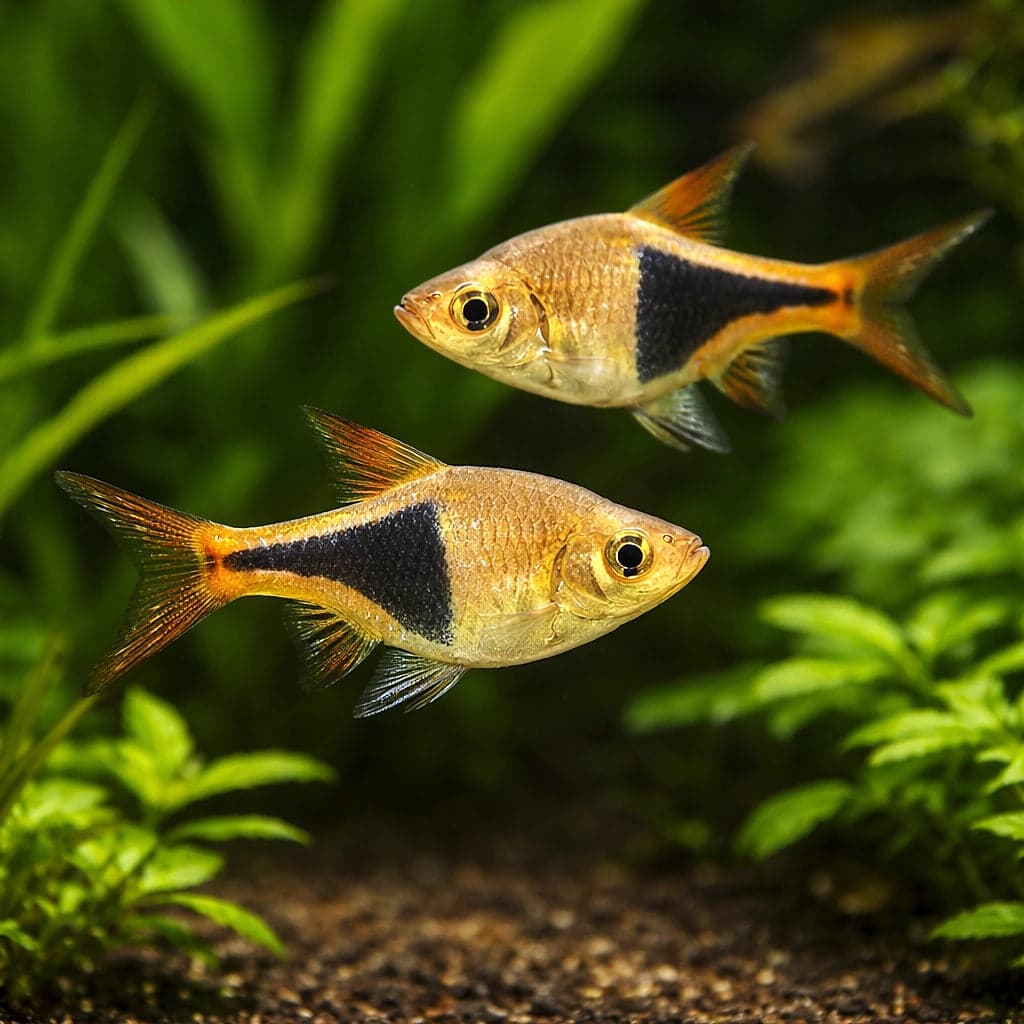
Harlequin Gold rasbora — our most-recommended schooling partner for ember tetras. Same water chemistry, gentle temperament, complementary colour against the ember orange. Photo: Tropical Fish Co warehouse.
The rule is the same as for cardinals — ten is the floor, not the target. Below ten, the school breaks down and you get individual fish hiding behind the heater.
Stocking guide by tank size:
- 30 L nano planted — 10 ember tetras + 6 cherry shrimp
- 40 L nano planted — 12 ember tetras + shrimp + 1 pair honey gouramis
- 60 L planted — 15 ember tetras + shrimp + 6 corydoras
- 90 L planted — 20 embers + 10 cardinals + shrimp + bottom dwellers
Watch: what a stable ember tetra school looks like
Tank mates that genuinely work
Embers are peaceful shy fish. Their tank mates must match both.
- Cherry / amano / neocaridina shrimp — completely safe. Adult shrimp, I mean — fry will be eaten.
- Corydoras habrosus or pygmaeus — perfect substrate companions in a nano tank, stay small enough to match scale.
- Honey gouramis — single pair fits a 40 L+ nano, gentle centrepiece without predation risk.
- Other small tetras — cardinals and neons mix well in 60 L+ tanks where there's room for two schools.
- Otocinclus — soft-water algae specialist, matches the preferred chemistry when you're using RO.
Avoid: any fish over 5 cm adult (will eat embers), angelfish (will eat embers by month 4 when they mature), bettas (male bettas aggressive toward all small fish).
Nano-tank setup for ember tetras
Ember tetras are the only tetra I'd genuinely recommend for a tank under 40 L. But nano tanks are less forgiving than standard tanks, and a few things matter more than they would at 100 L:
- Heater quality matters more. A poorly-calibrated heater in 30 L will swing 3–4 °C; in 100 L it'd swing 1 °C.
- Sponge filter or low-flow internal only. A canister designed for a 100 L tank will blow embers around the tank [?].
- Cover the tank. Embers jump when spooked. A full glass lid or cut-to-fit acrylic cover saves fish.
- Feed twice a day, tiny amounts. Over-feeding crashes a 30 L tank in 48 hours. Crumb-sized portions only.
- Weekly 20% water changes. Nano tanks handle nitrates worse than larger tanks; stick to the weekly schedule.
When your ember tetras arrive — our UK delivery protocol
Ember tetras are hardier shippers than cardinals because their narrow water-chemistry tolerance is less narrow. Our acclimation protocol:
- Dim room, open the box carefully.
- Float the sealed bag for 15 minutes.
- Drip-acclimate 30 minutes at 1–2 drops per second (shorter than cardinals because embers tolerate pH shifts better).
- Net into the tank — don't pour bag water in.
- Lights off for 2 hours.
- No feeding for 24 hours.
Live arrival guarantee: photograph the unopened bag within 2 hours of delivery if any fish are DOA. Full refund or replace.
Small body size = lower metabolic rate = less ammonia production per hour in the bag. A 2 cm ember in a standard shipping bag produces roughly 1/5 the ammonia of a 5 cm cardinal tetra over the same transit time. That's why our first-week survival rate on embers is 99%+ — the shipping physiology is on their side.
Ready for more?
For the deep-dive on ember tetra breeding, genetics, and planted-tank aquascaping, the ember tetra care guide goes further than this buying-focused page.
If you're comparing schools side by side, the cardinal tetra guide is the natural next read — it covers the harder-water-sensitive alternative.
Shopping by tank size? See our nano-tank fish hub for everything 5 cm and under in stock this week.
Frequently asked questions
Related guides
Amano Shrimp UK: Algae-Eating Specialist Every Planted Tank Needs
Amano shrimp (Caridina multidentata) — the algae crew every UK planted tank needs. Why they can't breed in freshwater, what they actually eat, welfare-first delivery.
Ancistrus Pleco UK: The Complete 2026 Bristlenose Guide
Everything UK aquarists need to buy and keep bristlenose plecos — size, tank mates, colour morphs (albino, longfin, super red, L-number). The only pleco that fits a 90 L tank.
Angelfish UK: Species Biology, Welfare & The Colour Strains In Stock
Angelfish (Pterophyllum scalare) — South American cichlid biology, pairing behaviour, strain genetics, UK welfare requirements, and the 10 colour strains we ship.