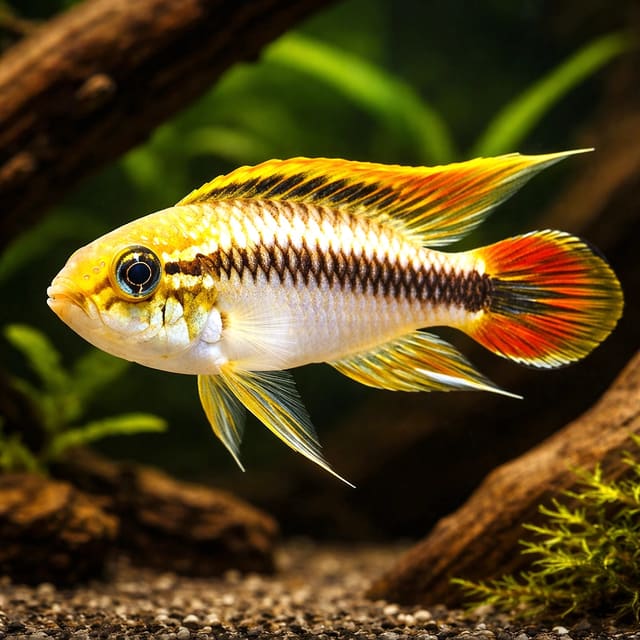
Aulonocara sp. 'Firefish' - Tropical Fish for Sale UK
24–28°C · pH 7.5–8.5 · 200L

Apistogramma agassizii
A beautifully patterned Rio Madeira dwarf cichlid that rewards aquarists with fascinating behavior and stunning color in a soft-water planted setup. Moderate care, semi-aggressive. 25-29C, pH 5.5-7.0.
Maintain these water conditions for optimal health and vibrant colors
The beautiful Apistogramma agassizii, commonly known as Agassiz's Dwarf Cichlid, represents one of South America's most sought-after aquarium gems. This stunning species originates from the blackwater tributaries of the Amazon basin, where it has evolved exquisite coloration and fascinating parental care behaviors. The Santarem variant showcases particularly impressive finnage and coloration, making it highly prized among dwarf cichlid enthusiasts. Now available for sale UK through specialist suppliers, this peaceful carnivore brings authentic Amazonian biotope appeal to planted community aquariums when provided with soft, warm, acidic water conditions. Aquarists seeking a rewarding species with both beauty and engaging breeding behavior will find the Agassiz's Dwarf Cichlid offers exceptional value for those willing to recreate its specialized habitat requirements.
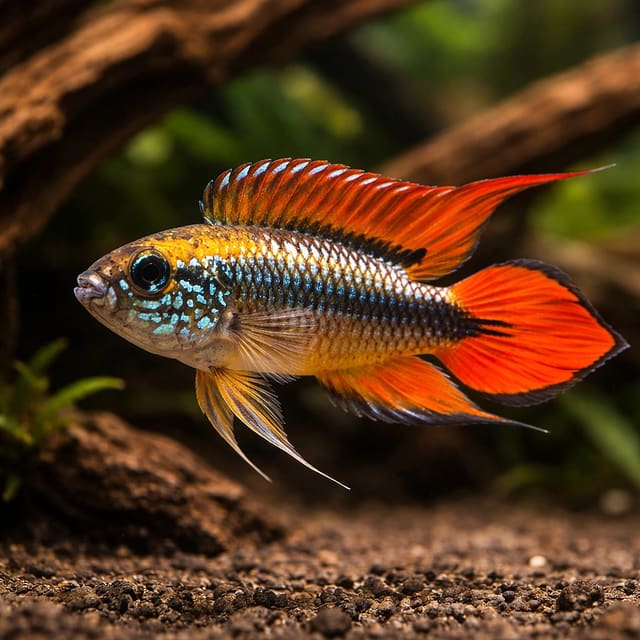
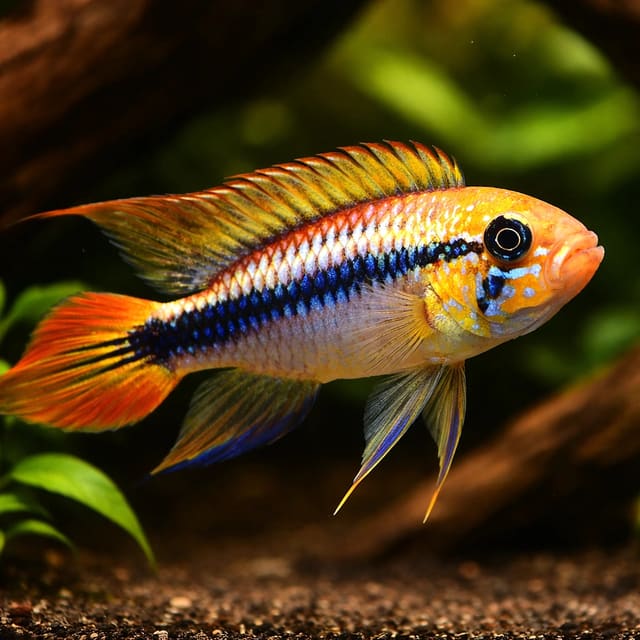
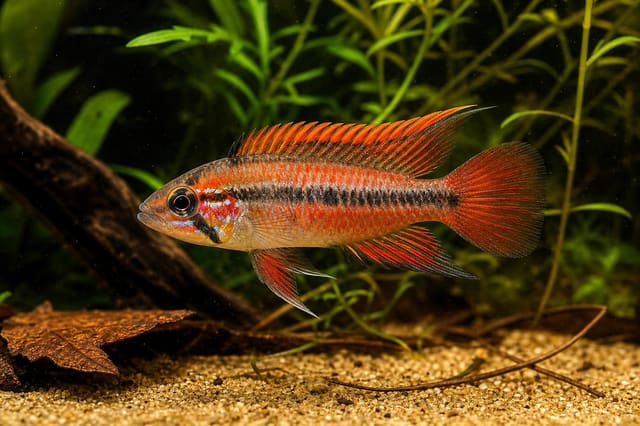
The Santarem variant of Apistogramma agassizii displays breathtaking coloration that intensifies dramatically with proper water conditions and breeding readiness. Males reach approximately 8-9 cm, while females remain considerably smaller at around 5-6 cm. The male's body exhibits a complex pattern of electric blue spangling across the flanks, overlaying a base color ranging from golden-yellow to olive-brown depending on mood and environment. The dorsal fin extends elegantly with elongated rays, often displaying vivid red or orange margins with blue highlights. The caudal fin may develop a lyre-shaped profile in prime specimens, with extended upper and lower rays creating a stunning spade-like appearance. Females are noticeably smaller and more subdued in coloration, typically showing yellow-gold bodies with darker horizontal stripes and rounded fins. During breeding condition, females may display intense yellow coloration as a signal of readiness. Both sexes possess large, expressive eyes with distinctive blue-green iridescence.
In their native range throughout the Amazon basin, particularly the areas surrounding Santarém in Pará state, Brazil, Apistogramma agassizii inhabits slow-moving forest streams, oxbow lakes, and seasonally flooded areas. The water is characteristically soft and acidic due to tannins leaching from decomposing leaves, wood, and organic matter, creating the tea-colored "blackwater" conditions these fish have adapted to over millennia. Dense vegetation both above and below the waterline creates dappled lighting conditions and abundant cover. The substrate consists of fine sand overlaid with thick accumulations of leaf litter, twigs, and fallen seed pods. Water flow is minimal, with most movement generated by seasonal flooding rather than strong currents. Temperature remains consistently warm year-round, rarely dropping below 24°C even during cooler periods. Dissolved oxygen levels can be quite low during the dry season, and the fish have adapted to tolerate these challenging conditions. The natural diet consists primarily of small aquatic invertebrates, insect larvae, and tiny crustaceans found among the leaf litter.
Recreating suitable Amazonian conditions requires thoughtful aquascaping and water chemistry management. An aquarium of at least 80 litres provides adequate space for a pair or harem group (one male with 2-3 females), though larger volumes offer greater territory options and water stability. Substrate must be fine sand 3-4 cm deep, as Apistogramma species frequently sift substrate while foraging and establishing territories. Aquascaping should include abundant driftwood pieces arranged to create caves, overhangs, and visual barriers—Malaysian driftwood or Mopani wood work excellently while releasing beneficial tannins. Add dried leaves (Indian almond, oak, or beech) to further acidify water and provide additional cover; replace leaves every 2-3 weeks as they decompose. Dense planting in background and sides using species like Amazon swords, cryptocorynes, and Java fern creates security while leaving open swimming areas. Lighting should be subdued, achieved through floating plants or careful positioning of fixtures. Filtration must be efficient yet gentle—avoid strong currents that stress these slow-water specialists. Maintain pristine water quality through regular 25-30% water changes using soft, temperature-matched water.
As specialized micro-predators, Agassiz's Dwarf Cichlids require a varied diet focused on small, protein-rich foods. Quality micro-pellets designed for carnivorous dwarf cichlids should form the staple diet, supplemented heavily with frozen foods including daphnia, cyclops, baby brine shrimp, bloodworms, and mosquito larvae. Live foods such as grindal worms, micro worms, and live brine shrimp provide excellent conditioning and bring out natural hunting behaviors. Feed small portions 2-3 times daily rather than one large meal, as these fish have small stomachs and benefit from frequent feeding opportunities. During breeding conditioning, increase the frequency of live and frozen foods to support egg production. The species may initially ignore prepared foods, requiring gradual transition from frozen foods to pellets by mixing them together during feeding. Avoid large or hard foods that dwarf species struggle to consume, and never rely on flake food alone as it lacks the protein density these carnivores require. Remove any uneaten food after 3-4 minutes to maintain the critical water quality standards Apistogramma demand.
Achieve optimal coloration and breeding condition by maintaining very soft water (GH 2-4, KH 1-2) using RO water remineralized with Amazonian-specific mineral supplements, combined with generous additions of Indian almond leaves and alder cones to release beneficial tannins and maintain stable pH in the acidic range.
Agassiz's Dwarf Cichlid displays fascinating territorial and social behaviors characteristic of Apistogramma species. Males establish small territories centered around suitable caves or sheltered areas, defending these spaces from rival males while tolerating females and non-competing species. Territorial displays involve impressive fin spreading, lateral displays showing the full body profile, and rapid color intensification—true aggression is rare outside breeding situations. The species spends much time near the substrate, investigating crevices and sifting through sand in search of micro-organisms. Swimming style is deliberate and purposeful rather than constant, with frequent pauses to survey surroundings. Males regularly patrol territory boundaries, while females range more widely when not breeding. When spawning, females become remarkably bold, aggressively defending nest sites against all intruders regardless of size. The species demonstrates good memory and intelligence, quickly learning feeding schedules, recognizing their keeper, and remembering territory boundaries. Stress is indicated by pale coloration, clamped fins, and excessive hiding—proper water conditions see these fish regularly visible and actively patrolling their domains.
Ideal tankmates must tolerate soft, acidic water while avoiding competition with the bottom-dwelling Apistogramma. Small, peaceful shoaling fish including cardinal tetras, rummy-nose tetras, and harlequin rasboras make excellent companions, occupying upper water levels without interfering with dwarf cichlid territories. Corydoras catfish species (especially smaller types like C. pygmaeus or C. habrosus) can coexist peacefully if the aquarium provides adequate territory space. Otocinclus catfish add interest and contribute to algae control without threatening dwarf cichlid fry. Peaceful pencilfish species like Nannostomus marginatus complement the biotope theme perfectly. Avoid large, boisterous species that create stress through excessive activity or compete aggressively for food. Never combine with fin-nippers like serpae tetras or aggressive cichlids of any size. Other Apistogramma species can be housed together only in very large, well-structured aquariums with clearly defined territories—mixing species requires considerable experience and careful monitoring to prevent hybridization and territorial conflict.
The breeding behavior of Apistogramma agassizii ranks among the most fascinating spectacles in freshwater aquarium keeping. Spawning typically occurs in a cave or similar sheltered site that the female selects and prepares by cleaning thoroughly. The male is invited to fertilize the eggs but is then expelled from the breeding cave, with the female assuming sole responsibility for egg care. She fans the eggs constantly, removing any that become infertile, and maintains vigilant guard against all potential threats—including the male. Eggs hatch after 3-4 days, with fry becoming free-swimming approximately 5-7 days post-spawning. The female escorts her fry in a tight cloud, moving them between locations if she perceives danger. For breeding success, provide multiple caves sized appropriately for females (small diameter ceramic or coconut caves), maintain very soft, acidic water (pH 6.0, GH 2-4), and condition both sexes heavily with live and frozen foods. Once fry are free-swimming, offer infusoria for the first few days, transitioning to newly hatched brine shrimp and microworms as they grow. Maintain exceptional water quality through gentle daily water changes while fry are present. The female may eat fry if stressed, hungry, or if water conditions deteriorate, so provide a well-planted tank with minimal disturbance during the critical first two weeks.
When you choose Tropical Fish Co for your Agassiz's Dwarf Cichlid, you receive specialist-bred or carefully selected specimens maintained in authentic blackwater conditions matching their natural habitat. Our dedicated soft-water systems use RO water remineralized specifically for Amazonian dwarf cichlids, ensuring your fish arrive already adapted to the exacting water chemistry they require. Each specimen undergoes comprehensive health screening in our quarantine facility, and we guarantee sex accuracy when purchasing pairs or harems—a critical consideration given the species' striking sexual dimorphism. We provide detailed biotope setup guides covering everything from appropriate leaf litter sources to tannin supplementation and water chemistry management using UK tap water. Our packaging includes careful temperature control and appropriate bag sizes to minimize stress during transit. With staff who actively breed Apistogramma species, we offer genuine expertise unavailable from general retailers. We're available for ongoing support as you establish breeding colonies, providing advice on fry rearing, pair compatibility, and optimal water chemistry maintenance. Your success with these magnificent Amazonian dwarf cichlids is our priority.
Healthy, vibrant fish from trusted suppliers
Detailed care guides and support
Your fish arrives healthy or we'll replace it
Properly quarantined and ready for your tank

24–28°C · pH 7.5–8.5 · 200L


24–28°C · pH 7.5–8.5 · 500L

24–28°C · pH 5.5–7 · 60L

22–28°C · pH 6.5–8 · 20L

22–26°C · pH 6–7.5 · 30L

22–28°C · pH 6–7.5 · 60L

24–28°C · pH 7.5–8.5 · 150L

22–28°C · pH 7.5–8 · 40L
22–28°C · pH 7–8.5 · 100L

22–27°C · pH 6–7.5 · 80L

24–28°C · pH 6–7.5 · 40L

24–28°C · pH 6–7.5 · 80L

24–28°C · pH 6.5–7.5 · 2000L
22–28°C · pH 7–8.5 · 60L

24–28°C · pH 7.5–8.5 · 200L